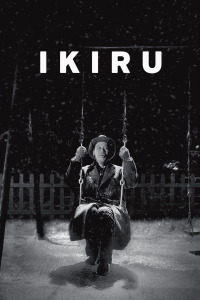
Review of Ikiru (1952) by Tiberio S — 18 Feb 2017
I'm in the early stages of my Kurosawa journey, and to say that this is his best work so far is a spiritless understatement. As I will see, Takashi Shimura (Watanabe) is to Kurosawa what Jack Nance is to a David Lynch film, and where I'd left off at Drunken Angel with him concerning over another's disease, here he is now the afflicted one in a performance so emotionally riveting that it's transcendent. There's a moment near the end of the film where he's standing up to authority, and the way his eyes dart, fearful of the consequences but relentless in his pursuit, is so honest that it goes beyond what an actor embodies.
In my journey thus far, Kurosawa has painted such a human portrait of Japanese culture that I often forget I'm watching a foreign film. I've learned that the culture is very much American, the music and dance, the attitude on the streets, prostitutes and gangs, singing "happy birthday" in English, certain words printed in public places in plain English.
If Watanabe's suffering is evident enough by the bored way he sits there doing his work, or by how pathetically overwhelmed he is to nightlife, it becomes painfully clear when he starts for fall for a young girl who was inspired by him to quit their mutual workplace. Here we see her giggly girlishness contrasted against his old "mummy" mannerisms, and his foolish fascination with her youth. Eventually she's not so childishly happy with him, but creeped out by his leering - we can only feel sorry. But he's inspired, he's going to make a change that will carry him through the remainder of his days. And he acts on the good of his community, making him a saint in the eyes of many. This is foreshadowed much earlier when his nightlife friend calls himself a Christ figure, but having nothing but knowing he'll die to back it.
But the film is grounded in neorealism. Our protagonist is shockingly dead with more than forty minutes of film left. The rest of his journey will be dealt with in flashbacks as his coworkers get drunk at his funeral and start to consider the idea that this new park in town happened because of him, something they only consider more seriously after the deputy mayor and other authorities have left. One coworker had flat out stated that it was in fact, but the rest, bound by the great system, were too afraid to see it this way. After they each share their stories and piece the puzzle together, they see clearly that this is Watanabe's park, and swear to uphold his honor and act as he did. The opportunity is presented in the following scene, and nobody acts as Watanbe would've, but follow suit with the system. Our one defender stands up, his chair falling over, but to no avail. He returns to his seat, and the camera focuses on the paper stack of work all are encumbered by. Later he returns to the park in memoriam of Watanabe, and we hear that Life is Brief tune for the third time, but more faint and without the lyrics. Whereas so many films struggle to have good endings, this is a brilliant note. He walks away on the bridge, and an odd frame of that, the sky, power lines, and the top of the park's swing set fill the frame.
I'm taken by the film's honesty, by the mesmerizing performances, by the sadness of life, systems, destined behaviors, missed opportunities, that the right thing comes at great hardship and sacrifice. This is a journey story, the time slot allows for us to get that in a huge, satisfying serving. We get so lost in the idea that he's left his job, and the absurdity that two weeks goes by, that we forget about the idea of what would happen if he returned. We get all of it here.
Watanabe is a Christ figure, he does carry the cross on his back in the form of burden. Christ died at age 30, Watanabe hasn't missed a day of work, or lived life, in 30 years. This is the thing a 30 year old like me needs to see! He does this to protect his son. We get a devastating flashback to his wife's funeral procession, his son flinging himself into his arms, crying as the Hearst turns a corner and he confronts the reality that he'll never see his mother again - watch Watanabe's face, it's awe-inspiring to see such rich emotion from an actor, experiencing the pain of this loss. In the end, he makes sacrifices for his family and then his community - they love him, and they weep for his passing.
This review of Ikiru (1952) was written by Tiberio S on 18 Feb 2017.
Ikiru has generally received very positive reviews.
Was this review helpful?