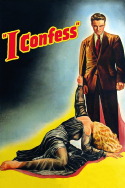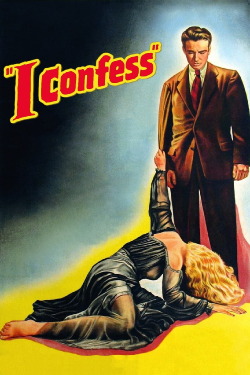
Review of I Confess (1953) by Paul Z — 20 Aug 2009
Montgomery Clift stars as Father Logan, an orthodox Catholic priest in a Quebec City church. To take care of the church and the rectory, he employees a caretaker, Otto Keller and a housekeeper, Otto's wife Alma, who are German immigrants with hardly any money, though alas in their homeland they were better off. Otto also works part-time as a gardener for certain upper-class homes. One night Otto asks if Father Logan will hear his confession. He confesses that he attempted to steal money from a person for whom he gardens, an affluent lawyer named Villette, and what with one thing and another he killed him. Due to the obligatory ritual of the secrecy of the confessional, Father Logan cannot tell the police, led by a driven detective played by the late, great Karl Malden, anything he now knows about this crime.
Can one expunge all guilt by transferring it to another, like contraband? Law and church burden each other. Which one is more socially helpful? These are the open implications of I Confess, Sir Alfred Hitchcock's fortieth movie, which opens on wonderfully dark compositions of cathedrals, juxtaposed with one-way signs. Only the most confident touch could wire a thriller to subject itself to partiality and present its themes of dogma and clear-cut moral codes. It is not one of Hitchcock's greatest films, but like many of them it demonstrates his supremacy over his era as a smuggler of themes, even a smuggler of socially shamed sexuality or, in many cases, psychotic violence.
In an unusually romantic passage for the director, two of his characters end up stranded on an island during a storm, forced to shelter for the night in a gazebo. This will lead not only to blackmail, but to the undertaking of such binding natures that cause so much trouble in the film. There are several variations on which way to comprehend the situation on all of its levels. The dimensions of the power of silence, the motivations which paradoxically combine guilt and self-preservation, and Anne Baxter's intractable looking-on. I call her The Stare Master. The answers are there somewhere, as Hitchcock nudges us with a curious choice of mood and one of the very few instances of slow-motion before the 1960s. Two characters share a last dance, a beautifully intimate shot, right up to extreme soft-lens closeup. It is in this sequence where Hitchcock chooses to reveal to us who and what comprise the story's dilemma.
When does the honor of dogma stop being honor and become a delusion of nobility? Really, it only hurts these characters. Part of Father Morgan's headstrong resolve to honor the confession is either the demonstration of an inordinately strong-minded individual, or the deeply buried reflection of the thoughts he has surely has about the murder victim himself. We decide. This is a protagonist who truly cannot function in a more conventional film, where the story necessitates good fighting evil, because the practices of his faith, however altruistic, are so dangerous.
This review of I Confess (1953) was written by Paul Z on 20 Aug 2009.
I Confess has generally received positive reviews.
Was this review helpful?