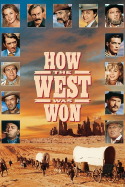
Review of How the West Was Won (1962) by Edith N — 07 Oct 2007
I really wish I could have seen this in proper Cinerama, on the ginormous screen this movie calls for. Failing that, I wish someone would make a properly remastered version--one that just might brush out those two vertical bars left over from where the cameras intersect. (They're more distracting on some prints than others; the print AMC has is pretty bad, made the worse by the pan 'n' scan process, which means that the bars jump all over the screen--and because the print's so bad, they're always visible. Better prints have long stretches where they're barely there.) But ever since I was young, I have loved this movie and its epic sweep, and thus we bring you Entry 500 and its cast of thousands. (Courtesy of Maksutov over on BAUT who sent me a copy.).
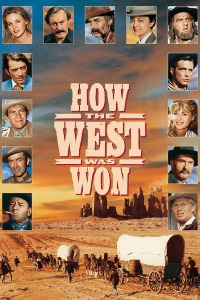
It's really epic; that's neither sarcasm nor exaggeration. For one, there is the story of four generations of American pioneers, here. We start with Zebulon and Rebecca Prescott (Karl Malden and Agnes Moorehead), their sons Zeke and Sam, and their daughters Eve and Lilith (Carroll Baker and Debbie Reynolds). Eve, the homebody, falls in love with mountain man Linus Rawlings (Jimmy Stewart) and settles by the banks of the Ohio River with him. Lilith goes out west and marries Cleve Van Valen (Gregory Peck). Eve's son Zeb (George Peppard) goes first to war, where he encounters a young Southern soldier (Russ Tamblyn) and saves the lives of Grant and Sherman (Harry Morgan and John Wayne, of all people).
Zeb marries Julie Stuart (Carolyn Jones), the daughter of Jethro Stuart (Henry Fonda), an old friend of his father's. After many offscreen adventures, they and their three children--Linus, Prescott, and Eve--take Lilith to a ranch she owns in Arizona. On the way there, he encounters Charlie Gant (Eli Wallach), an outlaw who has it in for Zeb, culminating in the famous shootout on the train sequence.
And that's not the whole cast. Spencer Tracy provides narration. Debbie Reynolds and Gregory Peck go out West along with Thelma Ritter and Robert Preston. Harry Dean Stanton is in Eli Wallach's gang. Richard Widmark is building the railroad. And some 12,000 extras come and go. This film is [i]huge[/i], even without the Cinerama. Heck, they got Louis L'Amour for the novelization!
Of course, it's pretty dated. True, the Arapaho are portrayed as being in the right against the railroad, but hardly any of 'em get any speaking lines. Mostly, they accuse Zeb of lying, which isn't quite true. At that, the Arapaho get more lines than any of the other tribes that lived in this country before the coming of European settlers. And the West is, after all, considered a thing to be conquered--and the epilogue treats us to the glory that is the modern freeway as the inevitable consequence of Western expansion. (I suppose it is, at that. But it's hardly an unalloyed good.) All of the immigrants we see are of European ancestry; there are no blacks nor even Chinese building the railroad. We brush on politics through brief glimpses of Raymond Massey as Abraham Lincoln; once he's dead, politics no longer intervene.
However, the grandeur of the film is hard to escape. As had been pointed out, this is what a [i]real[/i] all-star cast looks like, and it isn't those silly movies from the '70s where the cast is all people who look vaguely familiar. And the sweeping vistas of the West are well-captured by the cinematography. We are watching archetypes more than characters, of course--the Mountain Man, the Pioneer, the Gambler, the Lawman. They're all familiar to Americans from infancy, and not just for those of us who can't remember the first time we saw this movie! It doesn't matter if we can believe a lick of the story; the [i]feel[/i] of it is what we believe of our own nation's history.
That's only accentuated, I think, by the cast. We [i]know[/i] Jimmy Stewart is a quintessential American. Likewise Gregory Peck. Seeing them in these roles gives us the American history we want to believe, because we want to believe the mountain men were like Jimmy Stewart, not brutish, violent, and uneducated. That is the level on which this movie succeeds most--leaving out the undeniable beauty of its filming--the level of what we believe to be true.
This review of How the West Was Won (1962) was written by Edith N on 07 Oct 2007.
How the West Was Won has generally received positive reviews.
Was this review helpful?