Review of House of Wax (1953) by Everett J — 19 Jan 2009
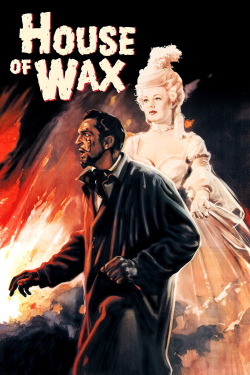
House of Wax.
Directed by André De Toth.
Story by Charles Belden.
Screenplay by Crane Wilbur.
Starring Vincent Price, Frank Lovejoy, Phyllis Kirk, Carolyn Jones, Paul Picerni, Roy Roberts, Charles Bronson.
It?s wax! It?s 3-D! Long before the present day obsession with churning out mediocre films in 3-D, there was a short period when it seemed like everyone was in on the act. This is one of hundreds of films that were released in the format in the early 1950's and it?s a crying shame to be forced to sit in front of my computer devoid of the infinite pleasure of viewing such a spectacle. Regardless, it?s a gripping goony-ride through the mesmeric psyche of cinema?s premiere artist of creepy villainy.
Vincent Price is Prof. Henry Jarrod, a mild mannered curator at a wax museum. He takes his creations very seriously and truly believes that he is able to communicate with them. He has immortalized the likes of Joan of Arc, Marie Antoinette, John Wilkes Booth, Abraham Lincoln and they all make quite a lovely family after a fashion. Unfortunately, Jarrod?s partner Matthew Burke (Roberts) wants more blood and gore, more mayhem but Jarrod refuses to corrupt his works with cheap thrills. Burke responds by burning the whole place down and admittedly it?s deeply sad and jarring to see so many wax figures demolished in such a cruel way. Burke escapes imagining Jarrod to have perished in the fire. Burke enters his room to play with the insurance money he nabbed from the fire and a horribly disfigured creature is waiting for him. After choking him he strings him up with rope and drops him into the elevator so it looks to the world like the sorry bastard has offed himself. Next, Cathy Gray (Jones), the chirpy lass to whom Burke is engaged, is murdered in her bed. She is discovered by her housemate Sue Allen (Kirk) who pitches a righteous fit.
A while later, Jarrod reappears having discovered a new location for a true house of horrors. This time, the deep longing has been replaced by common business sense. The fire has damaged his hands so he can no longer create works of lasting beauty and instead relies on help from assistants who shape the wax into a number of criminal types. These include Charlotte Corday, the butcher who separated Anne Boleyn from her pretty little head, and other grisly shocks.
The film creates a definite mood that is made genuinely creepy by the wax figures themselves. There is just something unsettling about the disconnect between the life as it was lived by the actual person and their wax counterparts. Each personage has a terrible narrative that comes through as the story progresses and it?s strange to see such lifelike yet motionless versions of the historical characters.
Jarrod merely wants to find living models for his works. He simply wants a face to work from that is Joan of Arc or Marie Antoinette. He is tired of dealing with imperfect models who lead to imperfect work. He has created Joan a dozen times and started again because she isn?t quite right. He was happy with Marie Antoinette but now is forced to start over and he really requires the proper face to do the job properly. He sees Sue and quickly realizes that her face is absolutely perfect so it?s clear what direction the film is heading in. Sue becomes threatened and in terrible danger and it?s up to those who care to come rescue her. Of course it?s always the moments you most want to happen that are always thwarted by the proper persons. The ending is appropriate and somewhat grand but it doesn?t quite make up for all the missed opportunities along the way. More bodies equals more fun and I?m convinced that Jarrod could have had a whole lot more fun if the film didn?t have a bloody awful moral attached to it at the end. It?s always lousy when the film turns like that and becomes simply a matter of good v. evil with good always prevailing. Naturally there wouldn?t have been much story if Jarrod had got away with it but I would have been more satisfied in the end.
The waxwork is remarkable in this film as each piece certainly captures the essence of the person. It?s easy to understand how they could possess certain qualities that would make them seem more than mere wax.
It?s no mystery that Jarrod is the hideously mangled killer who later steals bodies from the morgue and uses them in his work. It?s probably not supposed to be a big, shocking reveal because who else in this film would go to such lengths for his art? Jarrod is truly a gifted man with a deep, abiding passion for populating his life with those whose lives are a testament to their terrible will. He gains a sort of power from his creations and they in turn are imbued with his energy and skill. Naturally, it?s terribly tragic when he loses the use of his hands and is forced to instruct rather than do the work himself. He cannot shape his dreams into grand schemes embodied by immaculate creatures of terrific discomfort. Thus, he takes a brave step and employs the flesh of freshly plucked victims to the end of his finely crafted masterpieces.
Overall, this film does a fine job simulating the direct joy experienced when one encounters a dangerous new toy of one?s devising. In this case, the toys are the mannequins dipped in hot wax and dressed in attire appropriate to their particular era. They are dangerous in that they desire to eat your soul so they too can experience the fullness of life that is denied them. So, essentially, Jarrod is not too far off when he claims that the wax statues possess life. Indeed, they hold as much life as the living want to impart to them. If a person were, like Jarrod, to spend many hours treating them as living beings they would become charged with enough energy to appear alive for that person. Of course they would become much more scintillating companions than any mere naturally living person and would soon replace the need for other people altogether. Like Anton LaVey and his mannequins, Jarrod is deeply affected by the creation of his friends early on in the picture. He is greatly wounded when they are all torched and obliterated. The loss is so profound that it turns him into a killer. The only other explanation why such a kindly and caring man would somehow change so dramatically into a madman is that he was under the spell of some hideous mental disease or brain tumor. That is possible but the loss of his works is certainly much more dramatic.
Ultimately, this film is a bang on erotic thriller. The wax figures are intensely injected with tremendous sexuality that outdoes that of any other body in the film. Marie Antoinette is a ribald, sexual deviant who likes it on her knees in front of a mirror. Hell, even Joan of Arc digs it from behind and likes having her hair pulled really hard. Of course Anne Boleyn makes you beg for it and drink her piss out of a silver chalice. It?s amazing what a person can do with their imagination and a few finely crafted wax characters to play with. It?s pretty thrilling to think up all the filthy positions one might end up with if given the slightest chance. Of course flexibility is certainly an issue that would have to be worked out before hand. But that?s only a minor thing in this new land of exquisite craftsmanship and perfect, distilled order.
This review of House of Wax (1953) was written by Everett J on 19 Jan 2009.
House of Wax has generally received positive reviews.
Was this review helpful?