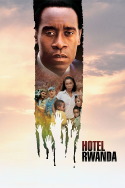
Review of Hotel Rwanda (2004) by Forrest P — 03 Jan 2011
An audience, I think, sets up certain expectations for a film like Hotel Rwanda. They expect, automatically, for this to be a good film with a certain emotional capacity and a relative feel for the true story it's trying to tell. Hotel Rwanda did not impress me to any extent, but I cannot say that it really let me down either. It's above average, but, perhaps, only just.
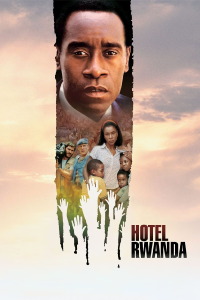
Don Cheadle keeps this film together. He stars as a hotel manager who protects 1200 individuals within the walls of his hotel during a time of bigoted, revolutionary uprising. Without his excellent performance, I would never have enjoyed this picture. He gives Hotel Rwanda every piece of credibility that we, the audience, needed from it. Far more, I think, than what director Terry George delivered. Where this film fails is in about three very key ways. First of all, the story lacked an epic feel to it that a film like Schindler's List had (and the similarities to the story being told between Hotel Rwanda and Schindler's List cannot be ignored). Whether or not this is because of budget difficulties is neither here nor there. I was just disappointed by the lack of scope that the film presented. The audience does not get a pure sense of an ever-present danger surrounding them, which is essential to getting this story off the ground.
The second way is in the life of Rwanda outside the hotel. I wanted to feel what it was like for those individuals who were getting slaughtered by the militia. At the end of the film, a caption comes on screen that tells the audience that nearly a million people were killed by the rebel forces. And during the film, we do get treated to the sight of hundreds of bodies cluttering the roadways, but here's my problem with this: these are complete strangers to the audience. We never get to know them as characters and so we never really get a feel for the true, visceral emotion that should be brought up by this. The film even directly addresses this. In one scene, Don Cheadle's character, Paul, tells a newsman that he does not think the sights they capture on film will instigate action by people in other parts of the world because they will say "That's horrible," and return to their dinner. Well, this is almost exactly what I thought during the film. I watched scenes like that and said "That's horrible," and that was it. In this sense, the film fails quite badly.
The third way is in visual style. This film really lacked any kind of visual style. I am not talking about art direction or visual effects. I am talking about very simple things like tense cinematography or even a murky backdrop that could have given it a more foreboding edge. Perhaps the film was trying to go for a greater sense of realism, but if this is the case, why not try for a documentary-style of cinematography? This lack of visual style is noticeable and sorely missed. I feel like that could have added a lot to the film, especially to the emotional impact that it could have had later.
But I have barraged this film enough, I think, and I am not so sure it truly deserves a lot of criticism. After all, there is a lot that this film does right. The first and most important thing is the performance I talked about earlier by Don Cheadle. He carries the film securely and it would never have worked without him. The audience gets to feel his pain every step of the way, especially in a very effective scene in which we feel the sadness buried in him and the futility it puts into perspective of doing such seemingly pointless tasks as tying a tie. It becomes almost a silly action, and this scene was put together magnificently, especially because of Cheadle's really gripping emotion carried out there.
We also get to see a lot of character interaction that works very well in portraying the life of this character and his family. I did want to learn a lot more about the lives of the other tenants and refugees, but I understood why we were given the story that was presented and the importance of it.
The screenplay is exquisite and it really works with showing people that the Jewish Holocaust was not the only time a genocide occurred. There are forgotten instances, forgotten heroes, and what this movie truly tries to do-and truly succeeds at-is reminding us of those heroes that we forget to acknowledge. This film is not put together and presented nearly as well as it could have been and should have been, but I feel it was not only a worthy effort but also an ultimately rewarding one. The expectations the audience puts on this film are met. The film may never go beyond that, but meeting them is important enough to keep me, for one, entertained. I liked Hotel Rwanda and wish that more stories like this were told more often.
6/10.
This review of Hotel Rwanda (2004) was written by Forrest P on 03 Jan 2011.
Hotel Rwanda has generally received very positive reviews.
Was this review helpful?