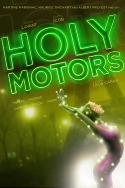
Review of Holy Motors (2012) by Joshua D — 29 Nov 2012
The criticism I'm hearing most about "Holy Motors" is that it's about nothing. That it means nothing. That they, the unhappy viewer, need more from their movies than random events. As if the road to nowhere is not interesting in and of itself. It makes me wonder, why don't we expect our concept of narrative to be challenged more in the movies we consume? Why don't we put forth as much effort in confronting art, as the artist has put forth in confronting us?
"Holy Motors" is, to me, an act of filmic hypnosis. It made the cinema lover in me immediately and deeply happy from frame one (and not just because it references so much cinema of the past and critiques trends in the cinema of the present). I appreciate that film is not simply just another way of telling a story. Film is painting with light. It features human beings at play. It is design and photography and fashion and imagination. Of all the things cinema embraces... story is just a single element. So how did it become the MOST important element? Or, even more baffling to me, when did our idea of story itself become so tepid?
The story in "Holy Motors" is writ large. It scans like a modern myth. Like the oldest stories the human race tells. It features improbable and fantastical things happening along a journey. Its protagonist is a modern Ulysses trekking through the strange and fabled land of human experience, always searching for home. It is the only story ever told. And yet, again and again I hear people say that the movie has no narrative. No character they can connect to. No meaning.
Just because director Leos Carax is playful and tenuous with "meaning" doesn't mean it's not there. This is a film that is both about the drudgery and the exhilaration of creating for a living. It follows a day in the life of an artist. An artist always on the move. Sometimes that artist is tired, sometimes inspired, sometimes longing, sometimes exactly in the right place at the right time to catch a glimpse of his past work.
A friend I saw it with was bored. I still can't even understand how that's possible. Here's a movie in which anything can happen. In which any image can be juxtaposed with any other. In which the central architecture is not some obscuring three-act structure built out of a tired overplayed premise, but instead, is a careening litany of virtually every possible premise available. It readily teeters from overindulgent spectacle to tiny truth and back again as it explores, but never fusses over, the role of new technology in cinema, complications of identity, the strange job of acting for a living and so much more...
Most importantly though, the movie is about being on the job. The job of being human. The work of being alive.
And we, the viewer, we work too. We work for meaning in the dark. We work to fashion the story. To touch the true character at the center of the experience. To understand where the human heart falls in all this flailing, anything-goes madness.
Life is work. Art is work. Observing is work. Isn't that beautiful?
âCinema is a territory. It exists outside of movies. Itâ(TM)s a place I live in. Itâ(TM)s a way of seeing things, of experiencing life. But making films, thatâ(TM)s supposed to be a profession.â? - Leos Carax.
This review of Holy Motors (2012) was written by Joshua D on 29 Nov 2012.
Holy Motors has generally received positive reviews.
Was this review helpful?