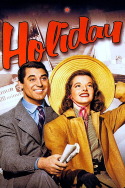
Review of Holiday (1938) by Edith N — 25 Apr 2009
It's funny, really. Hollywood has always liked to give us the vicarious thrill of seeing how the rich people live. Gloria Swanson essentially made an entire career out of wearing really nice clothes all the time. On the other hand, we are generally supposed to admire those who strike out an independent path, shunning the follies of the upper classes. While Katharine Hepburn wasn't in as many movies with Cary Grant as she was with Spencer Tracy, they were still in several, and they play with class in pretty much all of them. For one thing, while young Archibald Leach was middle class and had worked with a troupe of acrobats, the Hepburns were not exactly in his league. There's that delightful scene in [i]The Aviator[/i] where her family gets all snobbish over Howard Hughes--I don't know if it's true, but I know that they're the kind of family who could have done that. So it doesn't surprise me that, so far, all the movies I've seen them in together are movies where she's rich, and he's only rich in [i]The Philadelphia Story[/i]. He could play rich; she wasn't reliably good at playing poor.
Johnny Case (Grant) comes home from a vacation at Lake Placid with the joyous news that he's getting married. He met the girl on the trip. They've known each other for ten days, but that's long enough, right? So he goes to her house to see her, and it turns out that his beloved little Julia Seaton (Doris Nolan) is filthy rich. Their Manhattan home is at least four stories tall. It has an elevator. Johnny goes to the back door on the assumption that Julia must just work there or something, because surely she would have mentioned! And, of course, she ought to have. Her father, Edward (Henry Colker), is not too sure about the whole thing, but her sister, Linda (Hepburn), and brother, Ned (Lew Ayres), hit it off with Johnny quite well. In fact, Linda likes him a little more than she's comfortable with, given that he's going to marry her sister. She listens to him tell about he's just working until he's saved up enough to take a few years off and figure out who he is, and it delights her. She loves his friends, Nick (Edward Everett Horton) and Susan Potter (Jean Dixon). He would be perfect for her were it not for the whole marrying-her-sister thing.
Johnny and Julia were foolish. He freely admits to the Potters at the beginning of the movie that he knows essentially nothing about her. They plan to get married before they've known one another a full month. He knows nothing of her family; she knows nothing of his plans. Her father hosts an enormous engagement party for them, and even if Johnny has friends other than the Potters, they aren't there. It is clearly assumed that Johnny is just going to slide right into their life, and it is obvious that, if he does, he's going to end up like Drunk Brother Ned, who can no longer even think of escaping. Except, of course, through just passing out. And the foolish children don't even know that.
Every once in a while, I catch something in an old movie, or episodes of TV shows set long ago, that sparks realization of a change in how things work. There's an episode of [i]M*A*S*H[/i] that has the same change as this one. While, downstairs, people are wearing their best clothes, not because they like them but because they want other people to, the Potters and Linda and Ned are all sitting upstairs in the playroom--and they're singing. In harmony, even. On that episode of [i]M*A*S*H[/i], everyone knows the words to "The Tennesse Waltz." Singing is just something that people did. Now, I have sensitive ears; I don't want to be around when easily 90% of my friends are singing--but then again, I think they'd be better at singing if people did it more often. Also, despite the hardscrabble life Johnny has led, he is able to waltz quite well to Linda's little music box.
This was a play first, and then there was a 1930 version. The funny thing about the 1930 version, I think--which is apparently only available at the Library of Congress--is that the man playing Edward Seaton, a William Holden but not [i]the[/i] William Holden, was born in 1862. Of course, he died not long after, but it's always fascinating to me how people connected with one landmark of history end up tying into another one. Like all those old movie stars who went on to [i]Murder, She Wrote[/i] or [i]Columbo[/i].
This review of Holiday (1938) was written by Edith N on 25 Apr 2009.
Holiday has generally received very positive reviews.
Was this review helpful?