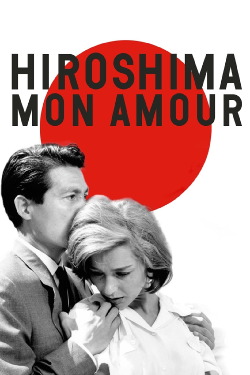
Review of Hiroshima Mon Amour (1959) by Peter B — 04 Mar 2010
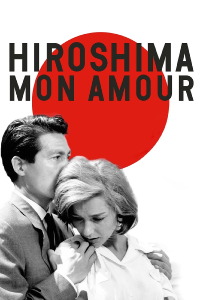
In Hiroshima Mon Amour, a married Frenchwoman from Nevers has a tryst with a married Japanese man from Hiroshima. He falls in love with her, she wrestles with the ghost of her last love, a German soldier who died on the eve of their elopement, as she prepares to return to Paris. Odd juxtapositions are used to convey her emotional conflict. The first scene merges images of her and her lover in bed, entangled in each other's arms, with horrific images of the aftermath of the bombing of Hiroshima. Indeed on some level this is an anti-war film and the spectre of nuclear war hangs over it, with key scenes taking place in an anti-war protest in which haunting imagery of deformation and seared flesh is given prominence. A horribly scarred ex-soldier is placed beside the lovers as they speak of their relationship. But it is also a tale of the traumas of love. In recounting the tale of how her German lover was murdered and she was disgraced for consorting with him, the heroine (finally named "Nevers", reflecting her tortuous attachment to her memories there) addresses "Hiroshima", her lover, as if he were the German she first loved.
The mental association of this man with her first love begins early on, with the twitching of his hand while asleep sending her into a brief remembrance of the German's death in an innovative use of flashbacks. Her love story with the German is chronologically disjointed as the narrative structure reflects her memories. Memory is a prominent motif in this film, it haunts her constantly and ultimately dominates her. There is a sense that her tragic story is perpetuating itself with the Japanese man falling in love with her.
This film gives an impression of continuing to live out our darkest hours through memory. The war goes on for Hiroshima and the French actress who lost her first love as it ended.
There are some stunning images of Hiroshima in this film. A radio tower looms like the Eiffel Tower in miniature as the woman finally makes her decision. We are left with a sense that the city has risen from the ashes and moved on. Whether or not the protagonists will do so is unresolved, but we are left with a romantic story every bit as moving as Casablanca, which clearly influenced it.
This review of Hiroshima Mon Amour (1959) was written by Peter B on 04 Mar 2010.
Hiroshima Mon Amour has generally received very positive reviews.
Was this review helpful?