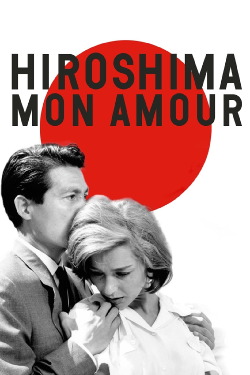
Review of Hiroshima Mon Amour (1959) by Harpreet S — 16 Sep 2011
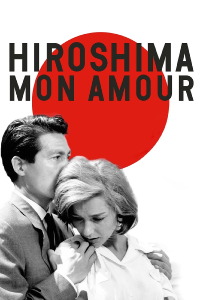
Alain Resnais, who directed this movie, didn't consider himself part of the French New Wave, and so I won't call this a New Wave movie; if it were, though, it would be one of the best of the New Wave movies. It's not really like any other movie I've seen; it's definitely unlike anything that had been made before it. It's hard to say precisely what the movie's effect or intent is, but it's definitely good.
The first ten or fifteen minutes of the movie give us a conversation about the bombing of Hiroshima, mostly in voiceover, as we see various images of the aftermath of the bombing. I think most if not all of the imagery of Hiroshima post-bombing is actual documentary footage. The effect is to document Hiroshima in much the same way Resnais's earlier film Night and Fog had documented Auschwitz. After this extraordinary opening sequence, we finally actually meet the main characters, of whom we had previously only seen backs and hands and heard their voices. They turn out to be a French actress and a Japanese architect having a brief adulterous affair. Throughout the rest of the movie, we follow the couple (mostly the actress) as they talk and remember what happened to them during the war.
Emmanuelle Riva is extraordinarily good as the actress. She seems very happy at first, but eventually we piece together her tragic past, and she reveals deep unhappiness. We don't learn as much about Eiji Okada's architect character, but I guess the opening scenes suggest that the trauma for the Japanese of Hiroshima is too big to be adequately represented anyway. Okada's performance is also very good, in any event.
What makes this such a famous and special movie, besides the opening documentation of post-bombing Hiroshima, is the way the narrative unfolds and particularly the way in which memory is represented. I wrote a little while ago about Citizen Kane's groundbreaking use of flashbacks. In Citizen Kane, the flashbacks are usually fairly long, self-contained scenes that are clearly demarcated as flashbacks. This movie, written by French writer Marguerite Duras, took flashbacks a step further than Kane had. Here, flashbacks are often presented in incomplete, short, fragmentary ways that might not initially make too much sense. You see an image, and only later are you able to piece together how everything fits and what actually happened in the story. The effect is not unlike narration in modernist writers like Faulkner or Joyce (although it's a heck of a lot easier to figure out than Ulysses). In addition to all this, the movie looks great; Resnais is a visually interesting as well as narratively innovative filmmaker. This is one very creative and very important movie, and I'm surprised by how little I had heard of it before.
This review of Hiroshima Mon Amour (1959) was written by Harpreet S on 16 Sep 2011.
Hiroshima Mon Amour has generally received very positive reviews.
Was this review helpful?