Review of Higher Learning (1995) by Martin D — 12 Mar 2010
John Singleton on the Complicated Truth of Integration.
The white kids at my high school--John Singleton's too, though he's a decade older than I--did not hang out in an isolated group separate from the other kids. This was pure practicality on our part. I mean, I liked Vicki and Ruth and the two Davids, and I could deal with Amanda Hoffman, but Melissa Rice dropped out midway through senior year and Brian Weiss disappeared from the ken of mankind. Heather Wertheimer was there and then gone and back again. And that, from what I can remember, was it. So, you know, we blended in. It is, however, true that there were black cliques and Hispanic cliques and Filipino cliques. On the other hand, there were also multiethnic cliques--ours, and probably by extension Singleton's, was mostly just the smart kids working on going to college, though within those, there were sub-cliques which could be ethnic in makeup. (The smart black girls and the smart Hispanic girls, basically.) However, I did see some of what's going on in this movie, and I know it happened even more in larger schools--there were only about 120 of us in my class all told.
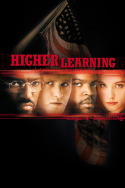
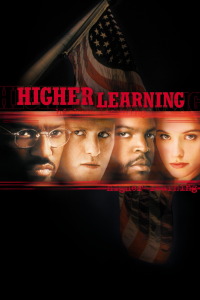
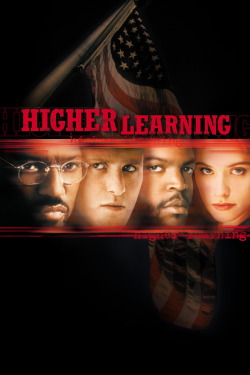
School is starting for another year at Columbus University. We are mostly concerned with Malik (Omar Epps), Kristen (Kristy Swanson), and Remy (Michael Rapaport). Each is a freshman, and each have their own issues and interests which they bring with them onto campus. Each one is handed their own problems, and what becomes interesting, and what drives the movie, is how they handle it. Malik is having difficulty with his scholarship, his running, and his studies--he's on a track scholarship. Kristen is a poor girl with rich friends, and they basically abandon her to get raped. Remy is kind of a dork, really, and he's never going to fit in. Not to mention that "super-duper senior" Fudge (Ice Cube, apparently soon to star in the desperately-needed [i]Welcome Back, Kotter[/i] movie), his first roommate, is frankly a real jerk to him for the express purpose of getting him to move out so Fudge can have his own room. And, of course, there is Wise Old Professor Maurice Phipps (Laurence Fishburne), who dispenses wisdom and poli-sci.
I'm wondering if I'm intended to, but I really find Kristen the most interesting character. For one thing, she is the only character to have a real, serious friendship with someone outside her own ethnic group--after her skanky white friends have rejected her. We never find out where in Orange County she's from, but most of the county is awfully white and awfully upper class. Her father was laid off from McDonnell Douglas; it's never said what he did, but we can assume he wasn't just a factory grunt. This means she's used to privilege and is now, for the first time, dealing with an environment outside her comfort zone. It's true there is some initial awkwardness with Monet (Regina King), but once they get over it, they become fairly close, with Monet clearly being a major part of Kristen's support structure. Monet is shown to be a little more concerned than I would have been about the implications of Kristen's friendship with Taryn (Jennifer Connelly), but it's obviously at least in part because she's looking out for Kristen's best interests, and Kristen is very obviously scarred by her college experiences thus far.
Not, I have to tell you, that you would have to be scarred to consider sleeping with Jennifer Connelly. And, by including Wayne (Jason Wiles) as a love interest, I think we move off some from that. Kristen doesn't know what's going on anymore, and this is her method of dealing with it--in one of the most beautifully sequenced sex scenes I've ever seen. Kristen's solution, the only one which really works, is to turn outward. She befriends Monet, Taryn, Wayne. Yes, she loses the blonde skanks, but she's really better off for it. And I'm sure Malik thinks he's turning outward, but he's turning to his own prejudices. He turns to his anger, which only gets him in more trouble. (The fact that the racist campus security officers seem to think he is always the one causing trouble instead of dealing with the real problem doesn't help.) Professor Phipps tries to help with his wisdom, but you have to want to hear it. Remy, too, turns insular and caters to his prejudices, and that makes him into a tool for the very influences Kristen feels are happy to split the campus apart for their own gains. The film even treats Kristen's sexual experimentation with respect.
Oh, it gets preachy. It's hard to deal with the subject in any significant sort of fashion and not. After all, there's a lot of ground between Kristen's, well, "We Are the World" mentality and the evil Remy gets caught up in and becomes. (Though it should be noted that Remy tells us his father is a survivalist.) But even Remy isn't ever really considered a bad person, and it's easy to see how Fudge set events in motion which ended in a way he never could have anticipated. It's also true that the truth lies somewhere between Dr. Phipps's idealized "nobody cares about your colour or sex" and Malik's "the black man can't get ahead." However, I would be greatly surprised if Singleton didn't know that. He hasn't done much in the nigh-on to twenty years of his directorial career, and I'd argue that there are several things in it which didn't need to be done. Still, he has lived in South Central LA, and he has walked the red carpet at the Oscars, and the world between those two experiences will give you a lot of places to think about when you're forming your worldview.
This review of Higher Learning (1995) was written by Martin D on 12 Mar 2010.
Higher Learning has generally received positive reviews.
Was this review helpful?