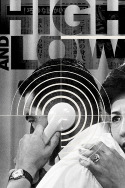
Review of High and Low (1963) by Paul Z — 15 Mar 2009
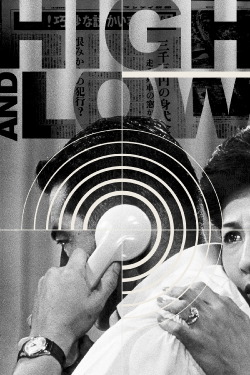
Eternally to be one of the very best police films or procedurals of any kind ever to be seen, High and Low attains its title's suggestion of social tangents by bouncing on restless, loud rock n' roll, unremittingly scooping waste on Schubert's Trout quintet, and deepening the highest point of its murder investigation with the counterpoint of the mechanical, repetitive style and beat of early swing music on a radio performance of It's Now or Never.
When all is said and done, this stroke of enthrallingly gritty vision, Kurosawa's 23 film, has several climaxes, as it is a thriller richly encompassed by feather-ruffling tautness and bolting releases. It is the result of film noir put in the hands of a master who is only reaching to the bottom of the pile.
A man seemingly street smart by the grace of parables of Greek mythology, unanchored in a drug-soaked urban decay steered by its night spots, the perpetually sunglassed villain has nurtured a perverse preoccupation. He lusts to echo the scalded anarchy of Japan's nethermost fundaments back into the face of the most flourishing man he can strike. His object overhead: an autodidactic footwear tycoon, Gondo, the immutable thorn in the undersides of the National Shoes company.
As indented by Toshiro Mifune in a performance that, to an American audience translates into shameless eating of the scenery but from a distance is deeply felt, Gondo may live in the inscrutable, time-honored house on the hill, a thoroughly reduced mansion that appears, from inside and out, to look egotistically down on the consummate city beneath it, but he prevails as a man embedded in an inglorious, hands-on history. "Shoes carry the weight of the whole body," Gondo belows early on, criticizing the tacky pumps his profits-over-quality corporate partners aim to market. A prosperous official with one foot in the past, Gondo by this time thinks he's one step ahead: He's engineered a way to overtake the company takeover his partners are about to try.
What Gondo doesn't expect is a plot to kidnap his son and command a devastating ransom. The plan creeps into effect, but when the frame hits a small hitch, our villain's henchmen accidentally seizing Gondo's chauffeur's son instead, he still orders the ransom, turning an ethical catch-22 in motion. Should Gondo pay the ransom and save a child that isn't his, at the cost of losing his company and heavily-mortgaged home? Or forgo the chauffeur's child and salvage his status, high on that hill, while his benumbed spiritual self falls hard and fast into the mirror-world underneath it?
In High and Low's screw-tightening first hour, Gondo, a crew of dedicated cops and Kurosawa's anamorphic lens, stay fastened in the mansion's living room, handling the kidnapper's phoned-in orders. It's a breathtaking chapter, built on a deafeningly silent soundtrack and laborious variations of group and individual compositions, mixing two-shots and seven-shots into glacial fractions and numerically exhausted collective portraiture. But once it branches into its procedural second act, the film's real crops unfurl. Compositions of groups of men in motion interchange with comprehensively particularized sequences of evidence examination. And Gondo's allegorical castle in the sky, once seen from the villain's angle, begins to adopt expressionistic dimensions. Evidence escalates, characters and trajectories adjust, and ultimately an startling defilement of crimson-pink smoke flags a chance into the abyss, receiving us as Kurosawa's camera descends into act three.
Feast your eyes, finally, on the Low: a degraded vice exchange filled with bickering sailors and cat-eyed whores, obliterated heroin freaks and undercover cops. In this devolved slum, talk is futile and disorder reigns sovereign, and in all of Kurosawa's film-making, there is nothing else quite so bawdy or deranged.
The vindications are here, if pounded in a climax, as becomes the film's abrupt about-faces of circumstance and dignified downfalls, cloaked in clear display somewhere soundly before the end. Toshiro Mifune, his body covered in pungent smudges, pushes his own manual lawnmower, intent on severing the weeds that scrape ever higher.
This review of High and Low (1963) was written by Paul Z on 15 Mar 2009.
High and Low has generally received very positive reviews.
Was this review helpful?