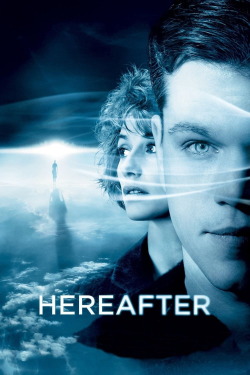
Review of Hereafter (2010) by Parker S — 05 Jul 2012
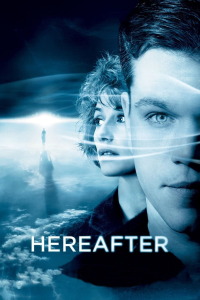
A masterpiece by Clint Eastwood and Peter Morgan featuring one of Matt Damon's best performances, a moving score and some remarkable special effects, "Hereafterâ? explores the concept of an afterlife in a truly fascinating and distinct way through not addressing the question of âwhatâ? but rather âwhy?â? In other words, Morganâ(TM)s screenplay is not interested in what happens when we die, but in why we so yearn for and desire there to be something more â" heaven or some kind of an afterlife.
By addressing this question, Morgan and Eastwood together manage to develop a deeply moving and sincere reflection about the need to believe in an afterlife, that when we die it does not simply end. The story weaves together three people who, like many of us, have all been confronted with death in their lives.
Marie (CÃ (C)cile De France) is a French journalist working on a story in Thailand when a massive tsunami hits and envelops the shore, its giant waves crashing down and leaving thousands deadâ"this disaster is meant to represent the 2004 South Asian tsunami, which left an estimated 230,000 people dead across Indonesia, Sri Lanka, India and Thailand.
Among the dead discovered in the aftermath is Marie, who is rescued from the water and resuscitated just as she begins to envision a bright light and shadowy silhouettes of familiar people who are no longer living. She becomes consumed with these images after being saved, and seeks out answers, putting her career in jeopardy in the process.
There is also a young English boy named Marcus whose twin brother, Jason, dies after being hit by a van while running from some bullies who are trying to tease him. George McLaren and Frankie McLaren, who alternated parts, play the twin boys. Both McLaren brothers deserve a standing ovation for their work in this film, as they provide such innocence and sincerity to Marcus, who, like Marie, tries to find answers.
The scenes showing interactions between Marcus and his brother reveal an incredible bond between them. They build on each otherâ(TM)s decisions and actions, they feel each otherâ(TM)s feelings. Their mother is a heroin addict, so they really only have each other to depend on day by day. Jason is more talkative and outgoing, while Marcus is shy and the quieter of the brothers, so when Jason dies, it leaves Marcus both lost and forced to take on some of his brotherâ(TM)s confidence.
In doing so, he discovers a man named George Lonegan (Matt Damon), a former renowned psychic who plays as the most complex character in âHereafter,â? as he serves as the linchpin of the film, bringing together the other characters in loss and desperation, sorrow and revelation. George once worked as a medium for people seeking out the voices of lost family members, people seeking reconciliation and resolution, and trying to find peace and purpose in their lives. The work wears down on George, as he is asked day in and day out to use his gift to reach the dead for others, until seeing their tear streaked faces and pleas for help becomes too much, âa curse,â? and decides instead to work a more traditional job where he is not surrounded by death and sadness all the time.
This is a powerful performance by Damon, who is able to bring such sincerity and complexity to George, a man lost in the world and within himself. When he attends a cooking class to find a hobby and meet people, he is paired with a beautiful young woman named Melanie (Bryce Dallas Howard). They immediately relate to each other and he invites her home for dinner after a few classes. They share a some tender moments before he reveals his past as a psychic and things get complicated.
Like Marie and Marcus, George cannot live his life as others do, and is haunted by death and what comes after. He cannot connect with others without his past returning to haunt him. These three people are connected by forces beyond any Earthly comprehension, and as brave and challenging as this film is in exploring these ideas, it ultimately is able to express them with quite Earthly humanity.
George listens to Charles Dickens audio books as he falls asleep. Marie rigorously researches writings about the afterlife, meets with experts in the field and works on a book about her near-death experience. Marcus wears his dead brotherâ(TM)s cap as a memento of the connection they had. He also feels a strange energy from the cap itself that comes into play in a surprising and poignant way late in the film. All of these nuances in the film contribute to the kind of delicately riveting atmosphere Eastwood has mastered. Like his 2004 Oscar-winning drama âMillion Dollar Baby,â? âHereafterâ? is layered with graceful, powerful images of which Eastwood is in complete command at all times. He is also working from a brilliantly reserved screenplay by Morgan (âThe Queen,â? âFrost/Nixonâ?).
This is one of the directorâ(TM)s most powerful and challenging films, a bold statement considering he made âUnforgiven,â? âMystic River,â? âLetters From Iwo Jimaâ? and the above mentioned âMillion Dollar Baby,â? all films eventually worthy of my âfavorite filmsâ? section. At 82-years-old, I believe the master director still has great work ahead of him, and âHereafterâ? is a clear indication that he will continue to grow as a filmmaker and challenge audiences.
To admire this film, you need not believe in life after death â" I do not. You only need to believe in the importance of communicating with and taking care of each other while we are still alive.
This review of Hereafter (2010) was written by Parker S on 05 Jul 2012.
Hereafter has generally received mixed reviews.
Was this review helpful?