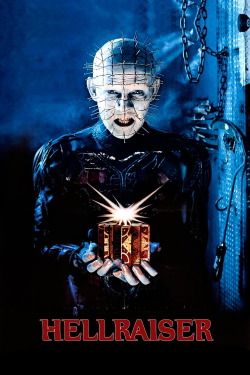
Review of Hellraiser (1987) by Jake R — 06 Jan 2010
After the explosion of gratiuty with the video nasties of the early 1980s, the horror genre stagnated somewhat. The slasher franchises concerning Freddy, Jason and Michael were proving with diminishing returns the lack of creativity that is endemic when studios try to use a 1-dimensional character as the basis of a single movie, let alone a string of endless sequels. In 1987 the 'Hellraiser' series would add another, more depressing series of cynical sequels and chapters that seemingly used the movie's poster for the majority of the shooting script. However, as with most of these franchises, the original movie is always the best of the series, and in some cases quite a landmark in horror cinema.
With 'Halloween' the last '70s began the fixation of having horror victims teenagers, with the exceedingly heavy-handed metaphor that excess of sex, drinking and drugs leads to an early, presumably hilariously violent death. 'Hellraiser' took a different approach, this time exploring, perhaps, the 'lighter' side of horror movie violence. It is certainly a sneering comment of horror audiences in general, that the main pleasure to be derived from a horror movie comes from the anticipation of fear and the spectacle of blood and guts, and exaggerated pain. The movie argues that if we as an audience are demented enough to enjoy all this suffering, then why can't the characters in the movie itself?
Granted, this is a situation where the idea is more successful in theory than execution (no pun intended). There's relatively little pleasure in the movie, and certainly no kind of humour or relief. It's relentless without being over the top, but one wonders exactly who is finding any of this 'pleasurable'. The most obvious suspect would be Higgins' 'Julia', who enjoys a fair amount of sex throughout the film, and there's a definite, queasy kinkiness about her, though her sexual aesthetic has aged very badly since the '80s. Indeed, the movie contains a plethora of fashion choices that would instantly win a laugh to modern audiences (despite the recent '80s revival). But beyond Julia's sexual pleasure and the obvious fun the Cenobites have with their victims, not many people enjoy their suffering.
This was one of the first mainstream films to use BDSM imagery and practises as a main part of the plot, and for the first time ordinary audiences could 'enjoy' all that that entails without feeling ashamed to have had to go to a 'special theatre' to watch such similar fare. But the subject is kept to a minimum and it's never even implicitly referenced in the film. It's not much big a deal because Barker isn't trying to make the characters connect their suffering with pleasure, he's making the audience connect them by juxtaposing the two sides very closely. This is in a visual sense, with quick cuts of sex or erotic tension mingled with shots of Frank's disgusting body or gory dream/flashback sequences. Just as we are aroused by one scene we're repulsed by another, and vice versa. Consequently, it's the atmosphere itself that is the most unnerving and uncomfortable aspect rather than anything explicit in the film.
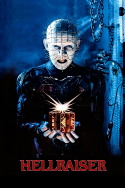
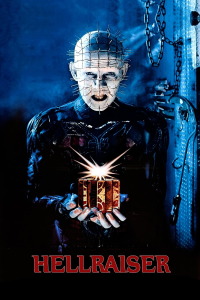
That aside, what really drags the movie down is its cast. Apart from the gorgeous Ashley Laurence, who also provides the film's best performance, the cast are anywhere between embarrassingly-naff and god-awful. Andrew Robinson, famously seen 16 years before as the punk chased by Dirty Harry, doesn't do well outside of that psychotic role. Clare Higgins is little better, probably coasting on impeccable theatre credentials that don't translate to such a notoriously awkward genre for 'acting'. Both Sean Chapman and Oliver Smith are next to infuriating with their lack of ability in their portrayals of 'Frank', redefining and varnishing the meaning of 'wooden'. Of course the Cenobites themselves, lead by series stalwart Doug Bradley need to do little other than grimace at the camera, so gruesome and hideous is Bob Keen's icky make-up.
Despite the majority of the cast failing to turn in anything that might take their character out of 1-dimension it's difficult to not like 'Hellraiser'. The visual style is commendably vibrant, with Argento-like use of colour and some brilliant, if at times cliche, imagery referencing all those unbearably creepy corners of our minds. The special effects have also dated well, since they're much easier to take nowadays compared to how unrealistic modern CG looks anyway, and the whole exclusively '80s' quality about it gives it a rather amiable vintage. So though it's not quite a classic, nor is it anything ground-breaking, it's still a unique, offbeat and bloody scary horror movie.
This review of Hellraiser (1987) was written by Jake R on 06 Jan 2010.
Hellraiser has generally received positive reviews.
Was this review helpful?