Review of Heaven & Earth (1993) by Paul Z — 27 Mar 2009
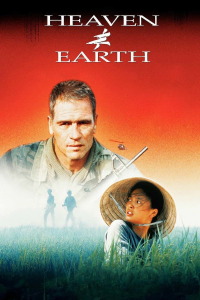
Stone looks objectively at the spiritual way of life led by a Vietnamese village, how they mind immaterial happiness to be able to survive the misery of their corporeal lives. The film begins as an exposition of the village, then begins to focus on one of its resident families, and all the while slowly tightens more and more into a study of one of the daughters, an impassioned girl named Le Ly, whose view of life is not much different than that of the rest of her family but embodies the journey that affirms the importance of their spiritual experience. She is born into a babe-in-the-woods atmosphere, in which her village lives as they have for centuries. All is in its place like the ancestors who are buried on land that has been in the same family for so long. Then a warplane screams across the sky, and in a heartbeat all she knows is sieged. What she believes to be her fate will take her from the rice patties of the Central Highlands to the sprawling bubble of California.
Oliver Stone has made films about Vietnam from the point of view of a combat infantryman and a paralyzed veteran, and now in this unsung gem he punctuates an indispensable installment into a trilogy by seeing the war through the eyes of a Vietnamese woman. The story is true, as were Platoon, drawn from his own first-hand experience, and Born on the Fourth of July, based on the autobiography of Ron Kovic.
I feel safe in saying that the seminal spirituality of this film is objective, and vitally so, because there are many things about this film that seem externally uncharacteristic of Stone's body of work. For instance, he is not known for films about women. This is the first time he has had to place himself inside a woman's thoughts, and that he indiscriminately does owes no small piece to Hiep Thi Le's performance in the leading role. Having been born in Vietnam, come to America as a child, knowing both worlds, is perfectly cast for such a culturally and realistically complicated character to portray. Seeing the war through her eyes, watching as foreign troops beeline across the fields of her family, we are asked by Stone to see how radically antagonistic the American strategy in Vietnam was. The long-term aim was to win the "hearts and minds" of the Vietnamese people. With this intent, we displaced them from the land of their ancestors, and shepherded them into "strategic hamlets" made to force the Viet Cong out, even if they worked more like camps to keep the residents in. This strife indeed emboldened them to relate to the Cong, who appreciated their same ideals.
For common growers who wanted just to farm, the war brought nightmarish dilemmas. Into her life one day comes a towering, rugged American named Steve Butler, in one of Tommy Lee Jones's becoming, persuasive and mood-swinging performances, who does not want her as a hooker, but as a wife. He is kind, compassionate, determined, yet maybe if she were less hard up she would discern a worrying connotation when he claims, "I want an Oriental wife." His image of her is desperately entwined with his own internal debilitations, his need for a woman who will concurrently absolve him, and submit to him.
Le Ly returns to America as Mrs. Steve Butler, to a land where the supermarket shelves seem to sprawl infinitely in all vectors and the in-laws treat her as something between a darling and an embarrassment. One of her American relatives is played, through skillful casting, by Debbie Reynolds. Le Ly has issues adapting, but not as many as her husband, who learns that his groundwork and 20 years as a "military adviser" have left him despairingly unfit for civilian life. Jones shows his talent for characters who are never scarier than when they are simpatico.
The anamorphic cinematography by the great Robert Richardson dials up the color palette so that the transition from the horrific chaos in Vietnam and the commodified epic pleasantry of America is almost explosively surreal. We follow Le Ly and her new husband into supermarkets and split-level San Diego kitchens with relentless wide angle lenses and sometimes even the out-of-sync slow motion Stone would soon fall in love with while making Natural Born Killers.
Part of what made Stone such a draw in the earlier half of his career and a deterrent in his latter half is that he treasures politically controversial topics. When the Vietnam War was the most vital in contemporary American history, just Stone made it his work as a filmmaker. Movies are a very different course to make a meaningful assertion than one which can be accompanied by explanatory notes. Movies interface in the ways things show, sense, sound. In Platoon, Born on the Fourth of July and now Heaven and Earth, Stone has us see through eyes that saw three bases of that atrocity.
This review of Heaven & Earth (1993) was written by Paul Z on 27 Mar 2009.
Heaven & Earth has generally received positive reviews.
Was this review helpful?