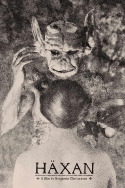
Review of Häxan (1922) by Edith N — 20 Mar 2009
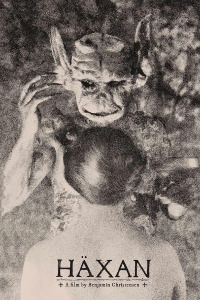
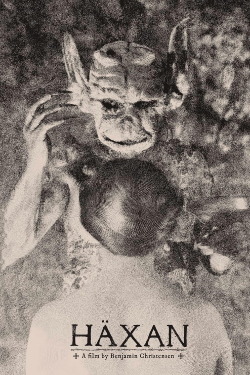
I don't think most people realize that B&W films aren't, necessarily. If I remember properly, even [i]Birth of a Nation[/i] involved some tinting. Of course, the process was incredibly tedious; each print had to be coloured for every frame, and it wasn't something most filmmakers bothered with--even serious ones. It vanished completely from later films, presumably on the assumption that, if you wanted a movie in colour, you'd by-Gods [i]make[/i] a movie in colour. In fact, I'm not sure I've ever seen a tinted movie from the sound era, much less the colour era. (The Little Girl in the Red Coat from [i]Schindler's List[/i] not really counting, of course.) Quite a lot of [i]Häxan[/i], however, is tinted red, the better to give the whole thing an ominous appearance, and some of it is tinted blue, to give it a haunted one. You see, "tinting" was not "colorizing." They just washed the whole frame in the same colour.
[i]Häxan[/i] is a Swedish documentary-ish film about the history of witchcraft. The first chunk of it is simply a history, using title cards and woodcuts to teach about medieval attitudes toward witchcraft and the Devil. In the second part, filmmaker Benjamin Christensen produces a reenactment of a set of sample witches--or, rather, accused witches, as he himself clearly does not believe in witchcraft. There is old Marie, the Seamstress (Emmy Schønfeld), accused of bewitching a man into illness. There is a younger woman accused of bewitching a monk into impurity. There is a pair of medical students illicitly performing autopsies on stolen corpses. There is a nun who wanders the convent at night, holding a knife or stealing the statue of the Baby Jesus. All of these are accused--old Marie talks, of course. (At least, I think she's Marie. The credits aren't terribly helpful.) The young woman, we know, is burned.
Finally, Christensen shows us modern belief in witchcraft and the possibility that the whole thing was just hysteria. Which it was, of course, but he means in the clinical sense. You know, the Freudian one--the one we don't use anymore, because it turns out to be bogus. Heck, he lists sleepwalking--the case of that young nun, for example--as a hysterical condition. To be sure, many "causes" of witchcraft were mere illnesses, be they natural physical ones that were taken as signs the victims had been bewitched or psychological ones that made the "witch" seem possessed. However, I don't think that accounts for the case of the young monk, who is obviously just young and infatuated with the girl. His fantasies caused her to be accused of witchcraft, because it couldn't be anything to do with his own thoughts.
Honestly, I was more interested in the earliest bits. A pure history of witchcraft panic in the Middle Ages is fascinating. The dramatizations get a little silly in places, especially the woman in the end sequence who is a hopeless kleptomaniac. Her desperate pleas about the Russian book she's stolen when she doesn't speak Russian, and how it's all to do with how she lost her husband in the War? Yeah, I could have done without those. Honestly, I could have done without Christensen's pointer to indicate to us where we should be looking; I wonder if it was a failing of his equipment that he couldn't just show us a closer view of that spot. I'll admit I don't know enough about 1920s camera equipment to be sure.
Most people, I suspect, don't really think of even the possibility of the silent documentary; even [i]Nanook of the North[/i] isn't really one. All the scenes were staged, the actor's name was changed, and the woman playing his wife wasn't actually his wife. This isn't really one, either, when you get right down to it. However, perhaps the first half-hour or so is. As I was watching it, I rather hoped the whole thing would be. I didn't watch the re-release version, the one with the narration by Burroughs; perhaps it leaves out more of the acted part, but I doubt it. I didn't compare lengths, but I strongly suspect that if it leaves out anything, it's the parts of the movie I liked best.
This review of Häxan (1922) was written by Edith N on 20 Mar 2009.
Häxan has generally received very positive reviews.
Was this review helpful?





![[REC] (2007)](https://cdn1.cinafilm.com/static/img/movie/5996792e/125/1-rec-2007.jpg)