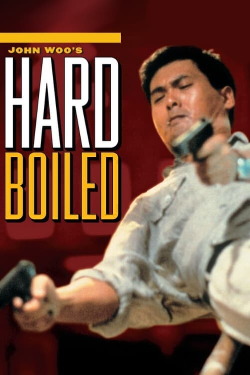
Review of Hard Boiled (1992) by Dan K — 27 Jan 2009
Once upon a time, I didn't care at all about John Woo movies. I don't recall why--I've always had some kind of appreciation for action movies. I enjoyed Face-Off well enough when I stumbled across it on television some years ago. I knew fans (still do) who endorsed it as artistically-produced, well-choreographed, "respectable" action. Perhaps it was that it was out of print for a while, or that I didn't often track down movies years ago and just took a while to happen upon an opportunity that interested me enough. The out of print status has earned quite an amusing and hilarious thread on IMDb, but it's a moot point now that it has been released as a "Dragon Dynasty" label title (though this is exactly what inspired the aforementioned thread and its endless animosities). This is also now the second time I watched it, but it felt choppy the first time as I was getting a bit confused by the people I was watching it with, who were claiming confusion, which led me to concentrate too hard and try to make plot connections that weren't there, as well as interrupting the flow. As a result, I decided not to review it then and left that for a second viewing, which I have now finished.
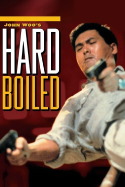
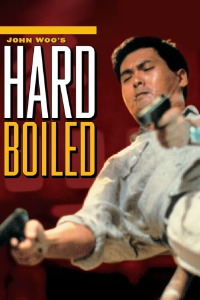
Inspector Tequila Yuen (Chow Yun Fat) is, as his title suggests, a police officer in Hong Kong, who begins the film by casually entering into a teahouse where he and fellows cops know an arms deal is taking place. The entire teahouse suddenly explodes when one of them makes a move on the deal, leading to an enormous shoot out that leaves Yuen's partner and friend Benny (Bowie Lam) dead at the hands of a triad gang leader. Tequila vengefully executes the leader without pause, which raises the ire of his boss, Superintendent Pang (Philip Chan), who tells the shrugging Tequila that this leader could have brought down even more with his testimony. Tequila is more interested in stopping the man behind him though, Johnny Wong (Anthony Wong Chau-Sang). Wong has his hands in more than his own gun-running though, taking interest in fellow Triad leader Hoi's (Hoi-Shan Kwan) man Alan* (Tony Leung Chiu Wai) after he successfully assassinates Johnny's rat from Hoi's gang. The investigation of this shooting leads Tequila to his informant Foxy (Wei Tung), who tells him the location of Hoi's gun warehouse in time to catch Johnny there when he plans to destroy it and kill Hoi. A gunfight in the warehouse leads Hoi's operations crippled, and then Johnny asking Alan to prove his loyalty by killing Hoi, who asks that Alan do it and not Johnny, accepting his fate, but asking that his men be spared. When Alan makes his choice, Tequila makes his entrance and in the final clearing smoke attempts to kill Alan only to find out his gun is dry--but Alan's is not and he smiles and walks away without harming Tequila. Tequila realizes that Alan is undercover and confronts Pang, who refuses to admit this and attempts to control Tequila instead. Foxy manages to tell him where Johnny's gun warehouse is though--under a hospital. With Alan's help, Tequila plans to finish off Wong's operation, and Wong himself.
I'm blessed with the ability to leave my mind open when watching a film drowning in hype like this one is. Often recognized as one of the best action films ever, and certainly one of the most influential, it's very hard to wander into it without some level of scrutiny, and a bit late to be absolutely blown away by the action (which has been copied, imitated, parodied and otherwise re-used until it's nearly ingrained). I actually played through the game that is the sequel (Stranglehold) without ever seeing this, and was amused to discover that its plot actually has little or no relation to this film. The other element I should admit is that I indeed watched the Dragon Dynasty version because it is the one in print and easiest to purchase--it's criticized fairly roundly by fans for an inaccurate aspect ratio (it is cropped and stretched in some way no one seems to be able to consistently explain, but the stretching is apparent in image comparisons) and dubtitles. I'm opposed to both of these on principle, but I'm also personally opposed to endlessly importing titles that are available in Region 1, however butchered (so long as the film as a whole is generally intact, anyway--an edited version would be something else entirely). I'm often struck when watching something in a language I don't know (and I don't know a thing of Cantonese) by the realization that frankly we can't ever have perfect translations. The idea that a word translates directly from one language to another is ridiculous, as there are cultural and dialectic connotations to consider. Sure, a hand is a hand--but maybe one understanding of "hand" in another language includes the forearm, or omits the fingers. It serves the purpose when translated, but it's not exact. And that's just nouns. Adjectives are far worse, where even one that carries the same denotative meaning (such as, say, "stupid") may be more positive or negative in one language than another. It's with this in mind that I swallowed my relentless pedanticisms and watched the film in this form anyway. Generally, some lines are absolutely nonsensical when compared to the original language, with a focus so great on matching lip movement that entire meaning is lost, but a good physical performance usually carries enough meaning to re-assess what's written at the bottom and understand the scene.
This DVD release aside, I don't think I've ever seen Chow Yun Fat in anything else except Wo Hu Cang Long/Crouching Tiger, Hidden Dragon, so this was a bit more of a revelation as to what he is known for (even the other movies as-yet-unwatched that I've picked up are mostly in this vein rather than that one). I struggled to get a handle on the character the first time I watched it, expecting a particular caricature/cliché and not quite seeing it. I was influenced, certainly, by what I had heard of the film and the video game sequel which I indeed played. Instead, though, he's a strange mix of Dirty Harry (apparently part of Woo's intention, as he mentions Steve McQueen and Clint Eastwood readily in describing the film, likely alluding to Bullitt in McQueen's case) and, well, Martin Riggs. He's ruthless in terms of violence, willingly killing people with a cold eye if he thinks they are wrong, even outside the "it's easier for him to shoot the bad guys than carefully arrest or non-lethally shoot them all" movie logic. His execution of the man who kills Benny is hard, fast and bloody. He's got a sense of humour though, but also an ethic and a philosophy that causes him to clash with Alan and his mixed moralities and undercover-induced neuroses. I liked the character (which is what you aim for in a film like this, however much depth you add, it's more to be enjoyed and appreciated than a character study or indepth character development and rounding). Leung as Alan is the character, if any, intended to be rounded and emotionally sympathetic, but this also makes him a greater risk, character-wise, because one has to build those sympathies and allow for grey or even fully dark actions. Leung lives up to this admirably, but because his character indeed does things we can't quite stand behind, his role as supporting that of Tequila is proper, even though it somehow seems the film is more about him and his struggle with being an undercover cop.
Woo's signature that makes the film as prominent in history as it is remains apparent even now, and shows a kind of logic that is often missing from his imitators. The major shootouts (the teahouse, the warehouse and the hospital, primarily) are a little more organic than most that imitate them, with the impressive and "badass" stunts not carrying that over-slick contrived feeling its imitators have. I mentioned in a recent review the feeling of stunts from decade to decade in action movies, and insofar as that, this film is not an exception. As a film from the 1990s, there's a feeling that stunts are still dangerous though more carefully edited and controlled than in prior decades, possibly because of the absolute absence of CGI. Regardless, when the image of Tequila sliding down a banister appears, he's actually using it to steady himself and walk rapidly down stairs. When he leaps backward, he pushes himself off the floor; when he leaps forward firing two pistols, he is landing behind a table, not landing in a perfect somersault that leads him to another leap and then a banister and so on and so forth. It's more real, like a person who actually has the gall to do insane and unreal things in the middle of gunfights because he is good enough to get away with them--and fearless enough. This isn't to say these things come off real--Woo is happy for guns to have never-ending clips (until drama or imagery requires otherwise) and indefatigable heroes. This isn't a criticism, because it's nice to have some movies that aren't focused solely on realism--that variety enhances the reality of those that wish for it and emphasizes the coolness of those, like this one, that don't.
The importance of coolness with these stunts was what stood out to me about them though: Woo is known to use slow motion and similar effects, but here it didn't feel like the modern over-use of hacks like Zack Snyder and modern action directors. It didn't occur endlessly to show casings falling in slow motion or to just really emphasize how "awesome" some stunt was, it was usually to make clear an element that would be difficult to keep track of at full speed or to give emotional emphasis to a moment. Often it simultaneously manages to up the coolness factor of these moments, but never seems excessive or unnecessary, which was refreshing and shows exactly why Woo made such an impression on those that followed him, and why he was better at it than they are. Wire-work has its place, of course, but it's better served in science fiction scenarios like The Matrix or in more martial arts-centric film, where it can be used to suggest near-mystical power in physical assault. The near-reality of the stunts is more appropriate to a film about police officers though, even as it is a huge variance from its Hollywood contemporaries in terms of stunt work--some folks reject Hollywood action entirely in favour of that which comes from Hong Kong, but it's merely a different style and approach. The violence of Woo's scenes is more aggressive and bloody, and the stunts focus more on the preternatural skills of dual-pistol wielding gunmen who use any surface (in a sort of rudimentary parkour) to their advantage, versus athletic prowess and luck helping to leap from one moving car to another.
I was not let down by this film, though it was a bit away from what I thought it was, which is no criticism either. I'm very happy with it--though I am now somewhat curious about the more accurate subtitles out there.
*It's surprisingly difficult to get a handle on what names, if any, were changed for the dubtitles. I know someone sneered at them somewhere I was reading, but at the same time I was at least hearing the syllables an awful lot when people were speaking to him, so either someone went "Hey, that sounds like 'Alan'!" and re-christened him, or that is actually his name and "real" subtitles are making up names. The complexity of sorting this out--freaking NAMES--is part of why I stopped caring about how accurate this was. That and the condescending negativity that exists around it.
This review of Hard Boiled (1992) was written by Dan K on 27 Jan 2009.
Hard Boiled has generally received very positive reviews.
Was this review helpful?