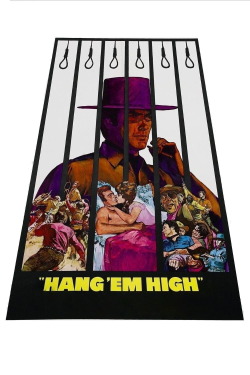
Review of Hang 'em High (1968) by Ola G — 06 Feb 2015
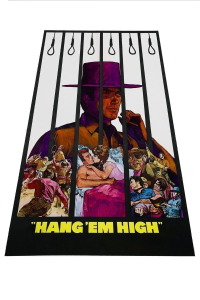
It´s the Oklahoma Territory in 1889. Jed Cooper (Clint Eastwood) drives a small herd of cattle across a stream. Suddenly a posse containing of Captain Wilson (Ed Begley), Reno (Joseph Sirola), Miller (Bruce Dern), Jenkins (Bob Steele), Matt Stone (Alan Hale, Jr.), Charlie Blackfoot (Ned Romero), Maddow (Russell Thorson), Tommy (Jonathan Lippe) and Loomis (L. Q. Jones) surround him and accuse him of having stolen the herd. He shows them a receipt for the cattle, but the man he bought them from was a rustler who killed the herd's owners. Cooper explains that he knew nothing about the murder, but only Jenkins expresses doubts about his guilt. After Reno takes Cooper's saddle and Miller takes his wallet, the men hang him from a tree and ride away, leaving him for dead. Federal Marshal Dave Bliss (Ben Johnson) sees Cooper in the distance and cuts him down while he is still alive. Bliss puts him in irons and takes him to Fort Grant, where the territorial judge, Adam Fenton (Pat Hingle), determines that Cooper is innocent, sets him free and warns him not to become a vigilante. He then shows Cooper the man who is responsible for the crime he was accused of. The man, Mcloud, is immediately hung for the murders and rustling. As an alternative, Fenton offers Cooper, a former lawman, the badge of a Deputy U.S. Marshal. Cooper accepts, and Fenton warns him not to kill the men who lynched him. During his first assignment as a marshal, Cooper sees his saddle on a horse in front of a small-town saloon. He finds Reno inside and tries to arrest him, but Reno reaches for his gun, forcing Cooper to shoot him dead. When word of this becomes public, Jenkins turns himself in and provides the names of the rest of the hanging posse. Cooper is determined to hunt down his lynchers and bring them to justice in any which way...
"Hang 'Em High" is a 1968 American Revisionist Western film and the first film produced by Clint Eastwood's Malpaso Company. The Revisionist Western, Modern Western or Anti-Western traces to the mid 1960s and early 1970s as a subgenre of the Western movie. Some post-WWII Western films began to question the ideals and style of the traditional Western. Elements include a darker, more cynical tone, with focus on the lawlessness of the time period, favouring realism over romanticism. Anti-heroes are still common, but with stronger roles for women and more-sympathetic portrayal of Native Americans and Mexicans. Regarding power and authority, these depictions favour critical views of big business, the American government, masculine figures (including the military and their policies), and a turn to greater historical authenticity. The film became a major success after release in July 1968, and with an opening day revenue of $5,241 in Baltimore alone, it became the biggest United Artists opening in history, exceeding all of the James Bond films at that time. It debuted at number five on Variety?' s weekly survey of top films and had made its money back within two weeks of screening. It eventually grossed $6.8 million in the U.S. It was widely praised by critics, including Arthur Winsten of the New York Post, who described "Hang 'Em High" as "a Western of quality, courage, danger and excitement". Variety gave the film a negative review, calling it "a poor American-made imitation of a poor Italian-made imitation of an American-made western". "Hang 'Em High" is yet another revenge themed western amongst Clint Eastwood´s film catalogue, and in one way nothing new except maybe the cynical look on the law and justice. In general it´s an ok western with interesting point of views on justice and vigilantism, but yet there´s nothing that really stands out or that truly engage you. Not one of Clint Eastwood´s best in my opinion.
This review of Hang 'em High (1968) was written by Ola G on 06 Feb 2015.
Hang 'em High has generally received positive reviews.
Was this review helpful?