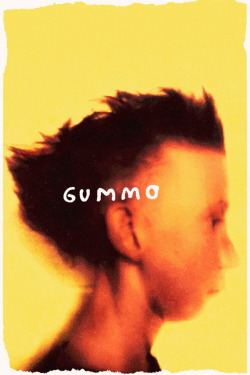
Review of Gummo (1997) by Wendy S — 03 May 2011
The nothingness of nothing, the meaninglessness of conformism and the ennui of existence. Sounds like the last thing for a film to be made about, right? But then there is "Gummo", a film that tackled it with such surreal handling and awkward story-telling (that mirrors the film's essentially subversive yet minimalist approach) that, although how polarizing it can be, has shared such an abstract yet endlessly intriguing piece of mind out of some trashed and dilapidated obscurity.
The film, although revolving itself around different misadventures of the tornado-stricken town's (Xenia, Ohio) juvenile inhabitants and seemingly at ease with its own lack of direction, its focus rests deeply upon friends/partners in crime Solomon (Jacob Reynolds) and Tummler (Nick Sutton) and their several miscellaneous exploits and small transgressions. But then, although they were the ones that were chiefly followed all throughout, the ADD of the camera is still evident, so why is that?
'That's what it needs', Director Harmony Korine may and could have said regarding Gummo's visual and narrative style. No, not just because of glorified 'pretense'; that's too vague and generalized a word. But because it complements its characters' urban journey into whatnots and wherever perfectly. It dared to observe this psychologically chaotic state brought forth by a natural disaster (though I think the film is not about its traumatizing effects) with a certain amoral viewpoint.
Now, I'm almost halfway done with my review yet I still haven't written anything about what the film is really all about aside from all those pseudo-nihilistic themes mentioned in the very first sentence. But here we go, a piece of my mind.
(SPOILERS).
I look upon "Gummo" not as a film dealing with the devastating after-effects of a catastrophic tragedy but as a sharply satiric, yet thematically contrasting piece of work about the endpoint of human entropy. Throughout the film, we see the people punching each other (genuinely), wrecking inanimate tables and chairs, and even spouting 'hate' racial statements. As we adjust into the film's confused perspective, we realize it's their way of life.
At first look, it's really hard to notice anything even remotely profound about the whole film, but digging deeper enough, I even found the 'feline torture fixation' prevalent in the teenagers' (especially Solomon and Tummler) set of daily activities a surprising symbolism.
The cats are the representations of an 'orderly' life. There's one scene where Tummler is about to shoot a black cat, only to be hindered by Solomon, telling him that it's a 'house cat'. The cat then ran inside the house. It was revealed that it's owners are three sisters that, although having some shares of personal eccentricities of their own, lives a considerably simple and 'ordered' life.
Considering that many of the juvenile characters are into killing cats, it's quite given that from their absurd preferences such as that, their lives are therefore rendered directionless due to their astute destruction of the 'guardians of homes' (an Ancient Roman symbol for felines).
Then after some time, the sisters lost the black cat. They printed out fliers to distribute to people in hopes of finding the animal. The next thing they know, they were sexually harassed (unsuccessfully) by an old man in a car. Yes, the deed was prevented, but it was a shape of things to come.
The next thing we see, the two of the three sisters are in a pool, amidst a rain, kissing with the Bunny Boy (played by Jacob Sewell, another significant character whose place in the film is really very unclear), on the way for a potential menage a trois. After that, there's Solomon and Tummler staring at the said 'missing' animal with cocked cap guns. They then shot the 'black' cat dead.
Then in the film's most haunting moment, the Bunny Boy ran through a shrubbery, into the camera, and, without emotions whatsoever, shows the dead 'black' cat. Like a leader of a cult he seems to be, the Bunny Boy, in victory, shows the animal as if proclaiming another conquest. It shows, through the loss and death of the cat, that the said conquest was indeed the three sisters, subconsciously convinced into the free-for-all ride into constant nihilism.
I also like how "Gummo" has able to convey in utter simplicity, the sheer innocence of the mentally disabled, especially the scene of the 'challenged' woman near the end speaking about how she always loved to put her dolls and toys 'straightened out' because 'she takes care of them'.
Because of her lack of idea of the psychological milieu around her, she lives an 'orderly' life, fully suggested by how she sings the ever-organized 'ABC' song near the beginning. And even after all of the displayed random acts of the film's characters whose minds and emotions are in askew, doing things for nothing as they head for endless perplexities to waste away, the woman sings 'Jesus Loves Me" as she calmly lies in her bed for a peaceful sleep.
"Gummo". Started rough, ragged and tasteless, ended as a simple, underlying embrace to the saying 'ignorance is bliss'. As her song lingers into the end credits, a heavy metal music suddenly interrupted it; we're back into reality.
This review of Gummo (1997) was written by Wendy S on 03 May 2011.
Gummo has generally received mixed reviews.
Was this review helpful?