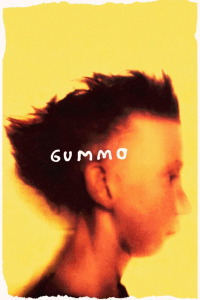
Review of Gummo (1997) by Trevor%20 G — 08 Nov 2017
Gummo is a 1997 film directed and written by Harmony Korine. It was also Korine's first feature film. The film was produced by Independent Pictures with a budget of 1.3 million dollars and was filmed in Nashville, Tennessee although the picture is set in the small town of Xenia, Ohio. The film does not follow a particular narrative trajectory and does not end in any conclusive way. It follows the everyday life of two uneducated and poverty stricken boys through a series of lo fi 'home recording' esque clips. Aside from these two boys it also follows two blonde bombshell sisters and their exploration of self and sexuality, a lost cause rabbit boy, twin brothers who murdered their parents, and a multitude of abnormal families. The beauty of Gummo stems from the absorption of the audience into the lives of these working class characters without patronizing or romanticizing their unrealized disconnect with modern and civilized society. It offers up an alternate way of life within our reality and forces you to observe and think upon it critically and without any specific direction or path. Harmony Korine employs a variety of tactics and concepts to assist him with his vision manifested within the film. Those concepts include friction of sensory aids to symbolize the disconnect within the character's relationships, the use of simple film medium to convey the character's simple lifestyles, and finally the appearance of Harmony Korine himself within the film.
First, I will be analyzing the friction of sensory aids to symbolize the disconnect within the character's relationships. For example, a girl is recollecting her past through storytelling. She speaks about how the men in her family would get home from work and go into her room and lay on top of her. While they would lay on top of her they would tell her that they are not there to hurt her and they are only there to make her feel good. They would rape her. She also talks about how she had consistent and ongoing sexual relationships with the men in her family behind her mom's and sister's back. While this voice over is playing in the background innocent visuals of the family would play. The family would be shown eating dinner or sitting out on the front porch, they appear happy.
This concept is very disturbing because of the contrast between dark and light, good and bad. The story that the girl is telling is morbid and disgusting while the visual is happy and joyous. There is an ever apparent contrast between Korine's style and modern film's style. Korine contrasts the two elements while most of the time modern film complements the auditory aid with the visual aid. Korine bashes the two together to create friction while modern film makes these elements harmonious. This element contributes to the overall takeaway from the film in a prime fashion. It creates discomfort and confusion, it pushes you away from the norm and that is what this film is all about.
Next, I will be analyzing the use of simple film medium to convey the character's simple lifestyles. For example, the two main characters, Solomon and Tummler, are riding bikes down the street. A very simple activity, right? This is conveyed to the audience through a very simple filming style. Actually, the most known and simple film style there is, home video. Harmony Korine films the whole experience through home video to simplify the film's premise. He wanted to convey life of the characters as simple. What better way to do that than show the audience through simple and basic film medium. Aside from the use of the home video Harmony Korine is also consistent with the way he shoots the characters and their interplay. If there is something important going on with a character the camera will make it very obvious. The camera consistently follows the characters that are important within the moment and they do not let you take your eyes off of them. After awhile you get the sense that you are in their world and are droning around with them. There is a major contrast between Korine's tactics and modern film's tactics. There is an immense variety of filming styles within the realm of cinema and film. Modern film uses techniques that are much more complex and they leave a lot more up to the imagination. On the other hand, Korine stays humble, simple, and blunt. If he wants you to see something he will not leave any other distractions in the way. This element of film language is the prime contributor to the films premise. It draws a direct relationship with what you are seeing to what you should be thinking.
Lastly, I will be analyzing the appearance of Harmony Korine within the film. Harmony Korine does not appear as himself but as just a boy on the couch. He is only on screen for a brief time, nearly 60 seconds. He makes this time count, every last second. He realizes both in the film and outside of it that way he says matters. As the boy on the couch he paints us a picture of his life. He speaks of depression and anxiety. He shows us that his entire family is dead and there is no one left on this earth to love him. He is a mess and he knows it, he is ready to die on that couch. Outside of the film he inserted that information with a dual purpose. The first and most surface level purpose was to form a generalization of the character's lives. He shows himself as average and the audience is left to believe that his circumstance is normal. The second and more cryptic purpose was to satirically comment on his life and the reality he is surrounded with. He is a cynic with a message and he purposefully let it bleed into the film. In modern film this is not seen often, except from the likes of Quentin tarantino, who accomplishes this feat with elegance and grace. The use of this concept is very important within two spheres. The world of this film and within Harmony Korine's world. Without this important moment in the film it would be impossible for the audience to tie the connection between Korine's reality and his message that he attempts to speak through the film.
To the plain eye Gummo seems to be simple in substance and it is very easy to understand. Harmony Korine ingeniously sneaks covert and sublime messages and symbolism into this film to build its cryptic and conceptual value. After each watch you understand more. You understand more about the character interplay, Harmony Korine, and the scene and movement Harmony Korine is the prestige of. After each watch and reflection you uncover more understanding of the world within the film and Korine's world outside the film. The film seems so surface level at first but with more thought and reflection it blossoms into something much more sophisticated. In Gummo Harmony Korine wields a double edged sword by being simple yet sophisticated. His art will be dissected and analyzed critically for years to come.
This review of Gummo (1997) was written by Trevor%20 G on 08 Nov 2017.
Gummo has generally received mixed reviews.
Was this review helpful?