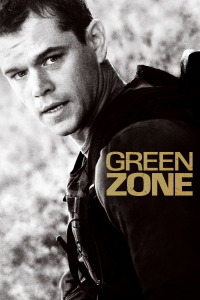
Review of Green Zone (2010) by Wayne T — 11 Jun 2015
Although the Bourne trilogy gave me mixed feelings, Green Zone had a concept which interested me.
The only reason that I knew of what the titular Green Zone was came from a small section about Chris Kyle's experiences in his autobiography American Sniper, and even then my recollection of precisely what that was proved to be vague. Many viewers are likely to go into Green Zone not even knowing the little piece of information I maintained before seeing the film, and because of that the experience can be confusing if you're not an American viewer who has been hit over the head repeatedly with knowledge regarding the invasion of Iraq. As an Australian, I am limited in my knowledge. Green Zone did not prove to do anything regarding educating me on what the situation was, rather it just throws audiences straight into the game and expects them to be updated on all the rules. The fact is that I was not.
With the lack of story context, Green Zone just gets all the more confusing when it becomes apparent that there is an abundance of characters to keep up with. So many of them are just meaningless supporting characters whose contributions to the story are ultimately so minimal that they become forgettable. Yet it is harder to remember what is actually happening than to forget them because so many just keep getting thrown at the audience while they attempt to decipher the narrative. But after a while, the slow politics and abundance of talking in the film becomes dull due to a lack of emotional involvement, a genuine sense of familiarity and an excess of characters which ultimately blunts the potential impact of the story. The problem is that Green Zone fails to balance its accomplished action scenes with sufficient storytelling, and as a result the film falls into the category of being a rather slow and unfocused political thriller which disguises itself as an action thriller with a massive budget. Frankly, the film does not justify the spending of $100 million or even really feel like a film which should have cost that much. American Sniper, Zero Dark Thirty and The Hurt Locker all told superior stories on budgets significantly smaller with each being smaller than the last, yet Green Zone tells such a scattered and unfocused tale composed predominantly of extensive, repetitive, slow and dull dialogue sequences with sporadic moments of intense action. The story in Green Zoen really bored me so much that by halfway through I felt like I had sat through far more than a mere hour of the film and was considering turning it off. But I hung on to maintain the credibility of a good critic and in the hope that perhaps the story would turn itself around at some point or at least have an awesome action finale. Unfortunately, Green Zone was consistent as a dull film and is hardly one I would find myself recommending to anyone.
But I will say that there are small aspects of the film I will give director Paul Greengrass praise for.
After directing the Bourne trilogy, Paul Greengrass really ups the scale for Green Zone which is effective in an action sense. Though he still has a lot to learn about narrative coherence, Paul Greengrass makes a meaningful contribution to the film on a technical level. With $100 million under his belt, Paul Greengrass is able to effectively male Green Zone a convincing story by capitalising on some high profile scenery, production design and costumes. Everything is filmed with powerful cinematography which captures both the large scale of events and the intense mood of things. The use of shakycam is not excessive but rather is moderated well and proves intensively realistic in this film. It comes into play most notable during the action scenes of the film. As a means of establishing a sense of realism in Green Zone, the shaky nature of the cinematography lets the film maintain a rather documentary feel at times. Occasionally, the lighting may be a little dark, but aside from that the cinematography is really on point well in Green Zone. The editing is good as well because it is intentionally a little rough to reinforce the edgy nature of the war but not to the point that it is impossible to comprehend what is going on. Green Zone serves as an exercise in improved action from Paul Greengrass, and so it's a step in the right direction for him in terms of action even if it is at the expense of storytelling.
And though the script smothers the actors beneath cliches and archetypes, they manage to pull through even if the individual results do not prove all that transcendent.
Matt Damon, like every cast member in Green Zone, is reduced to portraying a heavily archetypal character and as a result can only do so much with the role. But as part of the story's lack of character, there is a sense that he is playing an unknown soldier which is unintentionally effective for the narrative in parts. Ultimately, he steps up his physical game for the film and plays a strong action hero on an all new level this time. He is consistent with the part without reducing the role to an over the top action hero and plays the character with a sense of simplistic restraint, so he is decent enough to pass.
The most notable of the non-soldier characters are Greg Kinnear and Brendan Gleeson. Both of them approach their roles with a firm sense of understanding for the dialogue and speak with intense passion, and though it may be difficult for the audience to make sense of what they talk about, there is no denying that they truly exercise an effective understanding of it themselves.
So Green Zone boasts some entertaining action scenes, but what few there are prove to be buried beneath a surplus of confusing and dull dialogue sequences which quickly turn Green Zone slow, dull, repetitive and confusing without justifying anyone with any sort of explanation.
This review of Green Zone (2010) was written by Wayne T on 11 Jun 2015.
Green Zone has generally received positive reviews.
Was this review helpful?