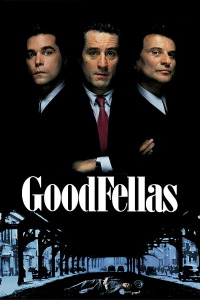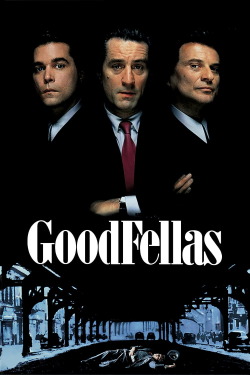
Review of GoodFellas (1990) by Mark W — 01 May 2018
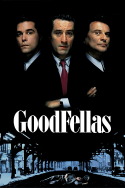
Such is the impact that they've had on popular culture, it never comes as a surprise to hear Francis Ford Coppola's The Godfather and The Godfather part II mentioned whenever the mob movie is being discussed. Not only are they synonymous with the sub-genre but they're also widely regarded as two of the best films ever made. Few films have come close to ever stealing their thunder but if there was one that has the potential to pop a couple in the back of their heads, it would be Martin Scorsese's Goodfellas which expanded on (and complimented) Coppola's films by providing a fascinating insight into the day-to-day machinations and the allure of mob life from a more personal point of view.
Plot: Based on the novel Wiseguy by Nicholas Pileggi about the real life story of Henry Hill (Ray Liotta) - a low level New York mafia member who turned F.B.I informant. We're shown his life from childhood, his induction to the local 'family', and his subsequent rise in status alongside pivotal figures Jimmy Conway (Robert DeNiro) and Tommy DeVito (Joe Pesci). Then it all starts to go wrong as Henry gets involved with drug dealing and loses the trust of his partners in crime.
What more can you say about Goodfellas that hasn't been said already? This is such a cinematic classic that it's been reviewed and dissected while topping numerous polls and lists throughout the years since it's release. Those who may not have seen the film are still, at the very least, aware of it and the impact it's had on the genre and other directors. It's arguably Scorsese's strongest and most iconic work and is responsible for influencing a new generation of filmmakers who, to this day, are regarded as some of the best of recent times; Quentin Tarantino borrowed heavily with its eclectic use of songs on the soundtrack, playing them out to sudden bursts of violence and Paul Thomas Anderson has emulated its long tracking shots while introducing numerous characters within the story. These are just a couple of notable directors that have so obviously learned from Scorsese's expertise. That said, Scorsese himself had already trialed these approaches in his 1974 masterpiece Mean Streets but it's Goodfellas where he honed these techniques to perfection and it's this film that often takes the kudos.
When you look back at Goodfellas, it's easy to take it for granted. Many of the stylistic flourishes are now par for the course but Scorsese was majestically showcasing the technical possibilities of his craft; There are flash cuts, freeze frames, crash zooms and montages, all expertly executed and aided by cinematographer Michael Ballhaus and edited with consummate skill by Thelma Schoonmaker - which make a huge and important contribution to the pace and vibrancy of the film. There is rarely a moment when the camera is static and it's this very approach that's required for, not only the plot to move at a brisk pace, but for us as viewers to feel involved in the events. In true pugilist style, Scorsese bobs and weaves through the lives of the characters which brings a real sense of excitement and one that makes us complicit in the actions that take place. If there ever was a comparison with The Godfather's then that comparison ends in how Scorsese conducts his business here. Coppola conducted a very operatic approach where we were left as mere bystanders to the inner workings of organised crime but Scorsese takes us closer. We are no longer eavesdropping on 'what offers we can't refuse', we are strictly being informed of the code at the heart of these operations and that we should 'never rat on our friends'. It's this very personalised approach from Scorsese that allows us to feel like we are part of this world. He takes us by the the hand and literally walks us through it with the Copacabana nightclub tracking shot a sublime example that allows us to involve ourselves in this dark but glamorous existence. It may not be the extravagant wedding of The Godfather but what it is, is an insight into the more inner-working-class elements and the roles of the foot-soldiers that make the crime syndicate tick.
In achieving such a personal result, Scorsese adopted a very meticulous approach and a great attention to detail. Surprisingly, a lot of improvisation and ad-libbing where allowed in rehearsals but Scorsese done this so he could allow the cast to be free and natural and he then formed this freedom of expression into transcripts that would work in a revised script. One of the biggest examples of this was Joe Pesci's frighteningly volatile portrayal of Tommy DeVito and his "funny how" speech which was actually based on an experience that a young Pesci came across while working in a restaurant. When Pesci relayed the anecdote to Scorsese, he decided to include it in the film but didn't include the scene in the shooting script, so that Pesci's interactions would elicit genuinely surprised reactions from Ray Liotta and the supporting cast. This is just a small example of Scorsese's approach to authenticity throughout the production with his cowriter Nicholas Pileggi also using exact quotes from his discussions with the real life Henry Hill - which resulted in the key voiceover that we hear throughout the film. As always, the method work of DeNiro played a part too; it has been said that he was directly in touch with Hill as well to enquire about the mannerisms of Jimmy Burke - the inspiration behind his character Jimmy Conway. Apparently DeNiro wanted to know the minutest details right down to how Jimmy held his cigarettes and how he applied ketchup to his meals and DeNiro's also had a watch and a pinkie ring to match it every outfit he wore onscreen.
It's needless to say that Goodfellas is an ensemble piece and it's the commitment from the whole cast and crew that bring this experience together and the actors really excel across the board. Relatively unknown at this time, this was the film that essentially introduced us to the abilities of Ray Liotta. Despite him not being an established leading man, he is an absolute revelation as Henry Hill as he manages to capture the youthful naïveté of a young man caught up in the glamour and Lorraine Bracco (rightfully Oscar nominated) matches him as Karen, his equally impressionable wife who gets way in over her head. A huge portion of the film relies on these two central characters and it often surprises me that they don't get mentioned as much as they deserve. Much of the attention went to Joe Pesci and his Oscar winning portrayal of Tommy and it is, admittedly, very hard to ignore his frightening volitility whenever he's on screen. There's also strong and intensely reserved work from Paul Sorvino and DeNiro, as always, shows charismatic class in what is essentially a lesser role for him. He seems happy to take a back seat to the others but whenever he's called upon, his subtle exchanges are very powerful.
As perfect as the cast is, however, Goodfellas could have been very diffferent. Instead of Ray Liotta and Lorraine Bracco we might have had Tom Cruise and Madonna - who were at one point considered. DeNiro could so easily have had Pesci's part but choose to step back and Al Pacino was offered DeNiro's role. Pacino foolishly turned it down for fear of being type-cast and it's a decision that he now openly regrets but when you consider these options the film could have looked quite different. As it stands, though, the entire cast are first-rate and no one puts a foot wrong.
Scorsese is on comfortable ground with Goodfellas and it shows. A tour de force crime film that never let's up and boasts career highs for most involved. The comparisons within the genre will forever rage on but one critic was certain from a very early stage. To quote the late Roger Ebert "no finer film has ever been made about organized crime, not even The Godfather". Many will agree and it certainly ranks as one of director Martin Scorsese's finest moments. This holds its own in any (and every) capacity and, to put it simply, it's a cinematic masterpiece.
Mark Walker.
This review of GoodFellas (1990) was written by Mark W on 01 May 2018.
GoodFellas has generally received very positive reviews.
Was this review helpful?