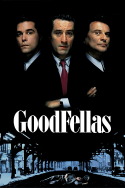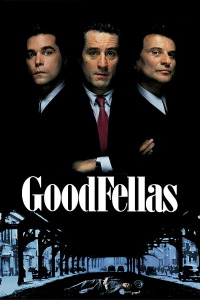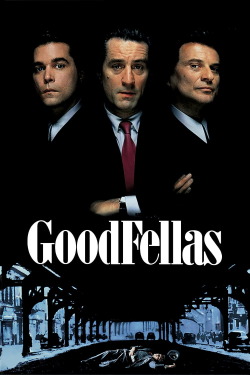
Review of GoodFellas (1990) by Moviemastered — 22 Mar 2016
Almost every filmmaker in the history of cinema would be thrilled by the knowledge that a feature of his (or hers) is considered an undisputed classic - a benchmark by which other, similarly themed movies are judged. Director Martin Scorsese, considered by many to be the finest American film craftsman working today, can claim a unique distinction - he has been responsible for a classic during each of the last three decades of the 20th century. In the '70s, it was Taxi Driver. In the '80s, it was Raging Bull. And in the '90s, it was Goodfellas (the most lauded, at least in terms of official awards and nominations, of the director's features). No one else, not even greats like Ingmar Bergman, Stanley Kubrick, and Eric Rohmer, can make a similar claim. With patience, care, and strict attention to detail, Scorsese has staked out an impregnable position in the history of motion pictures.
It is not a coincidence that Scorsese's three masterpieces all star Robert De Niro. These two men, who have worked together eight times, bring out the best in each other. Even their "lesser" collaborations, such as Casino and The King of Comedy, possess an energy and intensity that shows how well they understand one another. Scorsese is at his best when directing De Niro, and De Niro is at his best when being directed by Scorsese. The pair has become inextricably linked in the public consciousness because of Taxi Driver, Raging Bull, and Goodfellas.
There are essentially two kinds of Mafia movies: those that romanticize the life and those that depict it with gut-wrenching clarity. The best known and most accomplished of these films, The Godfather, stakes out its territory firmly in the first area, leaving Goodfellas to stand atop the other. Both pictures have fully realized, three dimensional characters and strong atmospheres, but Francis Ford Coppola's effort embraces the mythos of the gangster, while Scorsese's exploration is more pragmatic. Violence is a key component of each, but it is a more brutal companion in Goodfellas than in The Godfather. Clearly, the different approaches adopted by the directors result in films that, while populating the same genre, are dissimilar in temperament and tone.
Goodfellas is, as we learn at the very beginning, based (however loosely) on a true story. Developing the screenplay's skeleton from the events related in the novel Wiseguy by Nicholas Pileggi (who also co-wrote the script), Scorsese has used the facts from an infamous '80s case involving an important mob informant to develop a rich and multi-layered study of three characters and the culture that shaped their lives. It's a fascinating exploration of a lifestyle that has beguiled Americans for most of this century, whether in movies, in novels, or on television.
Oodfellas is as compelling and absorbing as any crime drama I have ever seen. The script shows all the facets of these characters; they are all fully developed individuals capable of great good and great evil. The moral ambiguity of their lifestyle is treated with a shrug. Goodfellas is not about Mafia dons, but about those who exist on a lower level. It's about the bonds that are formed between compatriots in crime, and how betrayal is the most heinous offense imaginable. The mob is a fraternity - an all-boys club where everyone looks after each other.
The story, which spans a quarter of a century, has an epic feel despite its intimate perspective. The first forty minutes, which detail Henry's childhood and his acceptance into mob life, is presented almost as a fairy tale, using the same kind of romanticized approach embraced by The Godfather. The purpose of this segment is to forge a bond between the audience and the main character while he is still relatively innocent. Henry does not grow up to be a nice man, but, because of the way Scorsese has structured the early portions of the film, we remain sympathetic to him throughout.
For character-based dramas such as Goodfellas to rise above the level of a well-crafted melodrama, strong acting is a necessity, and this movie contains several unforgettable lead performances plus solid support by those in lesser roles. The most flamboyant portrayal is turned in by Joe Pesci as the often out-of-control Tommy. Pesci won an Academy Award for his work here, crafting a character that can be charming at times and unexpectedly violent at others. (Pesci virtually replicated this part for Scorsese's Casino.) The brilliance in the performance is how easily and rapidly Tommy shifts from one mode to the other. A single minor thing - an action, a word, etc. - can set him off. Pesci makes the sudden transition seem credible rather than jarring.
Taken individually, each represents an amazing motion picture accomplishment, with Goodfellas standing alongside The Godfather as one of the two greatest mob stories told on film.
This review of GoodFellas (1990) was written by Moviemastered on 22 Mar 2016.
GoodFellas has generally received very positive reviews.
Was this review helpful?