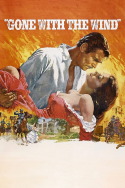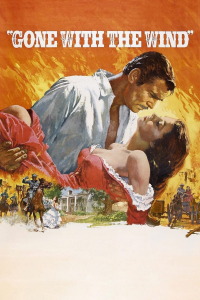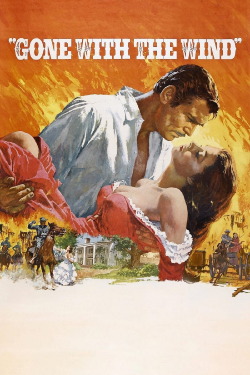
Review of Gone with the Wind (1939) by Lovely L — 09 Feb 2014
Any website or old timer could tell you that the 1939 worldwide box office smash can tell you that Gone with the Wind is one of the greatest movies in the history of cinema, and running at nearly 4 hours long it is one of the longest to receive such critical acclaim. But to truly know what it is all about and how it was so influential on culture, one must see the 8-time Academy Award winning epic historical drama for themselves.
Gone with the Wind has a first hour which drags on for a long period of time and simply sticks to the concept of love and marriage in 1861 without depicting the concept, instead of relying more on the idea of it and what it means to the characters. But the scenes just feel melodramatic and lacking in reaching what they really should be. Gone with the Wind doesn't emphasise the drama, and even though I later saw this as a depiction of what life in the context of Scarlett O'Hara's was before being dragged into the drama of the civil war, I found that in contrast to the succeeding almost 3 hours of the film, its first hour was merely a stretched start-up for what Gone with the Wind went on to truly become.
Certain elements of Gone with the Wind haven't aged as well as others, such as the pace, the length and the dramatic theme of the first hour. And as the film varies between types of drama, it may prove a bit too much for some viewers experiencing all this over a very long timeframe. The less patient viewers are likely to be gone before the wind has blown, so its important to remember that Gone with the Wind has an inconsistent but predominantly slow pace, and is a very long epic.
It's almost hard to believe that Gone with the Wind isn't actually happening, because it is so impeccably convincing since it has erratic passion in the heart of the filmmakers and utter dedication to detail from the actors. It feels genuine and therefore captures the real drama that comes with the story and how it touches on romance, slavery and the civil war. And under direction from Victor Fleming, it is brought to life excellently.
Gone with the Wind is one of the most memorable visual experiences for a film from as far back as the 1930's because it succeeds as a serious visual treat as well as in many other areas. Never failing to hit the epic scale that the film reaches for, Gone with the Wind is a cinematic breakthrough which features unforgettable imagery, shot on excellent locations with stunningly beautiful cinematography and an immaculate combination of skilled production design and fine costumes. And it just goes to show how skilful Victor Fleming is at telling the story.
One thing is that the style of the film makes the dramatic elements of the film seem more natural to fit into the context of the time where they would be more socially acceptable. Two examples are the scene depicting marital rape and the concept of slavery. Neither are really emphasised as being horrific but aren't exactly glamourised either, but rather put on display as being socially acceptable elements of the 1860's timeframe. It's rather shocking today, but if you look at it in the appropriate context it's more possible to understand.
And the musical score in Gone with the Wind is absolutely beautiful. It's a gripping and atmospheric to the true heart of the film, as well as proving to have a strong depiction of the scale of the film, since the score has a true epic feel to it. So as a technical achievement, Gone with the Wind is a massive success.
Also, the script is intelligent and very sophisticated, and is memorable for featuring one of the greatest lines in cinematic history, the moment when Rhett Butler utters the line "Frankly my dear, I don't give a damn." as it proves to display a dramatic end to all of the drama that has built up to it, and Clarke Gable delivers it perfectly by saying it in a sophisticated manner without going overboard or lowering the quality of the character he has worked to hard to create and characterise. It's extremely memorable. And also, the final line in the film "After all, tomorrow is another day" is one of the most important lines in cinematic history, because it reminds the audience that while the movie is over, the story is not. While the film ends on a sad note, it has an optimistic undertone for what the future could hold. But it confirms nothing and leaves the audience to predict what comes next, making it an open-ended film.
What makes the script so effective and the film to be of such great calibre boils down largely to the talents of the actors.
Vivien Leigh manages to grip the character Scarlett O'Hara perfectly throughout the entire journey taken in Gone with the Wind and over the course of 224 minutes of cinema, viewers witness what it is for an actress to truly develop a character. Scarlett O'Hara encounters and deals with so much in her life, and Vivien Leigh makes it all feel genuine and brings the character into a world of dramatic realism without being melodramatic or excessive, even if at times it may feel like she borders on it. Vivien Leigh is an all too memorable actress thanks to her work in Gone with the Wind.
Clark Gable is a perfectly charming lead in the role of Rhett Butler. The role is a challenge because the character experiences a lot of drama without ever dropping his level of sophistication, maintaining plenty of class the whole time but still managing to deliver believable dramatic emotion. Clark Gable completely nails that and delivers a classical performance with plenty of power and a flawless characterisation of Rhett Butler, solidifying him as a great movie character.
And Hattie McDaniel's performance is a breakthrough for African Americans in cinema. Her performance as Mammy is a determined and strong one with so much passion in it that she renders herself forgettable as an African American and more memorable simply as a great actress. She has some moments where she just steals the screen, and she is a seriously genial presence in Gone with the Wind which just makes it all the more satisfying.
Olivia de Havilland also manages to give a seriously strong performance as well in which she shares a strong chemistry with Vivien Leigh and maintains plenty of charismatic work with her line delivery.
Frankly, it's easy to see why Gone with the Wind is such a classic. And if you can get past its length and its pace, you can find yourself enjoying an excellently acted visual experience.
This review of Gone with the Wind (1939) was written by Lovely L on 09 Feb 2014.
Gone with the Wind has generally received very positive reviews.
Was this review helpful?