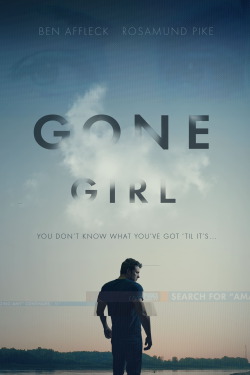
Review of Gone Girl (2014) by Nightreviews — 06 Oct 2014
“Everyone told us and told us, marriage is hard work”.
Gone Girl is the one film that will embed itself permanently in your psyche. A bold statement, to say the least, but it is the only statement that comes close to describing the frightening physiological paradigm created by suspense maestro Divid Fincher. Emotionally charged, disturbed and at times simply terrifying, Fincher’s analysis of what can go wrong with contemporary marriage is the ultimate battle of the sexes and search for answers; whether right, wrong, or completely unexpected.
An adaption of the widely sought-after 2012 novel by Gillian Flynn, Gone Girl paints a bloody portrait of battle between husband and wife Nick and Amy Dunne (Ben Affleck and Rosamund Pike) that asks the question asked by many who’ve had a relationship fall apart before their eyes: how much do you really know about your partner?
Contrary to its appearance courtesy of the narratively manipulating and heavily contrived editing and fragmented storytelling, the real issues in Nick and Amy’s marriage begin long before either of them even meet. Amy, who is introduced as the atypical yet very real trust-fund baby, lives most of her life steps behind her fictional alter-ego “Amazing Amy”, a character in a children’s series authored by her parents, Rand and Marybeth Elliot (David Clennon and Lisa Banes). Nick (Affleck) may very well portray himself as the perfect man. A writer for a men’s magazine, Nick finds himself at a yuppie party in the lower-east side of Manhattan before bumping into Amy, where he charms his way into her heart by confessing how he thought quinoa was a type of fish. The two depart the party where Nick leads Amy behind a bakery, the air glistening with sugar flakes, until the moment he kisses the specs of refined white power off her lips, the two perfect lovers fall in love.
But like everything that seems too good too be true, their magic doesn’t last. Both suffering in their relationship from the failed American economy and Nick’s ailing mother, Nick must pick-up his picturesque wife and life in urban New York City, and relocate to his Mid-Western hometown of North Carthage, Missouri. With the passing of Nick’s mother and his father’s admittance to the local nursing home for treatment of his Alzheimer’s, the couple is burdened with financial woes, prompting Nick and his quick-mouthed twin sister Margo (the fantastic Carrie Coon) to open a bar, perfectly named ‘The Bar’. Coming home to Amy for their fifth wedding anniversary, Nick drives into his perfect “McMansion” home and ideal wife, only to find the cat on the driveway, a wide opened front door, and Amy no-where in sight.
While many will spoil so much of what the film has to offer, it is best you go into it with a completely untainted opinion regardless if you’ve read the novel or not. Fincher and Flynn offer a completely revitalized reincarnation of Flynn’s novel with many layers, twists and turns, and most of all questions.
Fincher has given himself quite the reputation as a noble successor to Hitchcock, mastering the art of Hitchcockian thrillers and suspense. From Fight Club, to his highly stylized American interpretation of The Girl With The Dragon Tattoo, Fincher has become the most consistent American director working today. Staying true to his ominous and truly septic vision, faithfully collaborating with editor Kirk Baxter, cinematographer Jeff Cronenweth and music with Oscar winners Atticus Ross and Trent Reznor, Fincher is a meticulously relevant cinematic auteur who knows how to deliver in a tonal, visual, and deep subliminal forum that has quickly become his signature. Trying to ignore big set pieces, he goes to the most basic scenes in all films: two people seated in a room having a conversation. Fincher’s greatest cinematic tool is his focus on information, buried in the revelations between characters and their conflicts expressed in their dialogue. Exposition is his greatest asset, with drama driven by audience reaction to a character’s divulgence of new information—and Gone Girl is a testament to this.
While Gone Girl becomes the most sadistic cinematic version of he-said/she-said outside the walls of a courtroom, the film is pillared perfectly by its cast as well as its crew. Ben Affleck’s interpretation of Nick Dunne draws fine lines of empathy and calmness, as well as unhappiness and deception for his wife and the people in his mundane, quickly shattering life. Nick’s character, charming throughout the first act of the film, like any other man, shares his concerns about marital life, self-image, and the mistakes he makes as a man and as a husband. Affleck has never been better; yet, the next Caped Crusader isn’t the true runaway star of Gone Girl.
This review of Gone Girl (2014) was written by Nightreviews on 06 Oct 2014.
Gone Girl has generally received very positive reviews.
Was this review helpful?