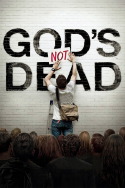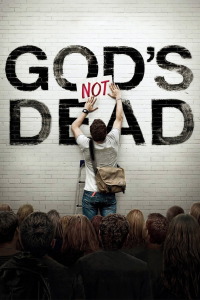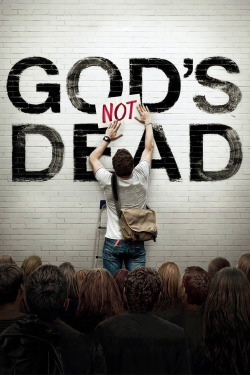
Review of God's Not Dead (2014) by Nathan L — 02 May 2016
This is a poorly crafted Christian propaganda film aimed at an uninformed and disenfranchised audience.
The film quickly launches into its primary plot with a silly scenario: A philosophy professor requires his students to either unanimously sign a statement proclaiming god is dead or suffer a scholastic backlash. The protagonist, Josh Wheaton, of course won't go along with such academic bullying.
The rather unlikely events in that scene set up the philosophical conflict that will dominate the movie. But it does more: It puts the audience on notice that this film's POV is in large part an anti-intellectual one, even as it sets up what is supposed to be an academic debate about the existence of god. The lens the movie views academia through is one of distrust and contempt. That POV is as old as the Christian canon itself, or at least as old as the Christian additions to that otherwise Hebrew canon.
In the New Testament, the knowledge and wisdom of humans often are unflatteringly juxtaposed with belief in a Christian god and the spiritual wisdom attained therefrom. This is not surprising. Early Christians on the whole were a lowly lot -- commoners with no access to education. Celsus, for example, described 2nd century Christians as follows: "They manifestly show that they desire and are able to gain over only the silly, and the mean, and the stupid, with women and children.".
Of course Celsus was engaging in a polemic and overstating his case. The writers of the NT often demonstrate a high degree of education in their texts. And while, except in the case of Paul's genuine letters (about half of those claiming his authorship in the Christian canon), we do not know who those writers were, we know they were educated if not honest. Most of those texts were either forged under the names of important early Christians or written anonymously and later falsely ascribed to such early Christians. But we also know their target audience on the whole was the uneducated class of whom Celsus wrote, as so many ancients were.
So surely stories such as the one contained in Acts 4 of the "illiterate (agrammatos) and ignorant (idiotes)" Peter and John befuddling the collective human wisdom and authority of the elite Sanhedrin must have resonated with most early Christians, who no doubt could easily envision themselves in the shoes of those two uneducated apostles as they relied not on worldly letters but on spiritual power and wisdom to make their case before the Sanhedrin. Never mind that the anonymous author of Luke-Acts, writing around 80 or 90 A.D., couldn't have known that, within about a century of his efforts, seven sometimes very sophisticated Greek texts would be either falsely attributed to or forged under the names of those two "illiterate and ignorant" apostles and subsequently canonized, thus requiring later Christians to scramble for apologetics to explain how two illiterates could have written such texts. In the earliest days of Christianity, the story of the commoners, Peter and John, making fools of the socially and intellectually elite with spiritual power and wisdom must have been a welcome balm for the ears of illiterate believers and widely circulated among them even before landing in Acts 4.
And so, too, this movie must resonate with modern Christian fundamentalists, if the high rating is to be explained. Indeed, in a vein similar to the story in Acts 4, early in the film, Willie Robertson of Duck Dynasty confronts an atheist blogger and befuddles her with simple straight talk about his beliefs. Of course, for purposes of this film, Willie represents just a good ol' Bible-believin' boy relying on the force of his beliefs rather than any convoluted academics. Forget that Willie is actually a college graduate. As with so much of this film, it's not about how things are but how they seem to evangelicals toting around a Christian persecution complex and a good dose of ignorance.
Yet this movie wants to take the paradigm of the superiority of spiritual wisdom over worldly wisdom portrayed in Acts 4 and Willie's encounter a step further. It's not enough for a redneck woodsman to upstage an arrogant blogger with the courage of his convictions; the film wants to move into academia and upstage it with its own tools -- science and reason -- or so the film hopes we'll believe. As Willie's confrontation with an atheist is intended to demonstrate, Christians don't need worldly knowledge to make fools of those in the academy; but the film also wants to demonstrate through its protagonist, Josh, that Christians also can use the tools of academia to do the same thing, if only Christians can wrest those tools from the hands of atheist academics long enough to do so. In this film, it is not human knowledge that's the problem so much as it is the atheist purveyors of such knowledge, who slant it and then bully those who won't go along with their distortions. And seemingly science and logic would support fundamentalist Christian beliefs if only those atheists weren't running the academy and stacking the deck against Christians.
But to make that case, the film has to engage in a load of intellectual dishonesty. For example, it ignores the whole of ancient Hebrew cosmology in the canon to focus on a Biblical passage that, with a little coaxing, might seem in line with modern cosmology. Thus, according to the film's protagonist, god speaking light into existence in Genesis is not necessarily inconsistent with the big bang of modern science (a theory perhaps ironically first proposed by the physicist Georges Lemaitre, who also was a Catholic priest).
Unfortunately for the film, Biblical cosmology and modern scientific thinking have about as much in common as this film does with a quality movie. In the Bible, especially in its earliest parts, the world is seen as a sort of snow globe -- a flat disk sitting on a foundation and encased in a shell, a firmament (raqia). God resides on the other side of that firmament but occasionally comes down from on high to visit the world's occupants and even opens windows in the surrounding shell to pour water upon the Earth. And despite god's abode being off limits to humans in the earliest parts of the canon, men ostensibly can reach it, if only they can build a structure that is high enough. And seemingly, but for god's active intervention, they might have succeeded with the Tower of Babel.
That snow globe cosmology of the Old Testament meshes rather well with several earlier cosmologies of nearby cultures and probably is indebted to them. Similar views of the structure of the universe can be found in many early cultures in other parts of the world as well and were not limited to Near Eastern societies, though the nearby Greeks moved beyond them even as Hebrew thought continued to languish there.
That relative stagnation no doubt was due at least in part to the Hebrew god having sided in holy texts with the inferior view. Many apologists now try to paint this Biblical cosmology as a symbolic rather than a literal one. Yet with there having been so many similar belief systems rattling around in antiquity, a contrary conclusion is required, and pretending the Old Testament's view of the cosmos is poetic prose that now meshes well with modern science requires the sort of flimsy chicanery this film trades in with relish. In this regard, the film seems to be counting on the audience's ignorance not just of science but of history and Hebrew scripture as well. It's not aiming at an informed audience but an intellectually disenfranchised one that's running on the fumes of faith.
But ultimately, this movie's greatest intellectual sin, aside from bad craftsmanship at virtually all levels, is it does what too many folks in deity-based religions do: It confuses the typical arguments for a god of creation as arguments for *its* god, a Christian one, being the creator. Even some Christians would object to this confusion. For example, many Gnostic Christians view the ancient Hebrew god of creation as a different deity from the one they worship. But aside from theological spats between Christian movements about the nature of their god, the most significant problem is that proving there is a god and proving some version of the Christian god is that god are entirely different matters. They have little in common other than neither will ever happen.
I suppose most of this film's intellectual sins could be overlooked were it an otherwise well-made piece of fundamentalist feel-good cinema serving to salve the wounded believer's psyche in the same manner as the cartoonish Rambo movies salved the wounded American psyche in the 80's. But even on that level this movie should fail. Its poor acting, editing, directing and writing prevent it from earning any such pass from me. Yet such failings don't seem to have prevented it from earning the appreciation of many believing viewers. Presumably those viewers are more concerned with affirmation of their faith, no matter how simple minded or dishonest that affirmation is, than the quality of the entertainment they ingest.
I'm giving God's Not Dead a charitable one star.
This review of God's Not Dead (2014) was written by Nathan L on 02 May 2016.
God's Not Dead has generally received mixed reviews.
Was this review helpful?