Review of Fury (2014) by James H — 13 Aug 2017
Authentic Uniforms, Hollow Men.
In David Ayer's take on World War II from the point of view of the death-trap-we-call-a-tank, Fury is a tale exemplifying the theme of a world gone wrong by building up the right kind of courage in order to survive. As in most well-devised scripts in the Hollywood tradition, a core analogy is played throughout the movie. Fury takes the body of the tank and symbolizes it for a single person, with its crew standing for a spectrum from saint to sinner. The battle raging outside the cast iron shell is the hell that is life-with pain being ignored and the close schooling of courage needed to endure it. Ayer's plan was ambition and if you can look beyond the superficial explosions and unnecessary obsession with authenticity, then you can see a glaring image of contemporary American society. To my mind the film will appeal to deep-thinking undergrad students and strategic war-buffs who want to see WW II battle video games come to life.
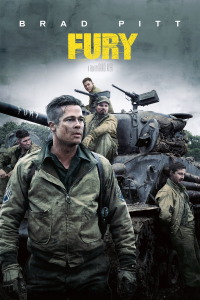
After returning from a mission that wiped out the rest of their platoon and killed their driver's assistant, Sgt. Don "Wardaddy" Collier (Brad Pitt) has his 5 crew Sherman tank tasked along with three other tanks to rescue troops who were unsuccessful in taking out two anti-tank guns camouflaged in the bush. This success brings them orders to help take over the next German town. Winning the town, one of the most interesting and suspenseful scenes of the film takes place inside an apartment above the town square. Wardaddy and cultured new recruit Norman Ellison (Logan Lerman) spend time building rapport with two attractive, classy German women. Both men receive the welcome suitable to their age-Wardaddy looks forward to the domesticity of a woman cooking for him, while Norman falls in love with a new friend. After the rest of the tank's crew arrives to spoil the peace and tenderness of the moment, Wardaddy is given orders to move out. As they begin to mount their tank, German artillery rains down on the town square blowing the apartment to rubble where Norman desperately returns to find his new girlfriend dead. It is a crushing emotional blow to Norman's life view and hardens him to hate the enemy. Moving on to their next task, the tank crew along with the two other tanks in their detachment are ambushed by the feared German "King" Tiger. It decimates the section leaving Fury the final task of overcoming the might of such a formidable opponent. Despite their losses, Wardaddy has Fury continue on with their mission. Passing a large roadside cottage, Fury runs over a mine and is proverbially "stuck in its tracks." Hoping to repair the tank, the crew is soon faced with the dilemma of engaging an oncoming platoon of crack SS troops or retreating. Overriding his principle of saving his crew over the war-lust of killing Nazis, Wardaddy takes the position to stand and fight.
The symbolic nature of each of the characters brings out the theme of building up the right kind of courage for this dystopia. Each character has their way of schooling Norman about their take on the facts of life. The unthinking, unsentimental animal Grady "Coon-Ass" Travis (Jon Bernthal), the opportunistic, selfish greed of Trini "Gordo" Garcia (Michael Pena), the spiritual Christian soldier Boyd 'Bible' Swan (Shia LaBeouf) and finally war's voice of reality and reason, Sgt. Don "Wardaddy" Collier (Brad Pitt). Although Brad Pitt is the star power in this movie, it is the character of Norman, symbolizing human conscience, who is the only dynamic character that goes through the kind of change that the experience of war impresses upon a person. It is fascinating to watch as each of these non-conscientious characters instruct and argue with Norman, the character of conscience, throughout the film. Pitt's Wardaddy is an appropriately static patriarch whose performance is right on the money. Mentoring Norman on accepting the credo war is hell and hell is life, recalls Ayer's Alonzo Harris from Training Day. Ayer seems to be telling us that America in the 2010s is an unforgiving culture where a person of conscience must shoulder the pain if they hope to go on living.
David Ayer went out of his way to ensure the physical authenticity of the story, down to the vehicles and clothing being vintage WW II. The old adage seems to fit here: "If the story doesn't say much, compliment the scenery." If the production pushed for Lerman's character of Norman as the diamond in the rough that outshines all the soulless crew member of Fury, they may have had an authentically staged and authentically felt experience of WW II that surviving veterans would have been proud to applaud. Instead we find a director that has not found an answer to his own riddle. Maybe a little bit of reworking of LaBeouf's 'Bible' character would have brought out an effective-if not spiritual-then at least an effective mystic ending. The audience does not care for a movie to simply end; they need the mystery of dramatic revelation.
David Ayer's film is not for veterans but for the youth of today. The analogy of the characters in Fury is the same as the one in his urban American city streets films such as Training Day. It seems that Ayer is continuing to deal with the insidious root of evil in those figures society ends up calling "heroes". And it seems Ayer still needs to take a better look at society. Nevertheless, the usual themes of war is hell and courage broadside this film going experience, yet the deeper story of the helplessness and vulnerability of Lerman's character ought to have been drawn out to bring the film to true cinematic height and a balanced closure. Perhaps Ayer's focus on the violence of men yet has but to discover and craft the unspoken vulnerability of men into his oeuvre. The beauty of cinema is its ability to demonstrate; thus, a man in war is his attempt to shield his vulnerability at every moment. My hat goes off to Brad Pitt for employing the defence of his character's vulnerability in especially the breakfast scene with the two proper German ladies. But it may not be for another number of films before Ayer acknowledges such dramatic possibilities to bring it to the audience via the characters-authentically-through drama. Again, a good movie for deep thinking undergrads and video game WW II strategy buffs.
This review of Fury (2014) was written by James H on 13 Aug 2017.
Fury has generally received positive reviews.
Was this review helpful?