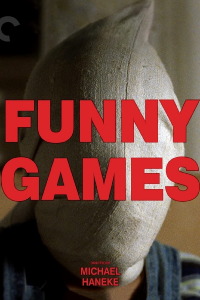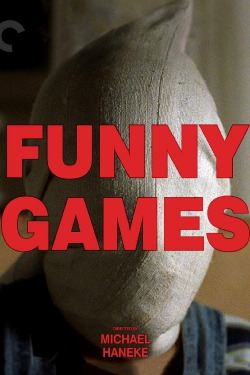
Review of Funny Games (1997) by Ian D — 07 Jul 2008
"My films are intended as polemical statements against the American 'barrel down' cinema and its dis-empowerment of the spectator. They are an appeal for a cinema of insistent questions instead of false answers, for clarifying distance in place of violating closeness, for provocation and dialogue instead of consumption and consensus.".
No other words could paint as accurate a picture of Michael Haneke. If you're a Hollywood junkie, look away now. Haneke doesn't suffer fools gladly, and in his opinion Hollywood is rammed full of them. This is the kind of attitude that has both endeared him to people of the same persuasion and made it all but impossible for his films to be widely accessible in the film capital of the world. Does this bother him? Not one bit. Why would it when to date his films have earned 5 wins and a further 4 nominations at Cannes? If anything it could be argued that America is missing out...
In any case, the way things are is the way that Haneke wants them to be. Until recently the Austrian showed no interest whatsoever in working in America and when he did decide to do so it was most definitely on his own terms. The result of Haneke's first foray into American film production was in fact a shot-for-shot remake of his 1997 film 'Funny Games' - hardly a typical debut. In this review I am going to talk predominantly about the original film, but even though it may seem a little pointless to go and see 'Funny Games U.S.' after experiencing the original German language film I would highly recommend it. A lot of people think that it is better.
Personally I see very little difference between the two and I believe that this is a product of soundly understanding Haneke's intentions in remaking his best known film. Haneke often includes acts of violence as a principal device in forwarding the narrative of his films. A criticism that I will never in my life accept as being deserved is that his films are gratuitous in their depiction of this violence. There are reasons for this; firstly the violence often takes either completely off-screen or just out of shot. Haneke realises the importance of the imagination whereas so many other directors too often revel in splashing on the fake blood. Secondly, Haneke's shooting style acts as a way to neutralise the 'Hollywood' effect and therefore presents things in a very matter-of-fact way. It's not quite point and shoot in a documentary realist sense, but there is a distinct lack of probing close ups, shot reverse shots and rapid editing for example. Due to this, the audience's reaction to the things that happen in a Michael Haneke film is completely different to what the audience feels when most other directors try to be shocking.
Haneke has frequently expressed his abhorrence at the desensitizing of audiences to violence and cites Hollywood as the driving force of this problem. I for one am not going to disagree with him, although I do not view the problem with anywhere near as much disgust because I too feel as though I have been desensitized. Haneke is one of the few directors that can portray violence in such a way that truly shocks me. 'Benny's Video', 'Funny Games' and his latest offering 'Hidden' are all films that I have found immeasurably hard to watch due to his handling of violent events and I cannot praise him highly enough for provoking such a reaction. Haneke has remade 'Funny Games' in the attempt to show American audiences' violence for what it really is; shatteringly powerful and completely unglamorous.
'Funny Games' is about a family who go on a trip to their holiday home in an affluent area by a lake, the exact location isn't given. Whilst settling in, two young men nicknamed Peter and Paul (although these names are not consistently used) arrive at the house and begin to make strange demands. Before long they start to get violent and the situation goes from uncomfortable to bad to much much worse. The two men terrorise the family by playing games with them but contrary to the film's title, these games are anything but funny; one of them is called 'whether by knife or whether by gun, losing your life can sometimes be fun'. There is not much else that can really be said about the plot - the film pays no attention to conventional storytelling technique and as a result of this often arrives at conclusions that will simply astound you. It is unbelievably tense and at times very hard to watch.
There are a few areas of interest regarding this film. The direction, which I have already touched upon, is one. Others are the issues regarding spectatorship and Haneke's fascination with the device of videotape that he frequently explores in his films.
Haneke's direction of 'Funny Games' is masterful. As I said before, there seems to be a sense of matter-of-factness about his filmmaking and this stems largely from his shot compositions. I get the impression that Haneke establishes what needs to be shown from each shot and then constructs the mise-en-scene as a painter would. Nothing ever seems cramped or clumsy; everything is neatly positioned in such a way that allows the viewer to appreciate the simplicity of what is within the frame. There is always plenty to look at - Haneke makes exquisite use of depth plains in order to establish a richness to each shot. These compositions become so important during Haneke's trademark long takes. One agonising scene unfolds before a static camera for 10 whole minutes - with each one that passes it only gets harder to watch. Despite the gruelling nature of the images on display, Haneke manages to construct each scene in a way that avoids monotony.
Perhaps the biggest talking point about the film is the way in which it involves the audience in the events that are taking place onscreen. The first time I watched the film I found this aspect of it very troubling, not necessarily because I was affected by it in the way that Haneke wanted me to be, but because I simply didn't like it. It is a strange thing when any actor breaks the '4th wall' unless you are watching a Shakespearian farce in which asides to the audience are commonplace. In a film it just doesn't work that often. Repeat viewing, however, revealed this aspect of the film to be much more than what it appears on the surface. In some ways the film is post-modern; at various points it is made clear that the two aggressors are aware that they are in a film (exactly 95 minutes in, Paul states that "we are not yet at feature film length") but it is their constant reference to the audience that best conveys the message that Haneke is trying to articulate.
I would hesitate to say, like some critics have suggested, that the audience become implicated in the atrocities committed by Peter and Paul but there is certainly an attempt by Haneke to make the audience aware that they are consumers of products that frequently endorse violence. Central to this idea is the bet that is made by Peter and Paul - the family bets that they will be alive by 9am the following morning, and the two aggressors bet that they will be dead. This is the catalyst that sets off the unstoppable torrent of violence. At various points Paul, who is clearly in charge, turns to the audience and comments on the events that are unfolding. He asks us to place our bets and teases us about being on the side of the family. At one point early on he turns his head slightly towards the camera and offers a knowing wink before one of the many crushing moments of the film.
It seems that Haneke is trying to make the audience aware of the fact that violence is a product like any other, and one that Hollywood makes a huge profit on because people want to see it. Although this may not be the way that most people think about violence in films it is clearly a truth, perhaps one that not many people are willing to admit. Whether or not Haneke will be able to successfully convey this message to the people who are least likely to admit it with his 'Funny Games U.S.' remains to be seen; I would imagine that most will treat it as a genre film and will therefore leave disappointed.
The film's most striking moment comes at a point when things don't exactly go to plan for Peter and Paul. During a lapse in concentration, Peter leaves a shotgun near to the mother of the family and she seizes her opportunity to turn the tables on her captors. In a blaze of Hollywood style action she shoots Peter only for Haneke to erase and replace the events via an unusual technique. Paul frantically searches for the television remote control and presses rewind; what next occurs is the rewinding of the action and the replaying of the scene in a way that benefits Peter and Paul. It is a very strange thing to watch but it is clear what Haneke is trying to do. At the single point where the innocent family gains the upper hand, Haneke nullifies their opportunity to escape and therefore the audience's hopes that they will do so. It is at this point that we realise that there is no chance of escape for the family and that we are watching a film markedly different to those of the Hollywood ilk.
This short sequence also perpetuates Haneke's fascination with the device of videotape which plays an integral part in both 'Benny's Video' and 'Hidden'. Haneke is fully aware of the power of the recorded image and he uses it go great effect in his films. 'Funny Games' sees the device occupy a role outside of the narrative but its presence is undeniable due to its control over the film at this point.
'Funny Games' is not the type of film that you enjoy. It is a really hard watch and at no point is it rewarding. In order to appreciate it fully it is advisable to try and understand what Haneke is attempting to say with it and view it as more than just a film. The true worth of this film lies underneath its exterior whether you buy into its message or not. At face value it is possibly one of the most depressing films I have ever seen, in no way is it entertaining. But it is magnificently constructed, infinitely interesting and well worth seeing even if you feel like the world is an awful place after you're done.
This review of Funny Games (1997) was written by Ian D on 07 Jul 2008.
Funny Games has generally received positive reviews.
Was this review helpful?