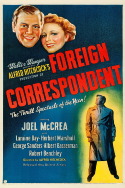
Review of Foreign Correspondent (1940) by Mel V — 07 Jun 2004
[font=Tahoma][color=#020202]Notable primarily for its bravura set pieces and Alfred Hitchcock's decision to clearly violate the rules of the then-current Neutrality Pact (which limited negative representations of Germans before the United States' entry into World War II), [i]Foreign Correspondent[/i] is a formulaic, if still enjoyable, piece of contemporary propaganda. All the key elements of the Hitchcock "wrong man" formula are in play, the spy plots, double agents, doubles, physical danger (escaped through skill, luck, and verbal dexterity, but never through violence or the threat of violence), and, of course, the romantic subplot that begins with mutual (or partial) antipathy and distrust and eventually turns into romantic love and trust.[/color][/font].
[font=Tahoma][color=#020202]An American crime reporter (apparently intended to represent naive, self-interested, and isolationist Americans), Johnny Jones (Joel McCrea), is sent to Europe by his publisher to follow a peace conference and, more importantly, a Dutch diplomat, Van Meer (Albert Basserman), who's apparently only one of two men to know the content of a secret clause (Clause 27) in a peace treaty between the Dutch and the Belgians. The secret clause is the formulaic MacGuffin, the plot device that drives the narrative as the object of desire for either the protagonist or the antagonist, but that is ultimately left unrevealed, or only revealed in a superficial manner. Jones, renamed Huntley Haverstock by his publisher, who's keen on impressing Europeans with a more distinguished name for his reporter, naturally stumbles into a spy ring on English and Dutch soil (operated by German agents), a kidnapping, an assassination attempt, and, typical for the genre, underground Fifth Columnists plotting to subvert the peace conference and force Europe into war. [/color][/font].
[font=Tahoma][color=#020202]In [/color][color=#020202]London[/color][color=#020202], Jones encounters several characters that will play pivotal roles in both his character development and in the plot's resolution: Stephen Fisher (Herbert Marshall), leader of the Universal Peace Party, his daughter, Carol (Laraine Day), and another reporter, Scott ffolliott (George Sanders). Not surprisingly, Carol provides the love interest, ffolliott the sometimes comic foil (as well as functioning as a key source of exposition). Jones, as the protagonist, encounters several levels of conflict, from Carol and Scott, who disbelieve him, to the spy ring (mostly nameless, but who speak with German accents), and a hidden antagonist, who, similar to Hitchcock's earlier [i]The Lady Vanishes[/i], isn't revealed until the mid-point. In classic Hitchcock fashion, the antagonist is first revealed to the audience, well before the protagonist, creating a gap in knowledge (with the audience in the superior position). The gap in knowledge helps to generate and sustain suspense, until protagonist and audience knowledge merge. Before this gap is closed, however, Hitchcock mines the levels of knowledge into an extended sequence, as Jones is left in the care of an elderly gentleman, Mr. Rowley (Edmund Gwenn, best known for his role as Kris Kringle in [i]Miracle on 34th Street[/i]), who may or may not be an assassin.[/color][/font].
[font=Tahoma][color=#020202]The success of a Hitchcock mystery/thriller depends on character development and plot structure, but also as importantly, on its set pieces. There are three notable set pieces: the assassination attempt of Van Meer under a sea of black umbrellas, the protracted investigation of a windmill-turned-hideout by the protagonist as he attempts to avoid discovery, and at the climax, an airplane crash into the Atlantic that, for its, time, shows Hitchcock as a master of editing, mis-en-scéne, and camerawork. No Hitchcock mystery/thriller, however, is complete without the infusion of humor at key points in the story to keep tension (and suspense) at manageable levels for contemporary audiences. Much is made of Jones' name change to Haverstock. Another running gag is made out of his propensity to lose his hat (or rather hats). Humor is also drawn from ffolliott's name on several occasions, the protagonist's escape from danger by climbing out of a hotel window in a bathrobe, and, of course, the romantic subplot, a series of seriocomic exchanges between the two leads.[/color][/font].
[color=#020202][font=Tahoma][i]Foreign Correspondent[/i] doesn't rise to the level of Hitchcock's best for several reasons: (1) Joel McCrea, a fine comic actor, is simply too lightweight an actor to handle the darker material the film calls for on several occasions, and (2) more importantly, three-quarters of the way through the film, the protagonist changes positions with the ffolliott character. Mired in the romantic subplot, ffolliott suggests a course of action and manipulates the main character into taking the female lead away for the evening, leaving ffolliott to unearth the spy ring's hideout in London, and attempt a rescue (Jones' returns to London, just in time to help resolve that plotline); (3) the political propaganda, handled deftly for most of the film, is made explicit through two speeches delivered by the protagonist in the final minutes, neither of which is particularly well-written (if, however, well meaning), calling for American participation in the impending war against Nazi Germany. [/font][/color].
[font=Tahoma][color=#020202]Flaws aside, [i]Foreign Correspondent[/i] entertains and illuminates (as a case study in contemporary propaganda), providing the audience with Hitchcock, if not at his best (he had one, maybe two, masterpieces in his past, with several more to follow in the next two decades), then at his nearly best. With [i]Foreign Correspondent[/i], audiences can also see the mature and maturing Hitchcock emerge, with more sophisticated storylines, deeper characterizations, fuller explorations of his thematic preoccupations, and ever more innovative set pieces.[/color][/font].
This review of Foreign Correspondent (1940) was written by Mel V on 07 Jun 2004.
Foreign Correspondent has generally received very positive reviews.
Was this review helpful?