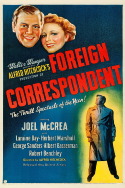
Review of Foreign Correspondent (1940) by Edith N — 24 Aug 2009
Hitch and His Propaganda Hammer.
I found large amounts of this movie hard to track. This is a failing in a thriller. It's one thing, as is so often the case in Hitchcock films, to be unsure what side various of the people are on, but I think you need to pick a character and track things through that character's eyes. Usually, he does that and does it well. However, I'm not entirely sure having so many screenwriters was the best thing for this film. Apparently, another problem was keeping it topical. The book was written before the Nazis came to power. The first attempted adaptation involved the Spanish Civil War. Finally, we get just-barely-prewar Europe. (To the point that whether it's prewar or not depends on what country you're in; it's set in August of '39.) It seems that it doesn't have an awful lot to do with the original book, and I don't feel inclined to go read it and find out if that version makes more sense. Since it's actually someone's autobiography, I hope for that person's sake that it is.
Okay. It's 1939, as I said, and an American paper is having trouble with its foreign correspondents, inasmuch as the information they got didn't really seem to be real information. Anyway, they decide that the best solution to the problem is to send out a really good reporter, John Jones (Joel McCrea), instead of someone who actually knows what's going on. They also give him an overblown name, this on the assumption that no one will trust a reporter named "John Jones." Anyway, Jones ends up covering a peace conference in Amsterdam, where he meets Van Meer (Albert Masserman) and the lovely Carol Fisher (Laraine Day), daughter of peace party leader Stephen (Herbert Marshall). Van Meer is killed in front of him--or so it appears. He finds out that it's a double (Samuel Adams), and he gets caught in some sort of bizarre intrigue involving spies for the Nazis, I believe on the premise that working with the Nazis will end with a peaceful solution to the problem instead of starting another world war.
Well, Europe was naïve about Hitler that way. Chamberlain and all that, after all. It seems that only Churchill seems to have actually read [i]Mein Kampf[/i]. We aren't really expecting McCrea to know what's going on, because he's clearly been chosen for his ignorance, I guess on the belief that, since the American people didn't know what was going on, either, they'd be more likely to sympathize with him, understand him. I think it's also part of our American culture of disliking the intelligent people. Personally, I would far rather have read the work of someone who had obviously, oh, some idea that Latvians had their own language. He does know that windmills aren't supposed to go against the wind, which is handy enough, but I'm not sure McCrea's character is entirely sure who Hitler even is, much less what countries he'd taken over by then. Much less the threat that other countries faced. All of Europe (except those bits already "annexed") seemed to be holding its breath, waiting to see if Hitler really went into Poland, but McCrea just stumbles along foolishly.
I really rather wish the film had been edited more tightly. Dorothy Spencer has done some very good work--the year before, she had edited [i]Stagecoach[/i]--and some not as good--in 1963, she edited [i]Cleopatra[/i]. (Which, sensibly, lost to [i]How the West Was Won[/i].) I rather get the feeling that Hitch wouldn't let her trim as much of the beginning as ought to have been done. Unfortunately, he had a thing about control, and this was sometimes a failing of his films. Also, I have to say that he gets a little overdone during this stretch with trying to get the US into the war--there's an epilogue which essentially begs us to, you know, start caring. A lot of the technical stuff, including the Amsterdam rain sequence and the spoiler at the end, is amazing. It's just that some of the not-as-good stuff rather heavily overshadows it. It's also a little disconcerting to see Edmund Gwenn being sinister, given that he would in just seven years be Kris Kringle.
It's odd that this was up against [i]Rebecca[/i] for so many awards. Once again, I am choosing not to look up what other movies were up in that year, which I think you can understand given the sheer number of movies released in any given year. But few directors today even make two films a year, and few directors have ever made two good films a year. (Even leaving out the fact that I don't think this one is very good.) It has often been noted that Hitch himself never won a competitive Oscar, just the Thalberg. I mean, he was nominated five times, once in this year (for [i]Rebecca[/i], not this), but he never won. He also only directed one person to a winning performance--Joan Fontaine in [i]Suspicion[/i]. (A total of eight were nominated, Fontaine twice, once for, um, [i]Rebecca[/i].) I think that says something about his skills as a director of people. He made brilliant films. It's just that I think his failures as a people person sometimes show. I don't think anyone here gives the best performance I could have imagined in these roles, though several of them are quite good.
This review of Foreign Correspondent (1940) was written by Edith N on 24 Aug 2009.
Foreign Correspondent has generally received very positive reviews.
Was this review helpful?