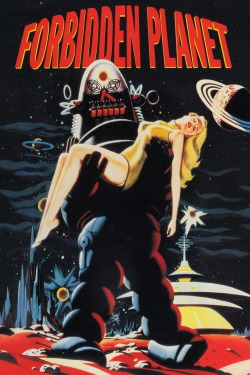
Review of Forbidden Planet (1956) by Anton B — 24 Sep 2008
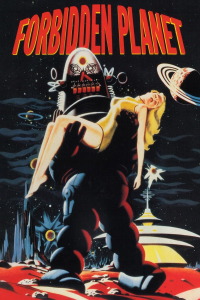
It doesn't take much to see the Shakespearean elements here. The question is, do you know the basic storyline of [i]The Tempest[/i]? Even the comic relief is pretty constant. It's interesting to piece together how much of this movie was based on the original play--and it's interesting to piece together how much of future sci-fi was based on the movie. It's not just the skimpy costume Alta Morbius (Anne Francis) wears; skimpy costumes have always been a staple of sci-fi women. (Though I do rather wonder why she refers to her own father [Walter Pidgeon] as "Morbius" at least once.) But the themes are all there, and they all have their roots in the Shakespearean origin of the story.
The [i]C57-D[/i], commanded by J. J. Adams (a dark-haired Leslie Nielsen), lands on the planet Altair IV. At least some of the studio publicity refers to the ship "invading" the planet, and the title rather implies such a thing, but it's not a true invasion. After all, Morbius, too, is a human from Earth. He had landed on the planet some twenty years earlier as part of the crew of the [i]Bellerophon[/i]. Now, he is the only living member of the crew; his wife died in childbirth, leaving only a daughter who has been raised as an educated innocent; the daughter knows quite a lot of information, but she knows very little of basic human emotions and interactions. This all changes when the other humans from Earth (all male!) arrive on the planet to relieve the lost crew of the [i]Bellerophon[/i]. Morbius is also accompanied by Robbie the Robot and all the technology of an extinct race called the Krell.
You begin to see. Not exactly spirits of air and fire, but rather close enough, I think. Morbius is not the true Duke of Milan, but he has become ruler of all he surveys, left alone with his daughter until an invasion of men. (While a comedy, this is not a pageboy play.) And Adams is not a prince of Naples, but he is commander of a pretty snazzy spaceship. And Alta (or Altaira, if you'd rather) is very much a Miranda. She must, in the end, choose between her father's empty domain and the world that she has never seen before. A brave new world, if you'd like. The horrors she begins to experience help make up her mind when she realizes their origin. But no one gives Morbius the chance to abjure his rough magic.
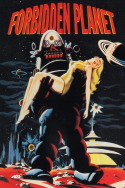
But about the movie--I don't much like the music. Or--I like it well enough, but I don't think it suits the movie as well as it might. Sometimes, the music is overly dramatic, but more often, it's just too [i]loud[/i]. It seems to be playing at a constant volume throughout, and anyone who knows the least bit about film music knows that it's wrong. There are moments that are supposed to be tender, and they are dampened by the overpowering nature of the score. The special effects are still pretty good, even by today's standards, though the design of Robby is awfully clunky. (Well, of course, they had to fit a guy in the suit!) He seems awfully inefficient; his arms don't seem to be capable of accomplishing half of what he's supposed to. The sets are decent. And, of course, this was in the days when Leslie Nielsen was a Serious Actor, so it isn't the silly comedy modern audiences have begun to expect of us. All in all, it's not bad.
Is this the greatest sci-fi movie ever made? Of course not. However, one is rather forced to use the word "seminal." It's a landmark of its genre, and it's pretty good for a landmark film. It's my experience that films that changed the nature of film are not always good. They are different in some way, but they are not always good. This is an important distinction. However, in this case, I can cheerfully recommend watching the film on its own merits, not just because of the merits of what came after.
This review of Forbidden Planet (1956) was written by Anton B on 24 Sep 2008.
Forbidden Planet has generally received very positive reviews.
Was this review helpful?