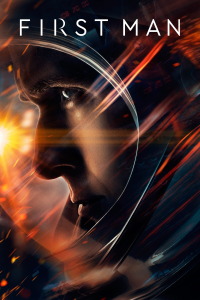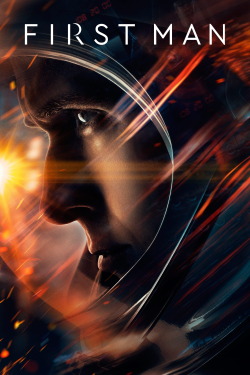
Review of First Man (2018) by Bertaut1 — 25 Oct 2018
Aesthetically laudable, emotionally vapid.
More an intimate character drama than a grandiose examination of man's place in the cosmos, First Man is more concerned with domesticity than the actual journey to the moon, attempting to demonstrate that behind the great moments of history exist personal demons and private motivations. Nothing wrong with that of course - contextualising small character beats against a larger historical canvas can produce compelling cinema. Terrence Malick's The Thin Red Line (1998), for example, uses the Battle of Guadalcanal as the background against which to engage personalised existential Heideggerian philosophical conundrums, whilst Michael Mann's Ali (2001) is more interested in Ali's private struggles outside the ring than his public bouts within it. However, for this kind of storytelling to work, one thing is essential - emotional connection. The audience must, in some way, care about the people on screen, otherwise their introspective problems are more than likely to feel like they are just getting in the way of the larger story. And that's exactly what happens in First Man - there is a lifelessness at the film's core, an emotional vapidity that can't be filled by exceptional technical achievements and laudable craft.
Based on James R. Hansen's, First Man: The Life of Neil A. Armstrong (2005), the film begins in 1961, and hits all the beats you'd expect in the lead up to the Apollo 11 mission in 1969, including the death of his daughter, Karen (Lucy Stafford) from a brain tumour; his marriage problems with his first wife, Janet (Claire Foy); the lunar landing alongside Buzz Aldrin (Corey Stoll); and his private sojourn to the Lunar East crater.
With this framework, the film remains tied almost exclusively to Armstrong's perspective, with the occasional shift to Janet. It sets itself the task of penetrating this most private of men, explaining why he was so driven, even to the detriment of his family. And herein lies perhaps the film's most egregious failing. It's as if director Damien Chazelle and screenwriter Josh Singer think the Apollo 11 mission isn't interesting enough by itself - there needs to be some kind of deeper "why" behind the whole enterprise.
In any case, the attempts to tease out the inner workings of Armstrong's mind don't really work, as he remains very much in his own world - no matter what Gosling, Chazelle, and Singer do to dress him up, Armstrong comes across as aloof and interiorised. Partly at fault here is Gosling's performance, with its fulcrum of emotionless stoic masculinity. Instead of giving the character hidden depth, the few discernible traits he possesses make him something of a cardboard cut-out, a 21st-century screenwriter's idea of what an American man who grew up in the 40s and 50s should be.
Another issue is that the filmmakers choose to locate Armstrong's primary motivation in the death of Karen, which is presented with a mawkish sentimentality, as Chazelle attempts to link Karen's death with Armstrong's determination - as she is dying, he holds her and looks wistfully into the sky, and on the moon's surface, he drops her bracelet into the Lunar East crater and cries a few tears. The problem lies in the overkill, detracting from whatever genuine emotion such details should evoke. Every time we see Gosling stare yearningly into the sky, the potency of the film is diluted just a little bit more.
Did he really drop the bracelet into the crater? We don't know. However, for me, the whole thing comes across as far too syrupy, an amateur psychological profiling of a man who was intensely private. I would have much preferred the Lunar East trip to remain a mystery - by showing us what they think might have happened, Hansen, Singer, and Chazelle cheapen the intensely personal nature of the moment, which Armstrong obviously chose to keep secret for a reason.
Make no mistake, however, the lunar landing itself is beyond spectacular, with Justin Hurwitz's incredible music and Linus Sandgren's superb cinematography coming into their own. The sequence was shot in 70mm IMAX, and it makes extraordinary use of the larger frame, with the first panorama of the lunar surface almost as awe-inspiring as anything in 2001: A Space Odyssey (1968) or The Tree of Life (2011). An especially well-directed part of the lunar descent is that rather than lay down a busy foley track, Chazelle pulls out the sound altogether, creating an eerie, otherworldly moment that literally gave me goosebumps.
However, despite the magisterial last 30 minutes, and some sporadically well-handled moments, First Man is underwhelming, and, for long portions, interminably dull. As good as that final sequence is, it's no compensation for the plodding and lifeless two hours that precede it.
This review of First Man (2018) was written by Bertaut1 on 25 Oct 2018.
First Man has generally received positive reviews.
Was this review helpful?