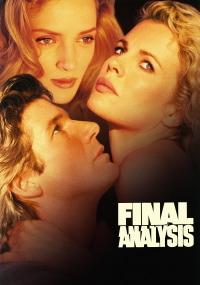
Review of Final Analysis (1992) by Sam M — 19 Jan 2016
After recently viewing such erotic thriller classics as "Basic Instinct" and "Wild Things," I've come to the conclusion that melodramatic, sexy psychological thrillers are perhaps my utmost guilty pleasure. I love how over-the-top they are, visually Hitchcockian and dramatically humungous, with a stealthy soundtrack symphonically heightening the untamed emotions of each scene. A couple of sex scenes peppered in and you've got a tale of suspense with multiple extra kicks, so trashy and so sordid that we'd like to call it high entertainment because the entertainment factor is so high.
The mid-1990s were the genre's pinnacle, several trying to imitate the successes of "Fatal Attraction" and "Basic Instinct" most prominently. An early example comes in the shape of "Final Analysis," released just a month before the former. Neurotic and malicious, it has moments of insight, but eventually falls into the trap of over-plotting; it is too fond of the plot twist, forgetting that viewers like to gasp but not so much so that breathing becomes a difficulty. It commences with aptitude only to fly off the rails sometime after Plot Twist #1 is revealed - after that, it becomes an eye-roll of a film, passing itself off as more of a wannabe steamer than a worthy one.
In "Final Analysis," Richard Gere plays Dr. Isaac Barr, a respected psychiatrist currently treating Diana Baylor (Uma Thurman), a young woman suffering from horrific recurring nightmares. It is a case not unlike many that he's already undergone, so things get much more interesting when he is introduced to Diana's sister, Heather Evans (Kim Basinger), a comely blonde trapped in a marriage to a self-loathing gangster (Eric Roberts). It takes Isaac and Heather only a few moments to pursue the considerable chemistry that rests between them, and, before long, a hot and heavy affair consumes their lives.
But, unbeknownst to Isaac, Heather suffers from a disease known as "pathological intoxication," through which a mere sip of alcohol can cause the victim to go completely berserk (we experience it firsthand through one laughable scene in which Heather has a drop of red wine at a fancy restaurant and ends up having a screaming fit that ends in a tackle). So when her husband is found bludgeoned to death, she becomes the prime suspect. But will her instability keep her out of the slammer?
I recall writing a review of Pedro Almodóvar's "Live Flesh" a while back where I discussed the succession of thrillers who try too hard to be sexy and thrilling and dramatic and stylish, but end up awkwardly attempting to combine all characteristics or unevenly spotlighting aspects of each. But I praised "Live Flesh" for doing it all with flashy subtlety - "Final Analysis," unfortunately, is the kind of film that falls under the aforementioned poor succession. It's more risible and self-serious than sensual and suspenseful, certainly under the impression that heavy doses of twists, of turns, equals a complex and smart thriller. But it doesn't feel like a slick game of oneupmanship on the part of its director, Phil Joanou; it feels like a weak Hitchcock tribute. Never are we convinced of what it has to provide, both stylistically (which is sometimes juicily noiry) and story wise.
The leading actors, possessing star personas that would make their inclusion in any film something to behold, seem stranded in a movie dressed up with no place to go. Gere is on auto-pilot, hero 101, if you will, as the film's leading man - his character is thinly written, without much of a personality to make us root for him. Basinger assures us that she's a worthy leading lady early on, but her performance later descends into camp so campy that I'd go so far as to say that she, plain and simply, misfires (but try reading her lines, committing the actions of her character - how effective would you be?). Only Thurman and Roberts are worthy of our time, she a would-be victim with a lot of tricks up her sleeve, he hammy and noticeably masochistic.
But "Final Analysis" is a misstep of a movie, a bad reflection of cinematic trends of the time without the heat and entertainment value of its better counterparts. With all the talent involved, it's hard to see what necessarily went wrong - and yet, it's easy, knowing that confidence can be a dangerous animal. A sure thing can't always be so sure.
This review of Final Analysis (1992) was written by Sam M on 19 Jan 2016.
Final Analysis has generally received mixed reviews.
Was this review helpful?