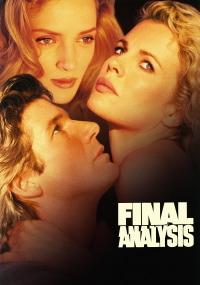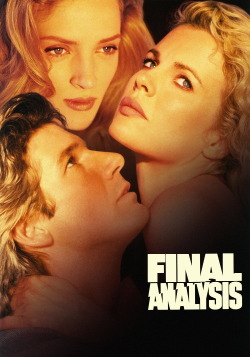
Review of Final Analysis (1992) by Smoothrunner — 21 Nov 2015
Imagine what will happen if stylish neo-noir science-fiction movie will be directed by young Ridley Scott at the peak of his career, based on the novel by talented amphetamine-addict, who is scribbling on drugs countless stories about borderline states, disguising themselves as science-fiction (Philip K. Dick), special effects in this film will be made by legendary Douglas Trumbull, Vangelis will write music, starring charismatic Harrison Ford, beautiful Sean Young, ingenious Rutger Hauer ("tears in the rain" line is his invention) and young Daryl Hannah? Well, the movie will get a commercial failure and the avalanche of criticism in the United States. That serves as another proof that nor commercial success, nor critics reviews should not be taken into account when assessing the motion picture arts.
"Blade Runner" is one of the last specimens of the pure art in the mainstream cinematography - it's when public's attention is drawn not by hurrying plot, but by exquisite picture, the so-called atmosphere that combines a certain style of storytelling, visual style, including special effects, high-quality music and actors' ensemble. If we add to this some philosophical depth and give the public time to reflect on each episode, without being distracted (harassed) by the following one, you will get an almost perfect motion picture. And if you appreciate beautiful motion pictures, then "Blade Runner" is your movie.
As of the idea of "Blade Runner", it is not obvious and at the same time is simple, like all true ideas - if at the beginning of the movie Deckard required Voight-Kampff test in order to determine whether Rachel a human being or not, at the end just two questions were enough for this. Actually, no more are required.
9 out of 10.
P.S. A small remark. If before watching "Blade Runner" you have not read the novel on which the movie is based - "Do Androids Dream of Electric Sheep" by Philip K. Dick - it is better not to read (otherwise you'll have false expectations). If you decide which version of the movie to choose, then just do not take "The Final Cut". I would suggest "The International Cut", as the most conscientious observance of neo- noir atmosphere and best explanation of the plot twists. Although "The Director's Cut" and unofficial (but most complete) "The Electric Unicorn Cut" have their advantages, but these versions are not as atmospheric and rather intended for hardcore fans of "Blade Runner". As I see it, director's hints on Deckard's artificial memory (dream about a unicorn and paper unicorn near his flat at the end, some dialogues) are excessive, contradict logic and unnecessary overcomplicate movie's main idea.
This review of Final Analysis (1992) was written by Smoothrunner on 21 Nov 2015.
Final Analysis has generally received mixed reviews.
Was this review helpful?