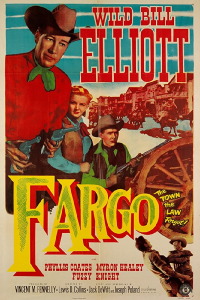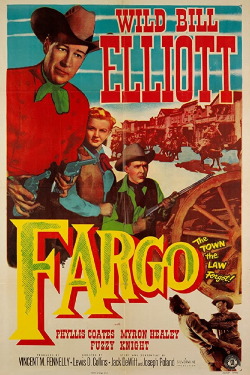
Review of Fargo (1952) by Rob S — 26 Jul 2015
As we read the text informing us that Fargo is a true story (which is a lie), we are introduced to the somber music which contains a medieval feel to it, being performed on harp to start, then switching to the use of more strings and drums. This small portion of music is powerful in that it conveys exactly the tone of the movie: we know collectively as an audience that this will be an upsetting story which takes place in a fairly "innocent" location - Minnesota.
Why is this film titled "Fargo," exactly? It is where everything is set into motion. The William H. Macy character (Lundegaard) drives up there to meet the two "villains" of the story who he employs to kidnap his wife so that they may con money from his wife's father. We don't know this right away, however; in fact, the information we're told is only certain bits, so we cannot fathom how simple this rather complex plan really is at first. Making the situation complex for the viewer, however, lets us know that anything can and will go wrong - and what do you know, it does.
While Frances McDormand may be the protagonist of the story, let's talk first about the best talent in this film - William H Macy. After watching this film, without knowledge of the show "Shameless," I doubt anybody could predict this actor would be a good fit for Frank Gallagher in Shameless - stubborn as hell, alcoholic, selfish, terrible father, anything but respectable. In Fargo, Macy portrays Lundegaard with perfect execution, a role on the opposite pole of his iconic Frank Gallagher. Lundegaard is a first time criminal, and it shows through the fact that he is an every-day-nice-guy, not very outspoken, and holds in his anger so much that he explodes when he needs to let it out. Macy tackles the overall nervousness of the character so well that he develops perfect mannerisms for the character - looking down due to shyness frequently, moments of losing control that are just right and not overly dramatic, stuttering, and a stupid smile to retain his innocence despite the horrific plot he carries out, putting his family in danger time and time again. Macy's portrayal is arguably the best performance of the film, yet he lost the best supporting Oscar to none other than Cuba Gooding Jr's role in "Jerry Maguire" that year.
Another strong aspect of the film is the character played by Steve Buscemi. Everybody thinks it, and the Coen brothers say it time and time again in their script: Steve Buscemi sure is a "funny-looking fellow." This is brought up at least twice by witnesses in the case - one prostitute and one bartender, who act as substitutes for the audience, the voyeur, the cinephile who observes and comments, but does not contribute much to the actual story. Buscemi's character is egotistical, funny, filled with rage; he is given authority which he does not deserve as Shep, who put Lundegaard in contact with Buscemi's friend, did not vouch for the Buscemi character. Buscemi is the comic relief to his counter part's scary, more dominating and menacing presence - he is a giant compared to Buscemi and does not talk unless it has to do with the job they have set out to do. This seems to be one of the only reasons Buscemi has to do practically everything - he goes alone on the actual "exchange" of the money and Mrs. Lundegaard, leaving only him to have to deal with the near-fatal surprise in store for him. He returns with the money for his partner (though he does not tell him there is much more buried in the middle of nowhere) and he rightfully complains that Gaear did not suffer an injury like him, though his deception is greedy and egotistical. It turns out that Gaear has a greedy nature too, possibly much greedier than Carl (Buscemi) since he thinks a sum of only eighty thousand dollars is involved and his reaction is very extreme.
Then we have Frances McDormand, playing Marge Gunderson, the protagonist who does not show up until thirty minutes into the film. If it were not for the presence of this character in the film, this movie would be an extremely depressing story. Marge represents the average Minnesota citizen who finds happiness with the simplicity of family life. She serves the police force as she serves her family - she is the sole breadwinner for her and her husband Norm, and she is pregnant, yet embarks on this mysterious, dangerous journey to find two murderers in order to put them behind bars. Her short speech to Gaear towards the end of the film is exactly what the film needs - it is reassurance that we are not alone in this world when we don't understand the evil behind greed which drives people to do the most awful things and strive so far from morality.
One final comment is that I love the presence of the character Mike Yanagita in this film. Most people would find this character to simply be a comic relief character, but as my brother pointed out, the fact that he lied about his life and was so convincing about it drives Marge to return to Lundegaard, who appeared to be just as innocent as Mike on the surface. To be honest, I thought this character was simple comic relief on first impression, but this didn't make too much sense to me since it did not drive the story further if that was the case, and I knew the Coen brothers are considered great filmmakers.
I very strongly recommend this film to all viewers who are comfortable with watching an R-rated film: it is simply one of the greatest dark comedies/crime dramas ever made.
This review of Fargo (1952) was written by Rob S on 26 Jul 2015.
Fargo has generally received very positive reviews.
Was this review helpful?