Review of Farewell My Concubine (1993) by Edith N — 18 Aug 2008
I understand the cultural basis behind the Cultural Revolution. I do. I still, however, don't think it really made any sense. Get rid of Western things--okay, I can go there. Japanese? Heck, yeah; the scars of the war were still fresh, even that long after. But I would think it would be important to celebrate the power and glory that was China, the fact that it had continued as one entity longer than just about anywhere else. It was a place of beauty and innovation when the West was still barbarian tribes running rampant across Europe. Isn't that a Glorious Past worth building on?
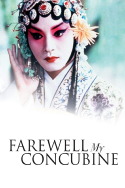
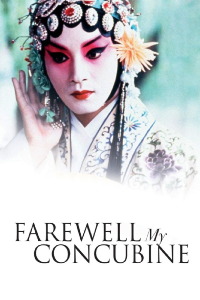
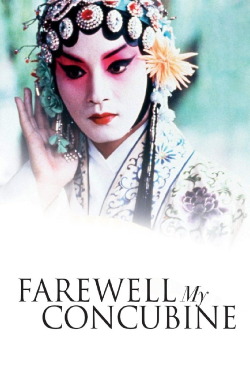
Cheng Dieyi (Leslie Cheung) and Duan Xiaolou (Fengyi Zhang) grow up together (as Mingwei Ma and Yang Fei) in a training school for the Beijing Opera. This isn't opera as we Westerners think of it. This is the ancient, stylized, all-male opera that existed in pre-revolutionary China. This is legends set to that Chinese music that sounds strange to Western ears. As they grow (into Zhi Yin and Hailong Zhao), their world begins to change. Eventually, they must make such decisions as how to treat the Japanese invaders and whether or not to flee with the Nationalists to Taiwan. All Dieyi really cares about is opera; all Xiaolou really cares about is himself. He marries Juxian (Li Gong) at one point; she loves him and is jealous of Dieyi, but Xiaolou will sacrifice her if it means protecting himself for that much longer.
Not even Dieyi is really a pleasant person. In Western terms, he's a prima donna. This is in several senses of the term, of course. But he really genuinely expects the world to stop what it's doing if what it's doing interferes with his ability to keep singing the role of the Concubine--and Xiaolou's singing of the role of the King. He despises Juxian, in part, I think, because Dieyi wants her husband, but at least as much because the fact that he has [i]become[/i] her husband makes him at best ambivalent at continuing to perform in the opera. The pair both have their own selfish goals.
It's a beautiful film, of course. After all, we are in the world of the Beijing Opera. Even when the world is going to pot outside, there is still glamour and glitter onstage. The costumes all but glow with their colour and light. Dieyi is given a box of jewelry by an admirer; the box is in the shape of the butterfly that Dieyi becomes. As a young boy, he is taught to become a woman, and it's a lesson that he never forgets. His makeup is always flawless, and he is genuinely lovely. I think there is an implication intended that his "becoming" a woman is responsible for his clear attraction to Xiaolou, but I think it's at least as much that Xiaolou protected him when they were both young, that Xiaolou has been the one constant throughout his unpleasant childhood--until they both make it onto the glory that is the opera stage.
In many senses, this is a true tragedy. These people are not to be envied. They are to be pitied. Yes, they live until the 1970s, no mean feat for decadent types in Beijing, and, yes, they seem able to keep some of the trappings of the opera, but they are still men broken on the wheel of history.
This review of Farewell My Concubine (1993) was written by Edith N on 18 Aug 2008.
Farewell My Concubine has generally received very positive reviews.
Was this review helpful?