Review of Far from Heaven (2002) by Adam H — 27 Jan 2011
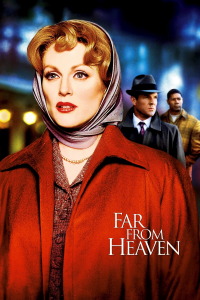
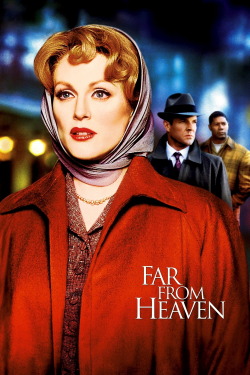
Todd Haynes' Far From Heaven looks and feels like a 1950s film, but it deals with issues that were not permissible by the morality standards of the Hollywood Production Code censors of the 1950s. Everything from the film stock and titles to the exterior and interior shots look as if they were lifted from a Douglas Sirk film. However, unlike Sirk's melodramas, in Far From Heaven plot points pertaining to social mores are not coded in between the lines of the script, they are dealt with openly and explicitly. What is refreshing about this, is the earnest manner in which Todd Haynes deals with the socially taboo topics of homosexuality and integration. Haynes is never preachy and he doesn't approach the film from a 2002 perspective. Far From Heaven always feels like a 1950s film dealing with these issues. And unlike so many modern films which approach controversial issues in a period piece, there is no sense of irony or snarkiness being conveyed. Modern films about the 1950s usually parody the era, but Far From Heaven treats its subject with seriousness and comes across as very authentic. This makes the film more effective in its push to engage the audience with the feelings of the characters. It also makes unrequited love of Cathy Whitaker and Raymond Deagan feels all the more tragic.
In the first act of Far From Heaven Cathy Whitaker has a seemingly perfect life. She and her ad executive husband are considered the ideal couple by the local society magazine. Her routine is identical to the one practiced in the "Good Wife's Guide." She always tries to make her husband as comfortable as possible. Even when he is drunk and insulting, she shrugs off his behavior with a good natured smile. However, after she catches him in a passionate embrace with another man, her perfect world begins to unravel and we begin to see the person beneath the glossy façade. Cathy is naturally a good person and she deals with her husband's infidelity in a manner in which a 1950s "good wife" would be expected to. She supports him and attempts to maintain her household and routine as if nothing is wrong. In the "Good Wife's Guide" there is a passage that reads, "Don't ask him questions about his actions or question his judgment or integrity. Remember, he is the master of the house and as such will always exercise his will with fairness and truthfulness. You have no right to question him." Cathy does ask Frank about how his therapy sessions are going but he is bothered that she brings it up. Cathy immediately admits that it was not her place to ask. This forces her to deal with her feelings internally. She refrains from discussing the situation with even her closest friend Eleanor. This is partially out of duty to her husband, but also out of personal embarrassment. Cathy does manage to open up a little bit to Eleanor after Frank hits her and Eleanor notices the bruise above her eye, but she is unable to fully express her emotions or the full circumstances.
Cathy develops a relationship of sorts with Raymond Deagan, with whom she shares similar interests. The time she spends with him becomes an outlet for her emotions, and the two develop a genuine love for one another. The fact that the social norms of the time and place dictate that their relationship be forbidden is tragic, because these two souls complement each other and fulfill emotional needs that each of them craves. Haynes really fleshes out these characters and creates a true tragedy. While part of Raymond seems to be using Cathy to break down the racial barriers supported by both the Whites and the Blacks, another part of him feels genuine love for Cathy. Once the reality of the social situation sets in and violence from both races befalls Raymond and his daughter, he chooses, understandably, to let the love go unrequited. Initially, Cathy cannot handle being ousted by her social circle for being seen with Raymond, even her daughter suffers a social out-casting. As a result, Cathy chooses to end the relationship, although she tells Raymond how beautiful he is. But after her vacation and the finality of her marriage, Cathy realizes that Raymond is her kindred soul and that her love for him is more important than social status. She feels deep feelings for Raymond and it is clear that he feels love for her as well. But the thought of acting on those feelings proves to be too dangerous of an obstacle for them to circumvent.
On the other side of the spectrum, Cathy's husband Frank becomes more and more shut off. Haynes shows him getting meaner and drunker as the film goes on. Frank sees his homosexuality as a "despicable" curse and actually tries therapy as a means of "correcting" it. This convention actually fits with the social norms of the fifties. When Frank realizes that he can't control it, he eventually asks for a divorce. Even though this is seen as his way of coming to terms with his homosexuality, the society of the fifties is not accepting of it. Frank and the man he loves are only shown together in hotel rooms. Their relationship is taboo, but they are willing to live their lives in the shadows as long as they can be together. Cathy and Raymond are not willing to do this. Of course, Raymond has the welfare of his daughter to think about, but it is sad that he and Cathy cannot find a way to make it work. Far From Heaven shows how society manages to dictate how people live their lives. Sometimes social pressures can outweigh a person's desire for happiness. Sometimes people are willing to sacrifice being a part of that society in order to be happy. Far From Heaven manages to express these ideas within the confines of 1950s suburban America without being preachy or condescending. That is an accomplishment.
This review of Far from Heaven (2002) was written by Adam H on 27 Jan 2011.
Far from Heaven has generally received very positive reviews.
Was this review helpful?