Review of Far from Heaven (2002) by Simon D — 11 Mar 2016
Todd Haynes has often been an experimental director throughout his career. He tackled the Glam Rock era with the dazzling, if mid-judged, Velvet Goldmine and had 6 different actors portray various phases of Bob Dylan in I'm Not There. Most recently his adaptation of Patricia Highsmith's Carol made many critics and viewers' lists for the best film of 2015. Despite his creative ambitions, however, he's never really been recognised in terms of awards. The only Oscar nomination he has received was, in fact, an Original Screenplay one for this film. I've yet to see Carol (which apparently shares similarities with this) but so far, Far From Heaven is Haynes' masterpiece.
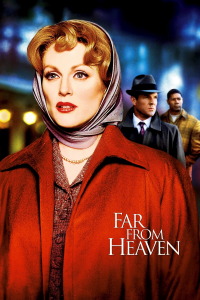
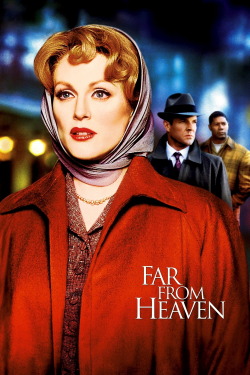
Connecticut in 1957 finds Cathy (Julianne Moore) and Frank Whitaker (Dennis Quaid) as the seemingly perfect couple at the heart of their community. Frank has a secret, though, and when Cathy discovers his double life, she begins a friendship with her black gardener Raymond (Dennis Haysbert). But such behaviours soon invite the unwanted attention and scorn of their so-called friends and neighbours.
As soon as this film opens, you are instantly struck by Elmer Bernstein's evocative score and a colourful palette that just radiates from the screen. It doesn't take long to realise that Haynes is paying homage to the film's of the 1950's. Douglas Sirk is a particular director that Haynes is emulating and recreating his melodramatic soap opera's like Imitation of Life or All That Heaven Allows is so convincing that you'd be forgiven for questioning whether or not you're watching a contemporary film. There's an intoxicating attention to detail whereby Haynes puts so much care into this film that you're transported back the 50's era. His efforts are so meticulous and refined that Far From Heaven is nothing less than a stunningly crafted piece of cinema. Peter Rogness' art design and Mark Friedberg's production design are simply splendid and the lavish costumes by Sandy Powell change throughout the film to suit the seasonal changes in the plot. All of this is perfectly framed by Edward Lachman's stunning cinematography. His use of light and vibrant, oversaturated colours keep in tune with the bold use of technicolor from Sirk's melodrama's and is absolutely exquisite work.
Haynes' intention is to capture the nuclear, corporate family living the dream of white picket fence America and he does so with a confidence and hugely creative eye. Despite his accomplished recreation of the times, however, Haynes chooses an entirely different direction for his narrative. What sets his film apart from the style of Douglas Sirk is that Sirk's films were all very conservative, whereas Haynes' perfect suburbia is shattered by very personal problems that would have been taboo and risqué by any standards during the 50's. Society, in Haynes' world, is full of casual racists and homophobes who view homosexuality as an illness and being kind to Negros socially unacceptable. The underrated Patricia Clarkson is the perfect embodiment for the judgmental rottenness that permeates the neighbourhood. She epitomises the very people of society that the three, inherently decent, principal characters of Quaid, Haysbert and Moore are up against. With the facade of some and anguish of others, it cuts across so many divides: gender, race, class, sexual orientation but although it's about several different levels of oppression it's, at it's heart, a story about the oppression of women. Ultimately, this is about a women's place at this time; how tolerant they were expected to be and how keeping up appearances was at the forefront of their place within a fractured, consumerist environment.
With his experimental evocation, Haynes could easily fall prey to pretension but for as much style as the film has, it has content to match. Simply speaking, it's a work of art.
Mark Walker.
This review of Far from Heaven (2002) was written by Simon D on 11 Mar 2016.
Far from Heaven has generally received very positive reviews.
Was this review helpful?