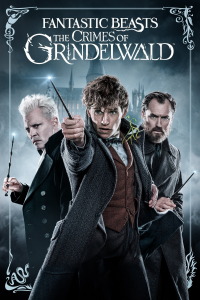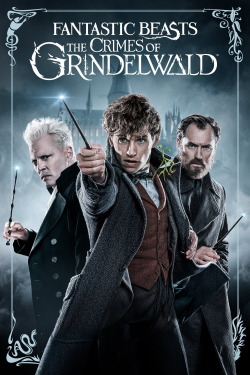
Review of Fantastic Beasts: The Crimes of Grindelwald (2018) by Terryd — 20 Nov 2018
Having given the latest instalment in J.K. Rowling’s magical world as unbiased a viewing as was possible, considering the scathing reviews, I would like to submit my own take on the film. I am neither a professional film critic nor a particularly rabid fan of the Harry Potter universe; however, I enjoyed this film for the reasons that any patient reader will discover below.
As a film, this story had only four goals: The Scheherazade goal, the Empire Strikes back goal, the revelation of familial heritage goal (also present in Empire Strikes Back), and the retrieval of a powerful, sacred object goal. In those goals this film succeeded and did so in an exciting, suspenseful, and entertaining fashion.
As the reader may recall, Scheherazade is the fictional narrator of the Arabian Nights tales who craftily kept herself from being cut in half the morning after her wedding night (and for 1,000 nights thereafter) by telling her husband stories and leaving off with a cliff-hanger before drifting off to sleep each night. Rowling and Yates have to avoid the literary executioner’s block by keeping us involved and excited about what is going to happen next. They accomplished this goal in two short scenes at that end of the film.
We all remember the shock of the Empire Strikes Back, our hero’s decent into Hell, the rise of the victorious bad guys, and the defeat of the forces of good. This is a standard trope that adds a little bit of realism to an otherwise fantastical “good always triumphs over evil” boring story. We see evil triumph all the time in the real world; and to lend a little of this realism to a story gives it a scent of veracity to the tale and keeps us hanging on to see the end. Despite this shout out to realism and the reference to the ugly reality of two world wars, this is not a Twentieth Century post-modern realism story. It is rather a Nineteenth Century heroic fantasy on the scale of The Prisoner of Zenda (just as Star Wars was). We all know that good will triumph in the end, it is just the details of how that triumph is achieved that hold our interest. Admittedly, the Dumbledore character is Homeric in its origins, a somewhat tragic, conflicted character of ambiguous means versus ends motivations and deep scars from past regrets. Fans who wish that Albus Dumbledore would just settle in as a kind, avuncular mentor and protector miss a depth that Homer gave all his heroes and villains. Long before post-modern authors thought they invented it, Homer recognized that people are complicated and heroic motivations often ambiguous. Let us not be confused here, Newt Scamander is not the hero of this story. The hero is Albus Dumbledore.
This brings us to the retrieval of the powerful and sacred object: The blood-oath amulet that the Niffler steals from Grindelwald and which Newt returns to Dumbledore. This is the talisman that prevents Dumbledore from confronting Grindelwald directly (and explains why he had pursued that confrontation through surrogates heretofore). This is a Samson’s Hair type of device. It makes Dumbledore vulnerable, much like Achilles’ heel or Superman’s Kryptonite, which is necessary because a perfectly invulnerable hero is boring. However, there has been established by the late reveal in the movie another chink in Dumbledore’s armor. This chink is the true identity of Creedence Barebone as one Aurelias Dumbledore.
The reveal of the true heritage served several narrative purposes. Firstly, it relieved a tension that had been built during the entire film regarding Creedence’s true identity. Secondly, the reveal provided a cliff-hanger to keep fans interested in the next installment. Most importantly, it heaped on the Kryptonite for Dumbledore. He may be in possession of the blood-oath amulet that he may or may not be able to destroy, but there is now another very powerful shield between him and Grindelwald and their final battle.
The next three films will no doubt be about how that shield is breached, as well as other minor fan service narrative devices about reuniting Jacob and Queenie, throwing Newt and Tina together despite themselves, and solving all the apparent continuity errors Rowling teased.
This was a well-crafted effort, not without editing errors. It succeeded in making me want to see the next chapter.
This review of Fantastic Beasts: The Crimes of Grindelwald (2018) was written by Terryd on 20 Nov 2018.
Fantastic Beasts: The Crimes of Grindelwald has generally received mixed reviews.
Was this review helpful?