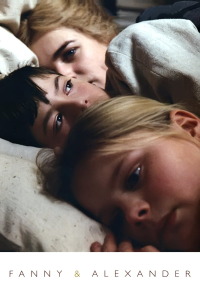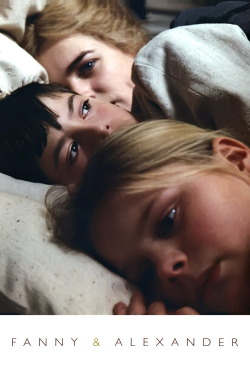
Review of Fanny and Alexander (1982) by Christopher C — 26 Oct 2013
Released in 1982 in a 5-hour version for Swedish television and cut to 180 minutes for theatrical release, FANNY AND ALEXANDER was meant to be Ingmar Bergman's last film. Though the great auteur lived on another 25 years and even wrote and directed some smaller projects, FANNY AND ALEXANDER can still be seen as a great capstone to decades of legendary cinema. (The best way to see it is in Criterion's 5 DVD set, which has both the television and theatrical versions, as well as two DVDs of "making of" and other commentary).
FANNY AND ALEXANDER deals with the great two preoccupations of Bergman's career, namely the absence of God and the unbridgeable gaps between human beings, but the result is wonderfully life-affirming. Fanny and Alexander are the children of Oscar and Emilie Ekdahl, actors in Uppsala circa 1907, but the film gives a panorama of the extended Ekdahl family, presided over by grandmother Helena, uncles Gustav Adolf (a restauranteur and the film's most comedic presence) and Carl (a professor who has fallen into debt and is trapped in a loveless marriage), their wives and children, and the selfless Jewish shopkeeper Isak Jacobi. This Swedish family lives in an Old World opulence that is hard to believe for audiences today, especially for a country whose class system by and large disappeared after the war. The rigid interaction among people not closely acquainted and the deference of servants to their employers make for gestures as alien to us 21st century viewers as a Noh play.
In a way, FANNY AND ALEXANDER is like those big novels of a century ago, by Tolstoy or Galsworthy, dealing with the vicissitudes of a whole family. The vaster family drama, however, is only a backdrop to a more personal one: Fanny and Alexander are soon orphaned, and their widowed mother eventually remarries, this time with a cruel clergyman. The children move from the freedom and comfort of the Ekdahl home to the austere bishop's place, where the children are punished for the slightest infraction by beatings or being locked up in the attic. The Ekdahls' torment living under the bishop is the great crisis of the film, and their unexpected liberation from it presents Alexander with a burden that he will carry into his budding manhood.
The original television version is the way to see Bergman's final masterpiece. Don't be daunted by the length: 5 hours should not be a problem in an age when people will watch an entire season of a sitcom on DVD in one sitting. FANNY AND ALEXANDER is not slow, meditative cinema like, say, Andrei Tarkovsky or Béla Tarr, but rather Bergman is always presenting the viewer with some engaging drama. The theatrical cut, which Bergman made only with the greatest regret, is a very different (and much weaker film), cutting out much of the film's magical realism, the touching meditations on growing old represented by the character of the grandmother, and some vivid depictions of early 20th-century Sweden.
This review of Fanny and Alexander (1982) was written by Christopher C on 26 Oct 2013.
Fanny and Alexander has generally received very positive reviews.
Was this review helpful?