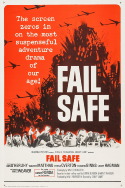
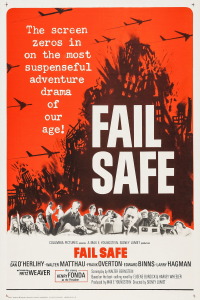
Review of Fail Safe (1964) by A.j. A — 03 Aug 2010
Of course, the obvious comparison will be made to Stanley Kubrick's "Dr. Strangelove or: How I Learned to Stop Worrying and Love the Bomb" (1964), based on the novel "Red Alert," by Peter George (originally published in the UK as "Two Hours to Doom" under the pseudonym of Peter Bryant). It was not a comedy (nor was it as well-written as the Burdick-Wheeler novel). Kubrick and George turned it into the black comedy classic it became.
With Kubrick having substantially more clout than Lumet at that time, George suing Burdick and Wheeler for plagiarism and Columbia Pictures releasing both films, though "Fail-Safe" was 'in the can' first, it was held back - and the movie-going public got to yuck-it-up over the prospect of nuclear annihilation. After all, the Cold War had recently heated to a boil with the Cuban Missile Crisis, Stanley Kramer's film "On the Beach" (1959) hadn't yet faded from the minds of the public - and President Kennedy had just been assassinated. People needed to laugh, if even at a black comedy.
Niels Bohr's famous quip, "There are things that are so serious that you can only joke about them," notwithstanding, an earnest discussion on trying to avert the total destruction of the planet is deadly serious - and on every level, "Fail-Safe" remains an outstanding, riveting and truly harrowing film.
Employing relatively spartan sets and two fine actors from his big-screen directorial debut, "12 Angry Men" (1957), Henry Fonda and Ed Binns, Sidney Lumet made a picture that on so many levels still speaks volumes today, nearly half a century later.
Not only an object lesson in how adults handle a crisis of cataclysmic proportion, but also very much a still-relevant cautionary tale about misplaced faith in sophisticated technology and the possible ramifications therefrom (as in "Colossus - The Forbin Project," 1970), perfectly enunciated in this exchange:
KNAPP: "The more complex an electronic system gets, the more accident-prone it is. Sooner or later, it breaks down ....
A transistor blows, a condenser burns out. Sometimes they just get tired, like people....".
GROETESCHELE: "But Mr. Knapp overlooks one thing. The machines are supervised by humans. Even if the machine fails, the human being can always correct the mistake.".
KNAPP: "I wish you were right. The fact is the machines work so fast, they are so intricate, the mistakes they make are so subtle that very often a human being can't know if a machine is lying or telling the truth.".
Even today, there is still no highly-complex technology that is truly "Fail-Safe".
10/10.
This review of Fail Safe (1964) was written by A.j. A on 03 Aug 2010.
Fail Safe has generally received very positive reviews.
Was this review helpful?