Review of Ex Machina (2015) by Ethan H — 05 Dec 2015
'The good deeds that man had done before defend him.'.
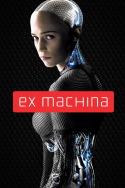
Robert J. Oppenheimer's words translated from Hindu scripture days before a failed nuclear explosives test, perhaps pre-empting the destructive legacy he'd leave behind. Such words are uttered in a drunken oblivion by the creator of Ex Machina's artificial intelligence AVA (Alicia Vikander), showing his understanding of the danger such a creation could reap by comparing it to the most destructive of weapons in history, the atom bomb. Later, 'Enola Gay' (the name of the bomb dropped onto Hiroshima) by Orchestral Manoeuvres in the Dark is played in the background. These hints towards apocalyptic consequences due to technological advancements lay just beneath the skin (or titanium) of the film. Such features make it a four-time nominee at the 2015 British Independent Film Awards, and rightfully so.
Early on a character asks 'Ever heard of the Turing test?' For those unfamiliar, a Turing test involves a series of questions with an unknown subject, the responses to these questions can then be analysed determining whether the subject is human or machine. Caleb (Domhnall Gleeson), a software engineer at a search engine known as BlueBook (the film's interpretation of Google), wins a competition to be the person who asks the questions in the test, under highly classified circumstances run by his superior Nathan (Oscar Isaac). A fairly appropriate narrative following the success of 2014's The Imitation Game surrounding Turing's developments. Yet, the test itself is not the primary focus, instead the relationships developed by the three characters drives the experience forward - and yes, this is an experience, leaving a paranoia and distrust for society amongst viewers.
This is an utterly beautiful film. From the film's opening helicopter shot of Norway's Valldal valley the viewer is exposed to the exquisiteness of the world's extreme nature with vast forests in contrast from ice cliffs. Deep within this primordial land lays a sophisticated technology. Nathan's home combine's modern architecture with rock faces of the valley, an almost poignant representation of the development of a new form of life, albeit artificial. Despite these environments being excellently constructed for screen by cinematographer Rob Hardy, it's the numbers collaborating within the visual and special effects team along with the art department who steal the show visually.
Alicia Vikander is transformed into what I believe to be the most visually striking representation of AI to date, overthrowing examples such as Sonny from I' Robot. These representations appear very similar in construction, yet considering the uncanny valley, which surrounds how a robot's almost identical resemblance to a human creates a greater sense of unease, they become very different subjects. Sonny's face is void of expression and appears to be formed from fiberglass, neither of which are human characteristics. AVA is constructed around her frequently expressive face supposedly formed of a skin like material. Sonny therefore presents comfort, a robot which looks like a robot. Whilst AVA delves further by presenting how a robot is formed to replicate the human appearance, causing doubt within one's head, despite the rest of her body clearly being animatronic. Many would compare this to Alien's Ash however, his robot status was hidden until the later stages of the film, therefore delaying the discomfort. AVA sustains this unease throughout despite being overshadowed by her beauty. Caleb sums it up when asked how he feels after meeting AVA - 'I feel... That she's fucking amazing.'.
Despite such interesting visuals, the music and sound triumphs over all. Geoff Barrow and Ben Salisbury produced a score of emotive power. During many of AVA's sequences, soft glockenspiel is overpowered by the impressive visual effects, emphasising the beauty of 'life'. As such sequences go on however; the music develops through the use of a vibraphone, creating a surge of vibration which resonates through the body. Such a physical reaction creates more than just discomfort, it triggers an emotional response, whether that be through lust or fear towards AVA. To achieve an emotional response from what is simply an inhuman robotic tale is impressive; one could even consider it to be Shakespearian as the romantic overtones between Caleb and AVA echo the likes of The Tempest.
Praise must therefore be given to the writing of Alex Garland. Previous works such as Sunshine and 28 Days Later are notable for excellence yet Ex Machina brings something different to the table. There are layers of complexity in both its narrative and its characters, both of which are wonderfully enigmatic, causing continuous shifts in opinions, just like a great story should. In an interview prior to release Garland referred to the time period of this film being '10 minutes in the future'. This setting feels unusually comfortable as a viewer as we quickly accept the idea that this is, in effect, a parallel to our reality. Dominant search engines and phone hackings are all too real to the world today yet the differences, such as the company name BlueBook, are distinguishable enough from reality to be acknowledged as complete fiction. This then allows us to associate the narrative to what Garland was really referring to, yet legally couldn't, with the likes of technological superpowers such as Google and Apple potentially driving the world to a point that it should never ethically have arrived at. It's as though Garland's thinks the world could use a couple more technophobes.
It's also worth noting the superb title given to the film, taken from the Latin phrase 'Deus ex machina' which loosely translates to 'a god from the machine', which links perfectly to the film's mechanical storyline. This title translation is referenced in the numerous religious connotations, as obviously as AVA representing Eve whilst Nathan (another religious name) often refers to himself as 'God'. The phrase also has a definition when it comes to literature which is that of a person or object which arrives unexpectedly, providing a solution to a seemingly unsolvable predicament. It depends upon your perspective to which character you assign this description to. Which character is trying to find a solution? Which character provides this solution? Numerous conversations surrounding such questions will occur after viewing, whilst upon a second watch you might find your sympathies shifting.
This is an astounding film. It's difficult to fault Ex Machina due to how captivating and enthralling it is in every way. Oppenheimer's words are later used to describe the apocalyptic nature of man's creations, nuclear and AI alike, whilst Caleb's conscience wanders. Yet again, such words have a powerful effect, even when heard 50 years on.
'I am become death, destroyer of worlds.'.
This review of Ex Machina (2015) was written by Ethan H on 05 Dec 2015.
Ex Machina has generally received very positive reviews.
Was this review helpful?