Review of Even the Rain (2011) by Pj P — 30 Aug 2012
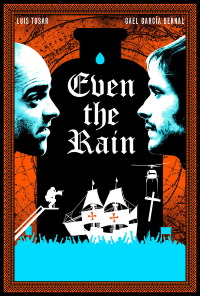
When the government decided to privatise the water supply the people rose up and after months of demonstrations the authorities backed down - Excellent result. No, unfortunately this wasnâ(TM)t in the UK but in Boliviaâ(TM)s third largest city, Cochabamba, between December 1999 and April 2003. It is against this background that IcÃar BollaÃnâ(TM)s â~Even the Rainâ(TM) is set (they will charge us for everything, â~tambià (C)n la lluviaâ(TM) - even the rain).
In the film Mexican director Sebastián (Gael GarcÃa Bernal) and executive producer Costa (Luis Tosar) are based in Cochabamba making a film about the Indian rebellion against the initial Spanish conquest. They are of course not making it in the Caribbean, where the actual events took place, but in Bolivia, South Americaâ(TM)s poorest country, because it is cheaper: the regulations are more lax, the extras are cheap.
The extra chosen by Sebastián to play the role of Atuey, the TaÃno chieftain who led the New Worldâ(TM)s first anti colonialist struggle is an Indian named Daniel (Juan Carlos Aduviri). In real life Daniel is a leader of the protest against the Cochabamba water privatization.
And so the two stories, 500 years apart, run in parallel with Sebastián and Costa trying to keep Daniel out of trouble, and bribing the local police chief to release him from the cells. Only, says the police chief, if he can be re-arrested when the last major scene of the film-within-a-film, where the Spanish burn Atuey at the stake, is finished shooting. This leads to an in-your-face scene where the Indian extras in period dress â" ie very little â" attack and overturn a police car and manhandle the policemen who have come to re-arrest Daniel.
There is not much subtlety in this polemic. There is more in the portrayal of film makers who risk the lives of extras in construction tasks for which engineers would be paid thousands. When Sebastián asks Cochabambaâ(TM)s mayor how the Indian peasants can be expected to pay their water bills the mayor points out that Sebastián and Costa are only paying their extras two dollars a day (the new water rates were an average of about $20 a month). In the film-within-a-film the Dominican friar Bartolomà (C) de las Casas loudly protests against the ill-treatment of the Indians: the film-makers, entangled in pragmatic economics, are all but silent about the clear injustice of 500 years later. The moral ambiguity of the film-makers is a powerful and interesting observation of both the industry and us as its audience and this is reflected in Gael GarcÃa Bernalâ(TM)s role as Sebastián. I suppose we are used to Bernal dominating a movie but here his part is irresolute and his performance suitably less forceful. Convincing too is Karra Elejalde as the lead actor playing Columbus - a cynical hard-drinking pro. But the star turns are certainly Juan Carlos Aduviri and Luis Tosar. Aduviri, a Bolivian Indian himself - who hadnâ(TM)t bothered to queue for auditions at first, ironically playing Daniel who we first see arguing about how long he and his daughter have been standing in the queue for extras â" is extraordinary in his first movie. This is excellent eh? A Bolivian Indian in his first role, selected by open audition, playing a Bolivian Indian, selected by open audition to play a TaÃno Indian chieftain. Even better is Luis Tosar, superb as the hard-bitten producer Costa, finally forced off the fence to commit himself to helping Danielâ(TM)s family.
So - we are not the first to ask the glaringly obvious question â" how much did IcÃar Boillan pay her extras? But this is trite; Boillan and her husband Paul Laverty, who wrote â~Even the Rainâ(TM) (and is Ken Loach's regular screenwriter) will Iâ(TM)m sure have anticipated it.
This review of Even the Rain (2011) was written by Pj P on 30 Aug 2012.
Even the Rain has generally received very positive reviews.
Was this review helpful?