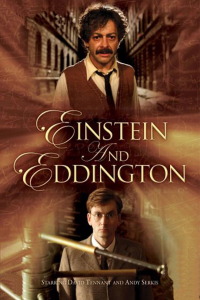
Review of Einstein and Eddington (2008) by Jean-Francois V — 16 Jun 2009
I had had "Einstein and Eddington" on my hard drive for months before the death of my mentor Stanley Jaki led me back to his books, which in turn rekindled my interest in cosmology and put me in the mood for the film. That it stars David Tennant and Andy Serkis (in addition to a favorite of mine, Jim Broadbent) only helped (other familiar faces, if not names, include Rebecca Hall, Donald Sumpter, Jodhi May and Anton Lesser.).
"Einstein and Eddington" starts in 1919 with Eddington's expedition to the island of Príncipe off the west coast of Africa to take pictures of the stars around the sun during a solar eclipse, and thereby corroborate or disconfirm Einstein's theory of the light-bending effects of gravity. Then the film flashes back to 1914, and follows the parallel lives of the two eponymous characters and their frustrated attempts at scientific collaboration as their two countries, Britain and Germany, go to war and become intellectually distrustful of each other.
As drama, "Einstein and Eddington" succeeds rather well. It never feels boring, has strong period flavour, is occasionally touching, and is well acted. As a documentary, though (for it is touted as a docu-drama), it was a little bit lacking.
First, the screenwriter was apparently more interested in Einstein's adulterous relation with his cousin and future second wife Elsa (which actually began in 1912, not 1914) and in Eddington's alleged homosexuality (as revealed in his love for his friend William Marston, who may well be fictional) than in the science itself, although we do get Einstein throwing his smelly socks from a boat and rather pointlessly dropping hard-boiled eggs from the third floor, and Eddington clearing the table for a demonstration of how the sun (a loaf of bread) bends space (the napkin), making the eath (an apple) go round.
Second, although the film seems to be very interested in the opposition between Einstein and Eddington's enlightened scientific internationalism and the nationalistic warmongering of their peers, there is no mention of Eddington's being drafted in 1918, and barely escaping prison thanks to the intervention of the Royal Astronomer.
Third, the film tries to set up easy contrasts and parallels between the two protagonists, probably as a way of counterbalancing the paucity of interaction between the two. Hence Eddington is presented as just an expert observer (Britain's best), when he was also a great mathematician, so as better to complement Einstein as as pure theoretician; Eddington's quaker beliefs and his efforts to square his science with his faith are stressed, while Einstein is rather disingenuously shown to be an agnostic, with no belief in God or the afterlife (actually, although influenced by Kant and by Spinoza's pantheism, Einstein was no atheist, and as Stanley Jaki shows, by making the concept of a limited universe scientifically tenable, he also salvaged natural theology's demonstration of the existence of God.) As for Eddington's alleged homosexuality, it may only have been inserted as a way of creating a bond of "forbidden love" between the two men (or maybe the Brits couldn't resist: try to name three recent British shows without homosexual characters.).
Fourth, I'm almost certain that Broadbent's Sir Oliver Lodge was made much more dogmatic and hung up than he actually was, so as to create a foolish, old-school authority figure for the younger Eddington to rebel against. What makes me say this is that, among other things, Lodge was also a genius scientist, and a socialist with a deep involvement in spiritualism. So I would bet my shirt that he never rose up in protest when his alleged god Isaac Newton was proven wrong by Eddington's photographs (in fact, I learned from a review of the film in the New Scientist that "It wasn't Eddington who announced the results of the eclipse test to the scientific community and the press, it was the astronomer royal, Frank Dyson.").
Just how careless with facts the film can be is best revealed by the inclusion, in 1919, of the taking of the famous photograph where Einstein sticks out his tongue, when in fact it was taken 32 years later, on Einstein's 72nd birthday, in 1951. I felt this was really cheap, and an obvious reflection on the film, which goes for the recognisable, the irreverent and the trendy, at the expense of truth.
My verdict is therefore very similar to the one I would pass on "Good Night and Good Luck": quite good as drama, frankly dishonest as history, which is deplorable as the general public is already extremely misinformed about science/faith issues and scientific history in general.
(I'm a bit sorry I missed Anton Lesser's introduction as Fritz Haber, because I have read the first volume of David Vandermeulen's brilliant graphic-novel biography of that Jewish scientist, and his name would have meant something to me. I recommend this two-volume series as an excellent, and probably more reliable, tie-in to this film. Volume 2 even features Einstein, as it covers the period 1908-1914. I'm also waiting for the Teaching Company's twelve hour lecture on Einstein to help me set the record straight.).
This review of Einstein and Eddington (2008) was written by Jean-Francois V on 16 Jun 2009.
Einstein and Eddington has generally received positive reviews.
Was this review helpful?