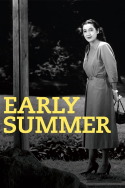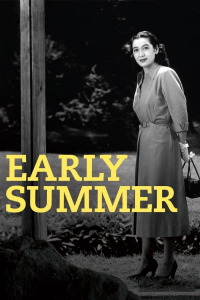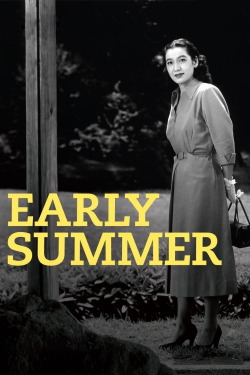
Review of Early Summer (1951) by Flike S — 05 Jun 2008
Ozu is well known for his static, detailed compositions, his affection for child characters (the camera being eye-level with them) and his repetitive plots which often cast the same actors in very similar roles, notably Setsuko Hara as the eternal virgin who usually must learn to accept adulthood. Is she a comment on Ozu's life, one he is directing at himself? Is she an avatar through which Ozu works through some of his own issues?
One way or another, Early Summer is the Michael Bay of Ozu films. There are an uncharacteristic number of moving camera shots, not to mention a veritable herd of children and a (rather shocking!) reference to lesbianism. Like Tokyo Story, the point isn't melodrama, but human interaction through the context of relationships, and it does so by introducing very organic emotional pits to sink into.
You come to appreciate Ozu as a master of ritual. For that reason this film is probably best viewed after you've seen some of his others, possibly after seeing the other two of the Noriko Trilogy (Tokyo Story and Late Spring). The cinematography offers a sense of youthfulness without sacrificing control and grace. As always, the simplicity of the narrative compliments the complexity of his characters as themselves, as archetypes, and as Ozu's own discourse with their function and meaning.
This review of Early Summer (1951) was written by Flike S on 05 Jun 2008.
Early Summer has generally received very positive reviews.
Was this review helpful?