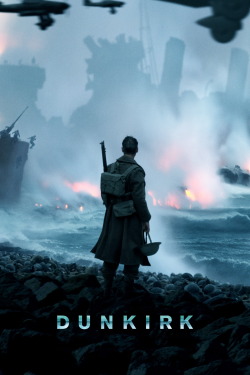
Review of Dunkirk (2017) by Kyle M — 07 Aug 2017
The topic of war brings a general complicated relationship for anyone due to its costly nature of semi-involuntary sacrifices in order to gain (noble) victory. For film, it's the filmmaker being challenged to authenticate the war-driven atmosphere onto the screen without glamourizing it, and the relationship gets based off on whether to see it on the big screen for scale or on the small screen due to the downsized interest. No matter the story with worthwhile value on a soldier or emotionally-imprinted areas, to garner mainstream audience to attend the big screen showing would probably depend on expected style in direction and level of performances, rather than indirect additions that comes from unrelated genres (ex: superhero).
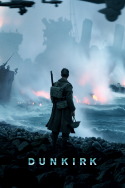
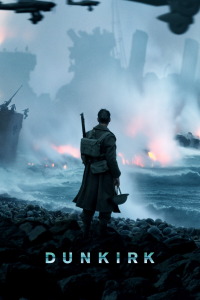
After "The Dark Knight" to "Inception" to "Interstellar", writer-director Christopher Nolan continues his well-known cinematic mastery in the fact-based territory for World War II in "Dunkirk". Like most or some war films, this one's unique in its own standing when not on the battlegrounds but away from it en route to home, with slimmed hope. The title speaks for the evacuation that took place on the shore of the titular French town with the Allied troops waiting for, and trying to find, a way to get further away from the Nazis' grasps. The narrative structure consists three stories that later intersects along the way in a nonlinear fashion such as: two young soldiers from the Mole are trying to find a stable sail without meeting continuous circumstances in a week's time; a father and two boys going on their own into the war to help out, till they get into conflict with a shell-shocked soldier they'd rescued, in a day's time; and a pilot fighting off Nazis jets on limited fuel while getting to France in an hour's time.
The nonlinear structure more or less proved effective when refreshing the immersive suspense through few different perspectives/angles that's really captivating and somewhat thrilling. It's also a narrative element that Nolan seems to go for as part of his excellent talent of turning something simple into something more complicated in a way of an equation to keep track of, which is apparently on occasions the main asset to go for. However, it also proved convoluting at the same time while trying to keep track, which is attempting to rearrange the narrative into something more linear in some parts. (Same goes to the general convolution of a war flick based on identifying characterization). That complication of the narrative quality was played around in one of Nolan's early, smaller films "Memento". So putting it simply, the simple element of the nonlinear structure that's convoluting whilst refreshing is like figuring out a complicated mathematical equation with an entertainment value.
While making this film, Nolan wants to make it a different experience apart from the battleground equivalence "Saving Private Ryan". When I say that, I mean "Dunkirk" takes place away from the war mongering fields, and the cinematic techniques parallels, or replicates, to those mostly heard and seen by little almost 20 years ago from Steven Spielberg's own auteurship. Nolan's own spin from the director's chair and as a writer is typically masterful, and that adds into the war genre through his first take with the special effects, including the sound editing and steadily-rushed cinematography, being perfect from the recognized filmmaking that gets followed.
Speaking of recognized filmmaking under Nolan is the music being composed by his long-time collaborator Hans Zimmer. It tunes fittingly like the previous films the two worked together on with the composed notes being a reminiscence of what was expressed in those films based on the scale. One of Zimmer's greatest hits goes to the pleasantness of working under Nolan, with the tone resonating the basis dramatic approach that one runs on, then later escalates nicely around the climax till the concluding "paragraph".
The frequent word that appears as a way to describe Nolan's filmmaking is "scale" that increases in each film he makes, particularly "The Dark Knight Rises" having a mass count of extras, with the actors in front and center, in one setting. "Dunkirk" follows that in a synchronized formation within a range of frames from wide to small, and the massive human body (the acting) of the film still impresses that make it seems that Nolan can achieve without digitalizing the crowd. This brings up another elemental merit that's typical is the performances and stamina from the cast - half being well-known while the other half are fresh showcases. It's a usual vision in his films whereas the aura of the energy from the performances goes along with the dramatic approach, and the characters expresses the script well with probably cheesy one-liners that are backed-up with further meaning and emotion at the same time. Overall, the performances were very well done as always, especially when capturing the emotions of the harsh, violent reality inside a war.
Christopher Nolan's latest masterpiece "Dunkirk" is genuinely one of the best war films, including one of his best by a slight decrease, and a nice cinematic experience for the genre that fits and nicely broadens the mainstream taste. To elaborate on that, it (personally) became an experimental proof from the spectatorship that auteurism can be a selling point for a film you probably wouldn't see often on the big screen, outside the story (i.e. "Sully"). It's great in its own way with a similar substance that requires from the genre that may be a little heavy as usual, but the epic art doesn't disappoint from the expected entertainment value. (A-).
This review of Dunkirk (2017) was written by Kyle M on 07 Aug 2017.
Dunkirk has generally received very positive reviews.
Was this review helpful?