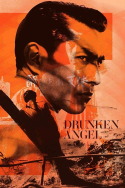
Review of Drunken Angel (1948) by Keith Y — 25 Jul 2008
This isn't Kurosawa's best. Obviously, I cannot say what is; I haven't seen enough Kurosawa for that. But [i]Seven Samurai[/i] was better than [i]Yoidore tenshi[/i], for all [i]Yoidore tenshi[/i] explores more complicated themes. (I hear [i]Ran[/i], [i]Yojimbo[/i], and [i]Throne of Blood[/i] are all pretty impressive, too, but as you may have noticed, we haven't gotten to 'em yet.) There are some interesting characters here, and there's some good stuff about, well, TB and the Yakuza. However, it's a weaker story, and I care a lot about story. I also, it should be noted, don't think Kurosawa had grown into his full talent when it came to cinematography yet, either.
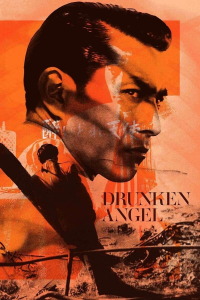
Takashi Shimura is Doctor Sanada, a slum doctor whose greatest enemy is the tuberculosis bacterium. Since he works among the poor, I should think it's a greater enemy than it would be for many other doctors. After all, epidemics breed in poverty. At any rate, when we first see him, he is treating a gangster named Matsunaga (Toshiro Mifune in his first Kurosawa film) for a wound. (He "caught his hand in a door.") While Matsunaga is there, Sanada checks his lungs and determines that, in addition to the wound, he probably has TB. Sanada treats the wound and sends Matsunaga to a doctor who will X-ray his lungs. And, indeed, the X-rays confirm Sanada's diagnosis. From then on, it's a battle between Sanada and Matsunaga; Sanada wants Matsunaga to just stay in bed and get better--presumably, there's more treatment involved than that, given that Sanada actually expects results--and Matsunaga wants to keep up his Yakuza lifestyle.
This film was made in an interesting atmosphere--apparently, Kurosawa hated the Yakuza, and it seems he wasn't best pleased with the occupying US forces, either, and those forces had control over his film almost as much as he did. One wonders how much of a threat the Yakuza were; I can't imagine they were thrilled with their portrayal here. Matsunaga keeps going on about the code of honour they share, but in the end, he's practically the only one who sees it. The other Yakuza are perfectly willing to let him die, if only they can get some good of him before he does.
There is also the story of Nanae (Michiyo Kogure) and Okada (Reisaburo Yamamoto). Okada has been in prison; Matsunaga's rise came about in no small part because Okada left a vacuum. Nanae loves and fears Okada, and she knows that, when he gets out, he will come for her whether she wants him to or not. Okada is willing to kill Sanada for her, in fact, regardless of how many lives he takes by killing the only doctor many of these people have. A major theme of the movie, in fact, is Yakuza selfishness despite claims of their code of honour.
I have yet to see bad Kurosawa. This isn't his best work, but it does still hold the amazing Kurosawa touch. I don't recommend starting here. However, I do recommend thinking about how very different this film might have been were it directed by practically anyone else. Kurosawa takes what could easily be a maudlin, melodramatic story and gives it life and humour. See one of the great ones first, by all means. But don't avoid this one, either.
This review of Drunken Angel (1948) was written by Keith Y on 25 Jul 2008.
Drunken Angel has generally received very positive reviews.
Was this review helpful?