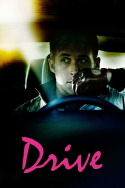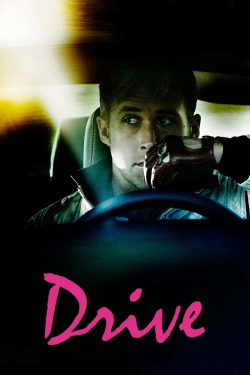
Review of Drive (2011) by Halfwelshman — 15 Feb 2012
At its most basic level, Drive could be described as "The Transporter with a brain". If you yourself possess even half a brain, you'll realise that it is so much more. Drive is a beautiful, thematically rich and powerful film.
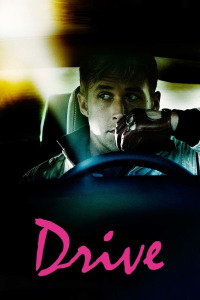
The whole cast are superb, with Ryan Gosling imbuing The Driver with a deep, brooding emotion, and making him a very engaging protagonist despite him being a character of very few words. It's a true testament to Gosling's skill as an actor that he can communicate to the viewer so much about what his character is thinking through a single facial expression, or physical act.
The Driver is also the epitome of cool, from his scorpion-emblazoned white jacket, sunglasses and Clint Eastwood-esque toothpick, to the leather driving gloves he dons and the unassuming analogue watch he fastens to his steering wheel when on a job.
Carey Mulligan is also extremely believable as single mother Irene, and has great chemistry with Gosling. It is because this central relationship, this unlikely romance works that The Driver gains much of its emotional leverage, and with the addition of a surprisingly effective soundtrack of soppy electro-pop love songs, the few moments of intimacy that The Driver and Irene share, and the ultimate tragedy of their story, is all the more affecting.
Bryan Cranston is brilliant as always as the crippled garage owner and low-level mob dealer Shannon, Ron Perlman is entertaining as Jewish mob heavy Nino and Albert Brooks is simply terrifying as Bernie Rose, the psychotic razor-wielding mob boss who serves as the film's primary antagonist.
The film is about fractured identity, and about redemption through good deeds. This never more clear than through the characterisation of The Driver. He remains nameless throughout the film, only referred to in relation to his profession - he is a functional tool before he is a person.
It is only through his steadily growing love for Irene and her young son Benicio, and through his quest for justice in punishing the Los Angeles criminal underworld that he finds his humanity, and symbolically saves his soul, proving himself to be a real person.
Building on these philosophically heavy themes, Hossein Amini's script is deceptively simple, but effective - he gives his characters enough to say to communicate their feelings and map their growth over the course of the film, but pleasingly he doesn't fall into the trap of convoluted, inherently unrealistic dialogue purely designed to show audiences how clever the film is.
These are real people, speaking (or not, in The Driver's case) as real people do, and the film's heady themes speak for themselves, and Amini knows this, and smartly doesn't resort to highlighting them in his dialogue, which would have made it heavy and laborious, rather than honest and minimalistic as it is.
Drive is not just an achievement for clever writing, but also a visual triumph. Cinematographer Newton Thomas Sigel uses his experience working frequently with Bryan Singer extremely effectively here - like in X-Men or Valkyrie, he is demanded in Drive to adapt his filming style to a number of visually and tonally different sequences - whether it's an expansive aerial shot of the glittering L.
A. skyline, or a frantic car chase, or a more mellow and intimate moment in Irene's apartment, Sigel always rises to the challenge and creates something visually striking. The cinematography, married with Matthew Newman's masterful editing and the effectively moody film noir lighting used throughout the film, Driver becomes a real thing of beauty.
Nicholas Winding Refn continues to prove his talent as an extremely creative, intelligent director that isn't afraid to challenge his audience. He's also extremely adept at handling action, without reducing himself to mainstream drudgery - the car chases and shootouts are all entertaining, but aren't dumb and obvious, and have more in common with the work of Martin Scorsese than Michael Bay.
Refn clearly knows that less is more, and is prepared to make you wait, to really rack up the tension before giving you a blood-soaked or tyre-smoke clouded payoff, and the set-pieces are far more powerful as a result.
Drive is many things - a religious allegory, an intense psychodrama, a tender love story, a gangster-thriller, a film noir, and it even has much of the iconography and themes of a classic Western. It looks great, sounds great, is well-scripted, clever without being pretentious, packs a real emotional punch and is extremely well-acted, particularly by the mesmerising Gosling.
Simply put, Drive is stunning.
This review of Drive (2011) was written by Halfwelshman on 15 Feb 2012.
Drive has generally received very positive reviews.
Was this review helpful?