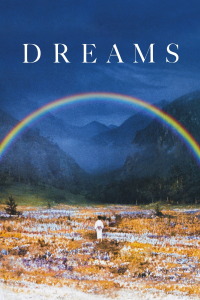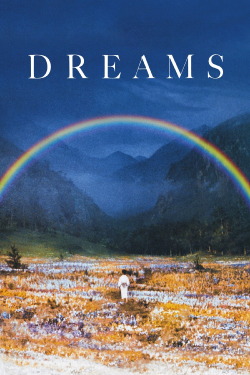
Review of Dreams (1990) by David C — 24 Jul 2010
Remaining (arguably) as his most delicate example of cinema, the late Akira Kurosawa left it the customary five-long years before releasing the long-anticipated Japanese epic 'Ran', before patiently waiting another five years when the highly established director let loose 'Dreams'. After finding finance from movie brats George Lucas, Francis Ford Coppola and Steven Spielberg and a secure release courtesy of Warner Bros. Pictures, Kurosawa began to write the screenplay for 'Dreams', a personal journey through some of the hallucinations he had seen in his sleep. Born 1910 in Tokyo, Akira Kurosawa was the seventh child to three brothers and three sisters. Before breaking into films, Kurosawa was enrolled in the Japanese army - from which one of the "Dreams" are present in the film - and later as a member of the Japanese Physical Education Association. In 1943, Kurosawa took the helm of 'Sanshiro Sugata', his first feature, which he followed up with Part-2 in 1945.Through the years, Kurosawa made 31 features, at first pumping out one or two a year, until his three hour epic 'Red Beard' which started his ritual 5 year seize between releases.
'Dreams' is split into eight segments, more so than stories as the segments are not always a tall-tale, more so a statement that Kurosawa seemingly needed to get out of his system. The first vision comes in the form of 'Sunshine through the Rain', a young boy -Kurosawa' has just left his house and run into the nearby woods only to find a parade emerging from a strange mist. He hides behind a tree watching on until they spot him looking and he runs away only to find that an angry fox has visited his home and left a sword for him to fall onto. The boy's new journey now is to search for the foxes' under the rainbow and beg for forgiveness. The second vision is 'The Peach Orchard'; a young boy sits in a room with five girls. He has an argument and decides to leave when he sees a mysterious girl inside his house and decides to follow her into the woods. Here, he is confronted by an array of Japanese men and women all in dress that demand that the boy cut down the all peach trees. The third is 'The Blizzard...' which is now famous for its silent opening where all that is heard is the wind rushing over the mountains and the clunks of instruments being used to climb them. This story follows Japanese folklore about the mysterious snow fairy and is probably one of the biggest visual treats on offer. The fourth is 'The Tunnel', as stated before this is one Kurosawas' nightmares of the war where he approaches a long, dark tunnel only to be confronted by what seems like a blood-stained dog growling at him to enter. At the other end he meets one of his darkest fears, his deceased army still marching and awaiting their orders from the commander. The fifth is 'Crows', Kurosawa's ode to celebrated painter Vincent Van Gogh where Kurosawa is strolling through a local gallery looking at and admiring his works of art. We he exits he seemingly enters one of Van Gogh's' painting where the land transforms consistently. The sixth is 'Mount Fuji in Red'. A volcano erupts, although the volcano is actually an exploding Nuclear Power Plant that threatens to wipe out an entire city. The seventh dream is 'The Weeping Demon'. Kurosawa walks over a black and desolate land, fighting the wind. Here in this mist covered world, strange creatures surround him, but these creatures are Demons. The eighth and final episode is 'Village of the Watermills'. An older Kurosawa crosses a long bridge that spans across a large streams washing away below. All around watermills turn, providing 'The Village' for nearly all the power they will ever need. Sadly, the last episode is honesty the worst in this near perfect package.
Kurosawas' eye for detail is exceedingly vibrant that some say he meant the film to look like it was a studio set. Although I'm sure you can make up your own mind, considering the importance of the film, the studio backing it and the money hiding behind. But in my personal opinion the colour and exquisiteness of narrative is exceptional and when watching the last thing you are caring about is if the set looks fake. The fantastic effect come from George Lucas' 'Industrial Light & Magic' and is one film you easily watch again. A film that soars quite closely to 'The Seven Samurai' in terms of its resourcefulness, Dreams will stay bright for years to come. Look out for the cameo by Martin Scorsese - it's great. Kurosawa died in 1998 following a stroke.
This review of Dreams (1990) was written by David C on 24 Jul 2010.
Dreams has generally received very positive reviews.
Was this review helpful?