Review of Donnie Brasco (1997) by Harry W — 02 Sep 2014
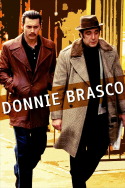
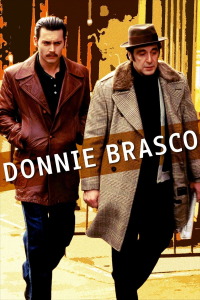
Led by Al Pacino and starring both Johnny Depp and Michael Madsen, Donnie Brasco sounded like a thrilling crime story.
Donnie Brasco is a slow burning gangster tale. It moves along at a pace which is very gradual and remains a lot more focused on its screenplay than on skyrocket story dynamics. The slow pace of the film may faze some, so viewers are really required to let everything come to them while they remain patient. At times, I found that it moved along a little too slow. I felt like there was a story that needed to be told in Donnie Brasco and that it was done with a stylish way of filmmaking and a firm screenplay. Donnie Brasco was a complicated and deep film which touched upon a lot of the theoretics of the crime world without resorting to Hollywood cliches. But while the story remains consistently realistic, it still adheres to a basic formula. By that I mean it goes back and forth between focusing on the personal life of Joseph Pistone and his career as an informant. This is a problem because while the latter is interesting, the same cannot be said about the former. The central focus of the film is arguably the nature of the relationship between Joseph Pitsone and Benjamin "Lefty" Ruggiero, and so when the film gets more focused on Joseph Pitsone and his wife Maggi, it loses momentum.
There are also so many characters in Donnie Brasco that it can become challenging to keep up with at times. Despite progressing very slowly, there are many characters the contribute to the two lives lived by Joseph Pistone who all make a different impact on the story ranging from major to minor. Having to remember what relevance they all play in the lives of both Joseph Pitsone and Benjamin "Lefty" Ruggiero. It seems as if Donnie Brasco attempts to fit too many minor elements of Joseph Pitsone's life into the story and emphasizing the existence of so many people, but like I said, the film is important in how it depicts the relationship between Joseph Pitsone and Benjamin "Lefty" Ruggiero. When it gets away from that and looks at the many other characters in the story, the effect of it is not as strong and it comes off as scattered. So Donnie Brasco proves to be largely all over the place at times.
But still, Donnie Brasco remains a strong film based predominantly on the asset of its acting, and to a lesser extent its style as the production design and scenery of the film help to assist in ensuring that everything feels legitimate, and it is all captured with strong and atmospheric cinematography which enhances the tension in situations at all of the right moments. The musical score in Donnie Brasco also gives it a tense feel consistently throughout the rough material.
Al Pacino proves once again that his greatest talents as an actor come from him taking on gangster roles. The thing that makes Donnie Brasco different to films like The Godfather Part II and Scarface is the fact that in Donnie Brasco, the gangster he portrays is one with mercy to him. He keeps his head above the crime game and has a sense of humanity to him, constantly maintaining a sense of growing disillusionment which ensures that he keeps a lot of depth in the role. He is unpredictable in the role because he has both the harsh nature of a gangster and the sympathetic side of a human being. Instead of resorting to playing the role as a one-dimensional archetype, Al Pacino takes the perfect angle on the character to emphasize his natural humanity as well as his relationship with Joseph Pitsone.
Johnny Depp reminds me how skilled an actor he is in Donnie Brasco. While he is predominantly known for high-profile and commercialised performances such as his Academy Award nominated role is Captain Jack Sparrow in the Pirates of the Caribbean films, Donnie Brasco is one of those films that remind viewers how good he is in more low profile and character oriented roles. In Donnie Brasco, he stands out because his natural charisma and strong dramatic line delivery shine as easily as ever, but his voice articulation is the central selling point. His change of voice tone is exceptional because it sounded so different from his natural voice or any of the others that he has put on so that he can play the role convincingly, and it is just incredible. When I looked back at the screen and realised that this was the voice of Johnny Depp, it was difficult to believe. But it was real, and it was exceptional. Johnny Depp shines in the role of the titular Donnie Brasco because of his deep involvement in the character, both physically and emotionally. In a film where he co-stars with Al Pacino, Johnny Depp does a strong job holding the screen equally by maintaining excellent character development which progresses very well over the course of the running time. Johnny Depp takes on the mature material in Donnie Brasco excellently and puts strong depth and natural charisma into the character which proves to be another winning performance from him.
Michael Madsen turns in a firm performance as well. In his supporting role, Michael Madsen never lets up for a minute because he is so consistently confident in the part and stands with a brooding strength. His intimidation and strength is all subtle, but you can see it through the angressive stare in his eyes and the way that he seamlessly interacts with the other characters and the entire universe around him. Michael Madsen is great in Donnie Brasco because he maintains a lot of underlying power in his performance while keeping himself cool about it like a good gangster should, and so he fits the profile for the role excellently and shares a strong chemistry with all the other actors.
So while Donnie Brasco is a film which fails to consistently illuminate its best elements due to a scattered focus, the quality of the performances from Al Pacino and Johnny Depp as well as the chemistry between them render the entire experience an unforgettable one.
This review of Donnie Brasco (1997) was written by Harry W on 02 Sep 2014.
Donnie Brasco has generally received positive reviews.
Was this review helpful?