Review of Dog Day Afternoon (1975) by Chris S — 14 May 2014
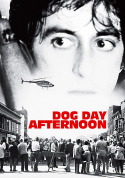
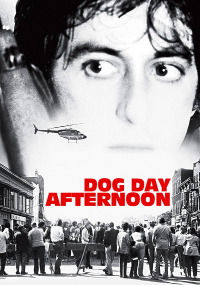
August 22, 1972-Two young men hold up Brooklyn's Chase Manhattan Bank at closing time. What begins smoothly quickly goes awry, leading partners-in-crime Sonny Wortzik and Salvatore "Sal" Naturale to inadvertently take the bank's employees hostage in a desperate attempt to escape the 200 policemen surrounding the building. The media immediately gets involved, allowing locals to immerse themselves in the melodrama and use it as a distraction from the late summer heat wave. A crowd of intrigued onlookers swarms the bank, observing the ongoing events and loudly expressing their reactions in equal parts cheers and jeers. Sonny finds himself in a position of celebrity, a would-be spokesman for the workingman, fed up with union wages and discontent with what his country has to offer him. His initial popularity vanishes when his supporters instantly turn on him after a local news station exposes his homosexuality and reveals that the motivating factor behind his criminal behavior is to fund his partner's sex change.
This dramatization of real-life events comprises the narrative of Sidney Lumet's 1975 film, Dog Day Afternoon, a "naturalistic" work that sits firmly within the pantheon of 70s cinema (Hollywood's "Golden Age"), a genre of films made between 1967-1976 that is defined by omnipresent themes of isolation, hopelessness and disbelief in the American Dream. In an era when "movies mattered," filmmakers chose projects that responded to and commented upon the defining cultural and political aspects of the time. Elements of these films included French New Wave stylism and neo-Western narratives, typically following morally ambiguous (often male) protagonists to an ambivalent conclusion and conveying nihilistic themes along the way. Late 60s counterculture had an obvious impact on the genre, as many 70s films carry overt anti-authority messaging, Dog Day Afternoon included.
A perfect storm of changes within the studio system and America's cultural climate allowed for this renaissance of filmmaking to occur. As a self-censoring industry, Hollywood once had a strict Production Code, which subsequently fell apart in 1966, allowing for more grown-up films to make it into the multiplexes. Simultaneously, Hollywood began to alter the ways it financed its movies and allowed directors more creative control over projects. The Production Code and studio system provided little room for "auteurs" (Orson Welles and Alfred Hitchcock stand as notable exceptions), so Hollywood directors with distinctive styles did not emerge until the late 60s. Around the same time, the audience for films began to gear toward the younger "rock n' roll" generation, so morally ambiguous screenplays covering subject matter such as pot-smoking drifters (e.g. Easy Rider) suddenly looked much more lucrative to producers.
By the time Dog Day Afternoon came around, Americans had survived a decade of social division in response to the Vietnam War, perpetual loss of trust in American politicians (and authorities) due to Nixon and-of most relevance to this particular film-crippling economic recession. The first two of these trends could not have unfolded the way they did without the sensationalism of modern media (notable moments include the Tet Offensive and the live broadcast of Nixon's Watergate testimony), a development that forever changed American culture. The instant celebrityhood attained by news coverage even managed to incentivize criminal behavior, leading fame-hungry individuals to commit acts of violence in exchange for notoriety.
Based upon a 1972 LIFE article entitled "The Boys in the Bank," Dog Day Afternoon contrasts the media's portrayal of events with the deeper realities that actually comprise them. Within the film, the media presents to the public a bizarre tale of a homosexual gone mad. Lumet's camera instead exposes a deeply human portrayal of a desperate man trying to support his loved ones, and for the first time in his life, be somebody. This instantly accessible humanity goes on full display to reveal the media's corruptive ability to alter events and sway public opinion. As Roger Ebert wrote in his original review of the film, "The presence of reporters and live TV cameras changed the nature of those events, helped to dictate them, made them into happenings with their own internal logic" (Chicago Sun-Times). Lumet attempts to capture all of this and more with Dog Day Afternoon.
Born in Philadelphia but raised in New York City, Sidney Lumet began acting at five years old, appearing in Yiddish theatre productions that his father produced and directed. He would later study acting at Columbia University and direct Off-Broadway plays for a few years before moving onto television in 1950 during the dawn of the so-called "Golden Age of Television," a breeding ground for many of the key players in 70s cinema. "Lumet has suggested that the key to his talent as a director may well be his origins as an actor," Joanna E. Rapf writes in her compilation book, Sidney Lumet: Interviews. This background likely contributed to his reputation as an "actor's director," or someone who could "deliver powerhouse performances from lead actors, and fine work from character actors" (Thomson). This skillset, and his working relationship with New York City (an omnipresent character in 70s film) catapulted Lumet into the top tier of directors with the help of a string of successful films, including 12 Angry Men, The Pawnbroker and Serpico. Lumet's varied choices in directorial projects quickly established his fierce "anti-auteurship," with which he denounced the idea that "good" directors need to have their own recognizable style. Perhaps fittingly, several critics have pointed to Lumet's lack of noticeable aesthetic as a weakness in his skillset.
When Lumet initially chose to take on Frank Pierson's screenplay in 1974, he had reached the point in his career where he not only had great freedom in choosing his projects, but he also held the coveted right of "final cut," the privilege of deciding-without studio interference-which cut of a film got released to theatres. "I'm pretty sure that if I want a new writer on the script, the studio or producer would let me pick one," Lumet writes in his autobiography. "Final cut is a tremendous source of security" (Lumet 48). To give a sense of Lumet's clout at the time, fewer than a dozen people working in Hollywood held this privilege. His critical and commercial success up to this point secured studio funding for Dog Day Afternoon with relative ease-no small accomplishment, and this at a time when producer Robert Evans had to fight bullishly to get Chinatown made.
In the original LIFE magazine article, journalist P.F. Kluge describes John Wojitowicz (Sonny) as "a dark, thin fellow with the broken-faced good looks of an Al Pacino or Dustin Hoffman" (Kluge). By 1974, each of these actors had already contributed heavily to the mythos of 70s cinema, Hoffman with The Graduate and Midnight Cowboy and Pacino with the first two Godfather films. Having worked with him on Serpico in 1973, Lumet cast Pacino in the part of Sonny. "It was a remarkable group. Pacino led them with a mad courage I've seen only two other times," Lumet writes (Lumet 33). One of the earliest Hollywood stars to subscribe to the "Method" school of acting, Pacino had shown time and time again his ability to embody characters right down to their smallest tendencies, from Frank Serpico's pervasive paranoia and androgynous swagger to Sonny nervously toying with his pocket watch. By juxtaposing his vastly different performances in Godfather Part II and Dog Day Afternoon, released within a year of one another, one can begin to comprehend the dedication young Pacino had to his craft. He and Hoffman, among others, made way for a new type of leading man in an industry that had historically only hired those who fit the bill of "Hollywood Handsome" (e.g. James Dean, Cary Grant).
After securing the role of Sonny, Pacino insisted on the casting of his friend John Cazale as Sal despite the actor's twenty-year age difference with his real-life counterpart. As a character actor, Cazale had already turned in a remarkably consistent body of work, having played habitual screw-up Fredo Corleone in the first two Godfather films and Harry Caul's (Gene Hackman) starry-eyed coworker in The Conversation. Lumet then chose relative newcomer Chris Sarandon to portray Leon, a gamble that clearly paid off, as he received an Academy Award nomination for his performance. To contribute to the film's naturalistic feel, Lumet cast untrained actors as bystanders and even as minor supporting characters, including the pizza delivery boy who famously proclaims, "I'm a star!".
Lumet continued to round out the important positions in his crew with formidable 70s figures, including editor Dede Allen, who had established her tendencies for innovative, New Wave-style cuts in films such as Bonnie and Clyde and Serpico. Lumet had developed a close relationship with the renowned editor on the latter film, as the two worked closely to edit it concurrently with production to meet time constraints set by the studio (Lumet). Finally, Lumet chose Victor Kemper (The Friends of Eddie Coyle) as his Director of Photography to "reinforce the film's documentary feel" (Lumet 89). Despite complaints from the studio, Lumet chose not to commission a score for the film, as he felt he could not "justify music weaving in and out" of a project designed to imitate real life (Rapf). As a result, the film's only music comes in the form of Elton John's "Amoreena" during the opening credits.
Lumet's significant amount of creative control led to some tensions with studio executives and screenwriter Frank Pierson. "You have euchred us!" an anonymous production manager yelled at Lumet through the telephone (Lumet 35). He expressed anger over a scene the director had chosen to cut from the script, which included footage of Sonny and Leon's real-life counterparts' wedding. Lumet thought it would inspire too much sensationalism and render audiences incapable of relating to Sonny, while the studio saw it as a marketing opportunity to build up the film's notoriety (A common tactic; just a few years earlier Midnight Cowboy sold tickets using the tagline, "Whatever you've heard about Midnight Cowboy is true."). Final cut allowed Lumet to have his way, and he replaced the footage with a picture of Leon in his wedding dress.
"The first obligation was to let the audience know that this event actually happened," Lumet said of Dog Day Afternoon's distinct visual style, though he may as well have been talking about Pierson's screenplay (Lumet 88). Lumet and the cast improvised upwards of 60 percent of the film's dialogue during table reads, a staggering amount, but a decision that led to naturalistic characterizations by each of the key players. It also provided for much of the film's trademark humor. Legend has it that Cazale improvised his "Wyoming" line, which acts both as a recurring joke and an effective bit of character development. Lumet even left a few scenes (including Pacino's infamous "Attica" speech) for improvisation on the day of shooting. Of course, all of these improvisations resulted in an almost complete rewrite of Pierson's original dialogue. People commonly joke about writers getting slapped around in Hollywood, but Lumet insists that "[Pierson] was selfless and devoted to the subject matter. The actors may not have said exactly what he wrote, but they spoke with his intention" (Lumet 34). Lumet calling the shots on set may have allowed for a more holistic take on the material, but the other players' contributions should not be underestimated. Pierson won the Academy Award for Best Screenplay and, according to Lumet, "he deserved it" (Lumet 34).
Upon its September 1975 release, Dog Day Afternoon received almost universal acclaim from the major critics, with much of the praise falling upon the film's darkly hilarious dialogue and Pacino's moving performance as Sonny. "The interactions between Pacino and other key characters are magnificently written, acted and directed," writes the staff of Variety. Pacino had established himself as something of a critic's delight by this point, having earned their allegiance early on with his performance as a heroin addict in 1971's The Panic in Needle Park. "[Sonny] becomes one of the most interesting modern movie characters, ranking with Gene Hackman's eavesdropper in The Conversation and Jack Nicholson's Bobby Dupea in Five Easy Pieces," writes Roger Ebert (Chicago Sun-Times). The film went on to earn five Academy Award nominations, including one for Pacino, though its only win was for Pierson's screenplay. The film found box office success as well, capitalizing on its broad and timely cultural appeal to earn $50 million off of a $1.8 million budget (Lumet became notorious for finishing productions under budget, having picked up a tendency for thrift during his time spent working in television.). The movie holds up to this day, and stands tall as some of Sidney Lumet's finest and most culturally impactful work, providing poignant commentary on the modern era's exploitative media and the humanness behind seemingly absurd behavior.
"The televised image certifies the reality of events and, at the same time, removes them by equating their meaning to that of the commercials-the cheerful haiku-that frames them."-Vincent Canby; New York Times.
Canby included the above piece of wisdom in his 1969 review of Medium Cool, an extraordinarily meta film about the media's role in inciting politically-charged events. I would argue that it applies more accurately to Dog Day Afternoon, in which a man finds both a voice and an audience by lashing out at the world, only to realize that his actions represent little more than a distracting freak show on the periphery of a hot summer afternoon. The public values him and Sal based upon their entertainment value and little else. The local media feeds this furnace of exploitation to feverish heights for the sake of its own ratings, simultaneously piquing the public's interest in the story and preventing them from seeing the relatable truths behind it. The public sees a man madly screaming "Attica!" and hurling money at riotous crowds. They see a man crazy enough to have a drag marriage presided by a defrocked priest. What they do not see is Sonny Wortzik, a loving husband and father who grew disenchanted with life and wanted one last shot at changing things for himself and for others.
Lumet wastes no time in setting the tone for this humanization, opening the film with a montage of everyday events in order to achieve the opposite effect of the media's sensationalism. The five-minute opening credit sequence (featuring the aforementioned "Amoreena," a moseying tune with lyrics about everyday life) serves to set the film's overall feeling of normalcy. Instead of building up tension toward the bank robbery, we barely even notice when it has started. As city noises begin to drown out the music, Lumet transitions seamlessly from hidden-camera footage of New York City to a shot of Sonny, Sal and Stevie sitting in a car outside the bank. "They seemed like just one more shot of a group of people on that oppressive summer day in New York," writes Lumet (Lumet 57). This visual aesthetic provides the viewer with no choice but to acknowledge that these are normal people, not unlike the ones shown immediately beforehand.
While much debate amongst film academics goes into the definitions of Realism and Expressionism, Lumet has said that Dog Day Afternoon's aesthetic falls more along the lines of "naturalism," or "as.
This review of Dog Day Afternoon (1975) was written by Chris S on 14 May 2014.
Dog Day Afternoon has generally received very positive reviews.
Was this review helpful?